
Topic 12 has five sub-topics: 12.1 Experimental design, 12.2 Acid–base titrations, 12.3 Chromatography, 12.4 Separation and purification and 12.5 Identification of ions and gases. Nearly all of it is Core and it underpins Paper 6. The Supplement statements are chromatography of colourless substances with a locating agent, and the Rf equation.
Central idea: good practical chemistry means choosing the right apparatus for the measurement, the right method for the separation, and the right test for the substance — and describing what you actually see.
Before you start
- Pure substances and mixtures; melting and boiling points (Topic 1).
- Salt preparation, solubility rules and indicators (Topic 7).
- Precipitation and ionic equations (Topics 3 and 7).
Learning objectives
- Name apparatus for measuring time, temperature, mass and volume; suggest advantages and disadvantages of methods; describe the terms solvent, solute, solution, saturated solution, residue and filtrate.
- Describe an acid–base titration and how the end-point is identified.
- Describe paper chromatography and interpret chromatograms; Supplement use a locating agent and calculate Rf.
- Describe and explain separation methods; suggest a method from given information; assess purity from melting and boiling points.
- Describe the tests for the anions, aqueous cations, gases and flame-test cations in the syllabus.
Introduction: the analyst's toolkit
A forensic chemist handed an unknown white powder, a water company checking a supply, and a student in a Paper 6 examination all ask the same questions: what is in this sample, how much, and how pure is it? The answers come from a small set of techniques — measuring accurately, separating mixtures, and carrying out tests whose results are known in advance. This chapter collects those techniques in one place.
12.1 · Experimental design
1Measuring apparatus and key terms 12.1.1–12.1.3 Core
| Quantity | Apparatus | Notes |
|---|---|---|
| time | stop-watch | start at the moment reactants meet; record in seconds |
| temperature | thermometer | stir before reading; read at eye level |
| mass | balance | use “mass” (not “amount”) for solids |
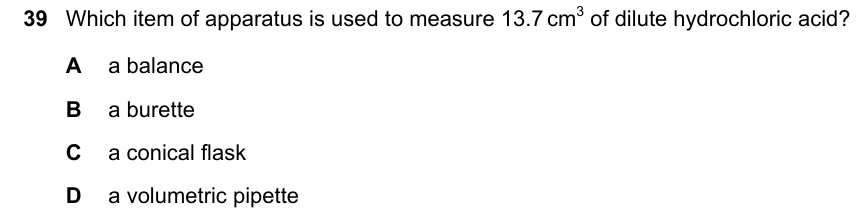
| volume of liquid (variable, precise) | burette | reads to 0.05 cm3 (recorded to 0.1 cm3 in Paper 6); used to add a measured, variable volume, e.g. 13.7 cm3 |
| volume of liquid (fixed, precise) | volumetric pipette | delivers one fixed volume, e.g. 25.0 cm3 |
| volume of liquid (approximate) | measuring cylinder | quick but less precise |
| volume of gas | gas syringe | or an inverted measuring cylinder / burette over water |
When suggesting advantages and disadvantages of a method or apparatus, think about precision (a burette is more precise than a measuring cylinder), heat loss (a polystyrene cup insulates better than a beaker), gas loss (a gas syringe loses gas if the bung is slow to be fitted; hydrogen barely changes a balance reading), and safety.
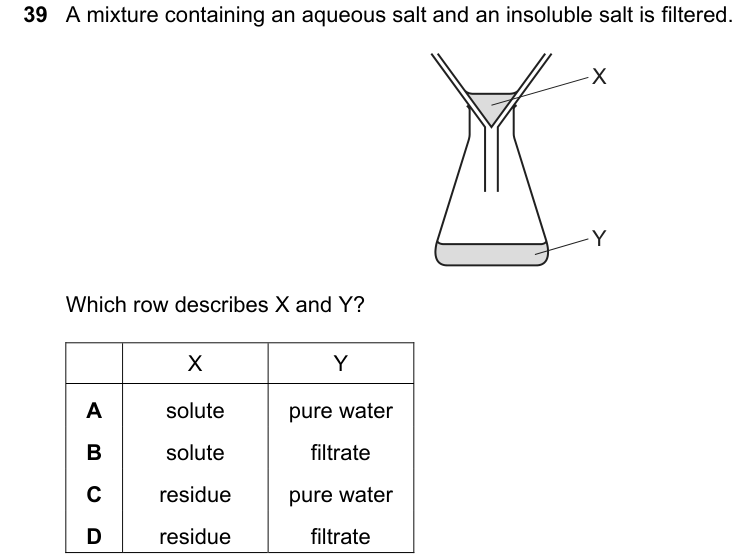
A solvent is a substance that dissolves a solute. A solute is a substance that is dissolved in a solvent. A solution is a mixture of one or more solutes dissolved in a solvent. A saturated solution is a solution containing the maximum concentration of a solute dissolved in the solvent at a specified temperature. A residue is a substance that remains after evaporation, distillation, filtration or any similar process. A filtrate is a liquid or solution that has passed through a filter.
Attempt these before opening the solutions. Each reference gives the component, session and question number of the original examination; the answers follow the published mark scheme.
Solutions and mark-scheme guidance · set A
A1 Answer B
A variable, precise volume (13.7 cm3) needs a burette. A balance measures mass; a conical flask is imprecise; a volumetric pipette measures one fixed volume.
A2 Answer B
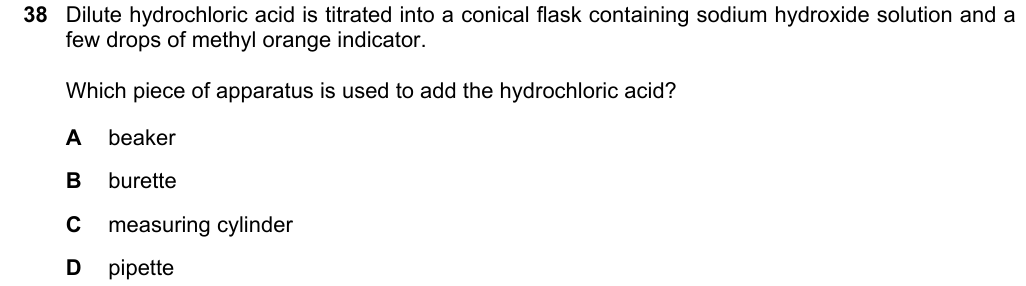
The acid is added from a burette. Some confused burette and pipette.
A3 Answer D
The insoluble salt stays on the paper as the residue (X); the solution passing through is the filtrate (Y).
A4 [3]
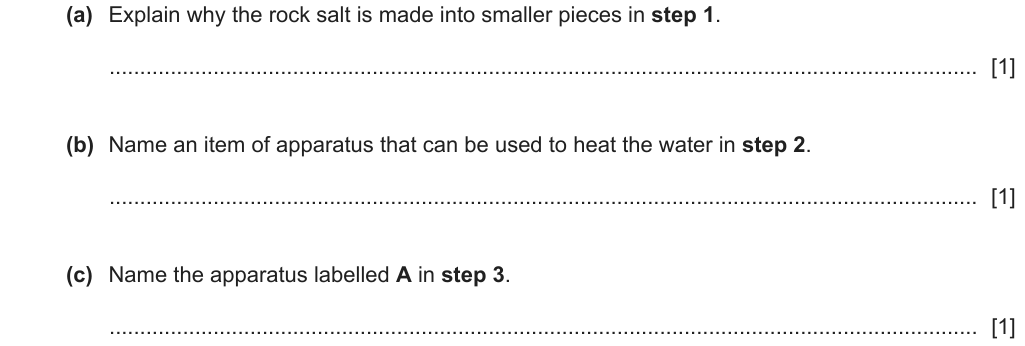
(a) To speed up dissolving ✓ (larger surface area). (b) A Bunsen burner ✓. (c) A funnel ✓.
Examiner feedback: “to dissolve the salt” or “to make it smaller” did not go far enough; “filter” is not the name of apparatus A — it is a funnel.
12.2 · Acid–base titrations
2Acid–base titrations 12.2.1–12.2.2 Core
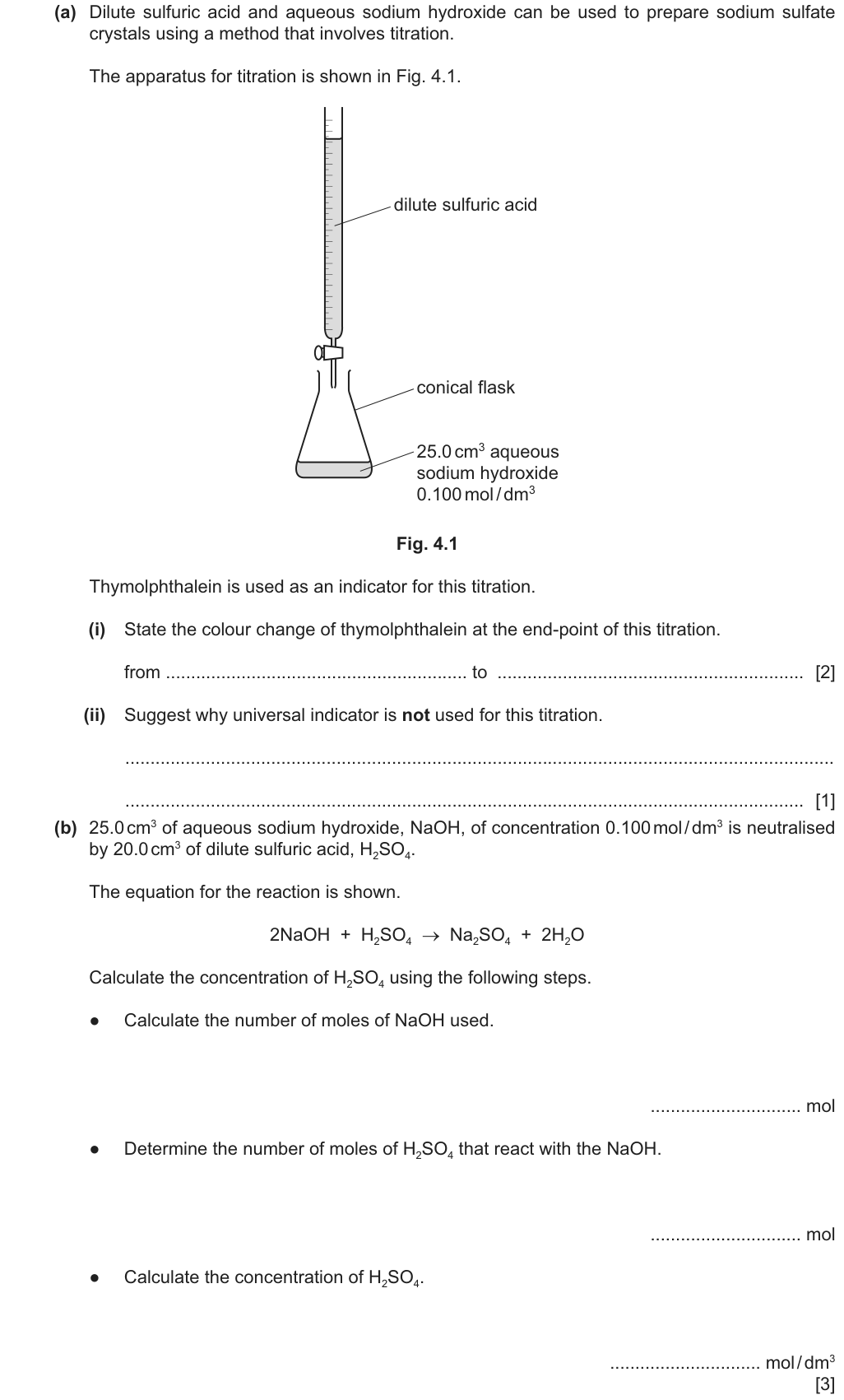
A titration finds the exact volume of one solution that reacts with a known volume of another. Procedure:
- Rinse a volumetric pipette with the alkali and use it to transfer exactly 25.0 cm3 of alkali into a conical flask.
- Add a few drops of a suitable indicator — methyl orange or thymolphthalein.
- Rinse and fill a burette with the acid; record the initial reading.
- Add the acid to the flask, swirling continuously, with the flask on a white tile so the colour change is easy to see. Add dropwise near the end.
- Stop at the end-point — when the indicator just changes colour permanently. Record the final reading. Titre = final − initial.
- Repeat until concordant results are obtained (titres within 0.10 cm3), and use their mean.
| Indicator | Colour in alkali (start) | End-point |
|---|---|---|
| methyl orange | yellow | yellow → orange (red if too much acid) |
| thymolphthalein | blue | blue → colourless |
Universal indicator is not used in titrations: it has many colours and changes gradually, so there is no sharp end-point.
25.0 cm3 of 0.100 mol/dm3 NaOH is neutralised by 20.0 cm3 of H2SO4. 2NaOH + H2SO4 → Na2SO4 + 2H2O.
| Moles NaOH | 0.100 × 25.0/1000 = 0.00250 mol |
| Mole ratio | 2 : 1, so moles H2SO4 = 0.00125 mol |
| Concentration | 0.00125 ÷ (20.0/1000) = 0.0625 mol/dm3 |
| Check | smaller volume of acid than alkali, and the acid is diprotic, so its concentration is less than half that of the alkali ✓ |
Attempt these before opening the solutions. Each reference gives the component, session and question number of the original examination; the answers follow the published mark scheme.
Solutions and mark-scheme guidance · set B
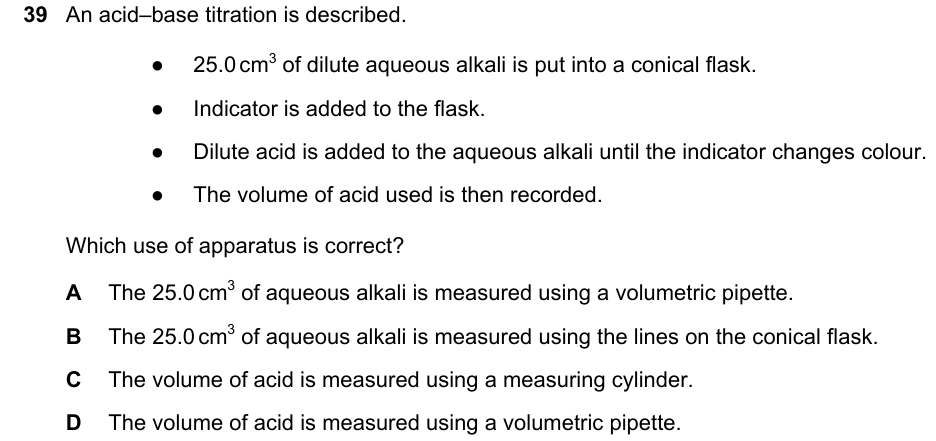
B1 Answer A
The 25.0 cm3 of alkali is measured with a volumetric pipette; the acid is added from a burette.
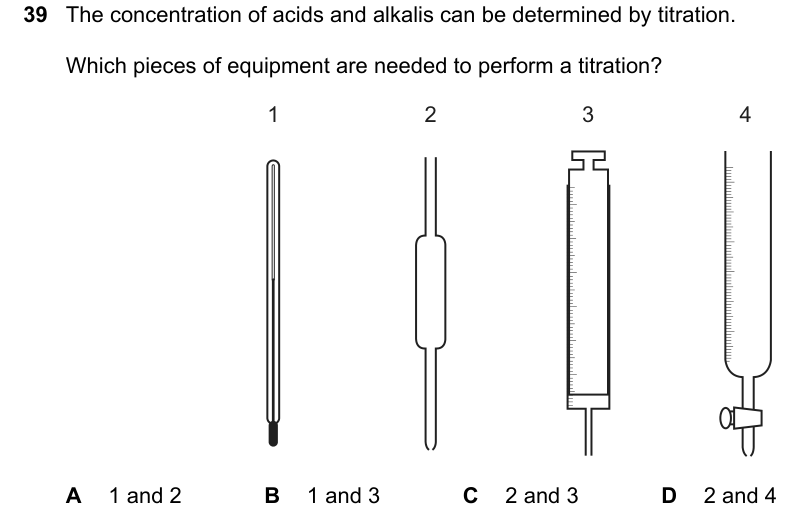
B2 Answer D
A titration needs a burette and a volumetric pipette.
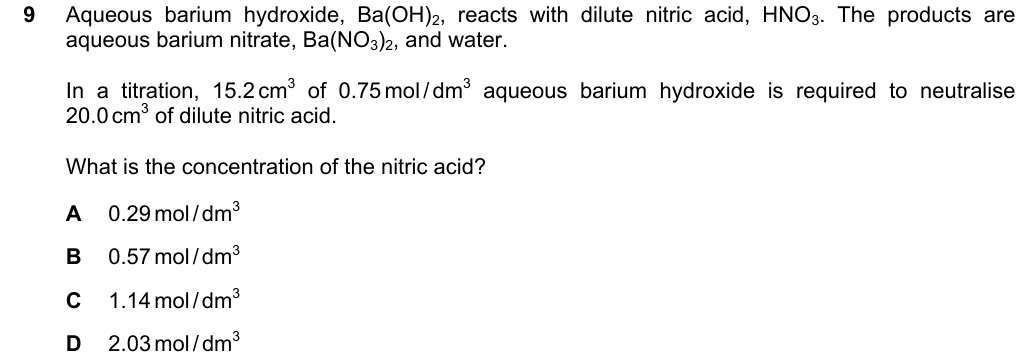
B3 Answer C
Ba(OH)2 + 2HNO3 → Ba(NO3)2 + 2H2O. Moles Ba(OH)2 = 0.75 × 0.0152 = 0.0114; moles HNO3 = 0.0228; concentration = 0.0228 ÷ 0.0200 = 1.14 mol/dm3. Most assumed a 1 : 1 ratio.
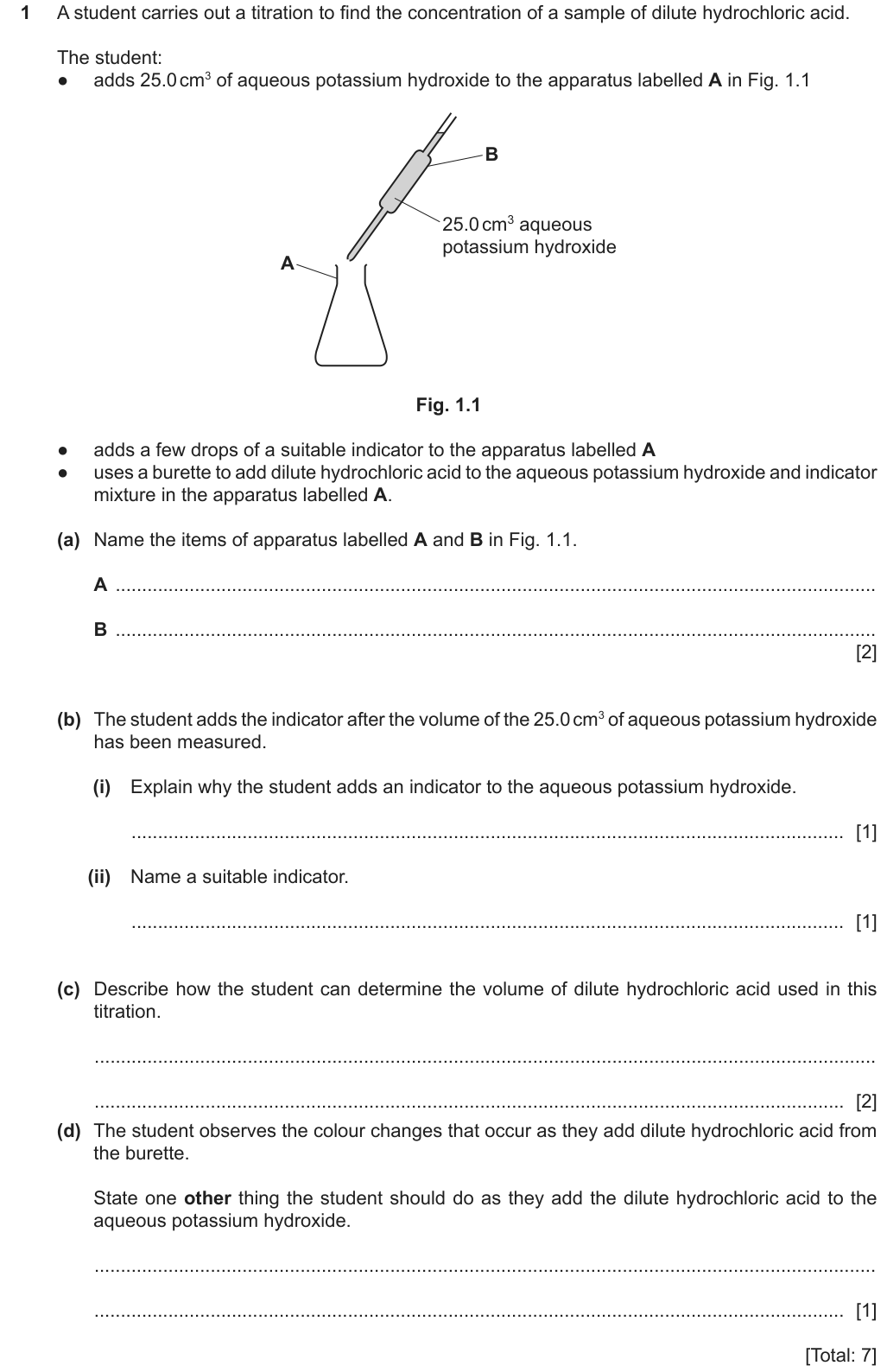
B4 [7]
(a) A conical flask ✓; B volumetric pipette ✓.
(b)(i) So that it changes colour at the end-point ✓. (ii) Methyl orange (or thymolphthalein) ✓.
(c) Take the initial and final burette readings ✓; volume = final − initial ✓.
(d) Swirl the flask ✓.
Examiner feedback: “dropper” or “dropping pipette” is a different item. “The indicator changes colour” without saying why lost the mark. Universal indicator is unsuitable — no sharp end-point. Some suggested pouring the flask into a measuring cylinder.
B5 [6]
(a)(i) From blue ✓ to colourless ✓. (ii) It has too many colour changes ✓.
(b) 0.00250 mol ✓; 0.00125 mol ✓; 0.0625 mol/dm3 ✓.
Examiner feedback: some reversed the colours. Many said universal indicator is “only for pH”, without mentioning its several colours.
12.3 · Chromatography
3Paper chromatography 12.3.1–12.3.4 CoreSupplement
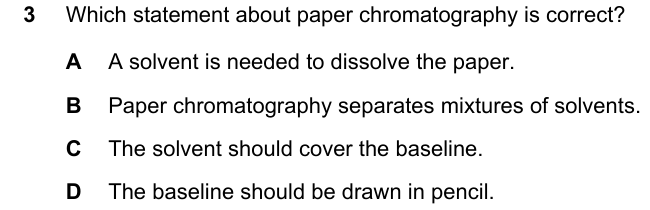
Paper chromatography separates mixtures of soluble substances. Method:
- Draw a baseline in pencil near the bottom of the paper (ink would itself separate and move).
- Put small, concentrated spots of the samples on the baseline, with known substances alongside the unknown.
- Stand the paper in a suitable solvent in a covered container, with the solvent level below the baseline (otherwise the spots dissolve into the solvent) but touching the paper.
- The solvent rises up the paper, carrying the substances different distances according to how soluble they are in the solvent and how strongly they are attracted to the paper.
- Remove the paper before the solvent reaches the top; mark the solvent front in pencil; dry.
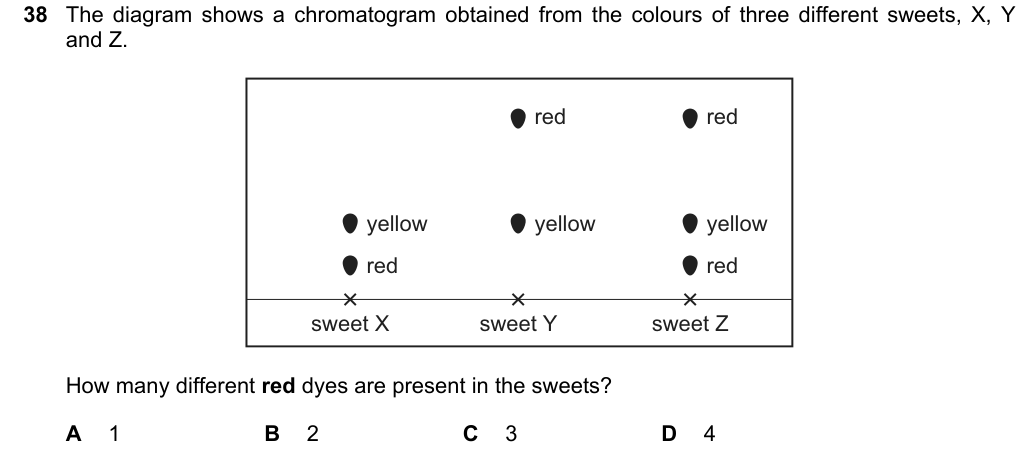
Interpreting a chromatogram. A pure substance gives one spot; an impure substance (a mixture) gives two or more. An unknown is identified by comparison: a spot at the same height as a known substance (same solvent) is probably that substance. A substance insoluble in the solvent stays on the baseline.
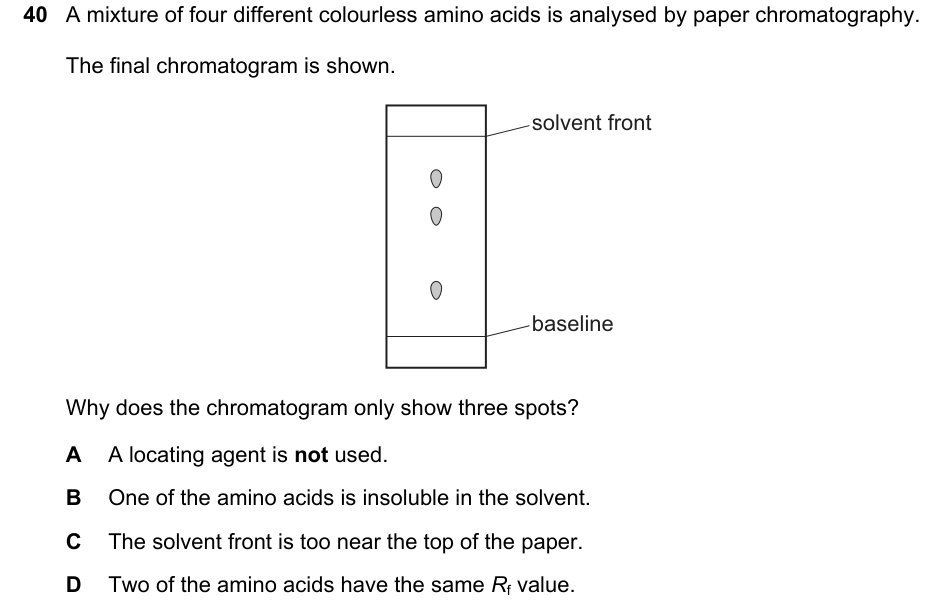
Supplement Colourless substances (such as amino acids or sugars) are separated in the same way, but after drying the chromatogram is sprayed with a locating agent, which reacts with them to form coloured spots. (Knowledge of specific locating agents is not required.)
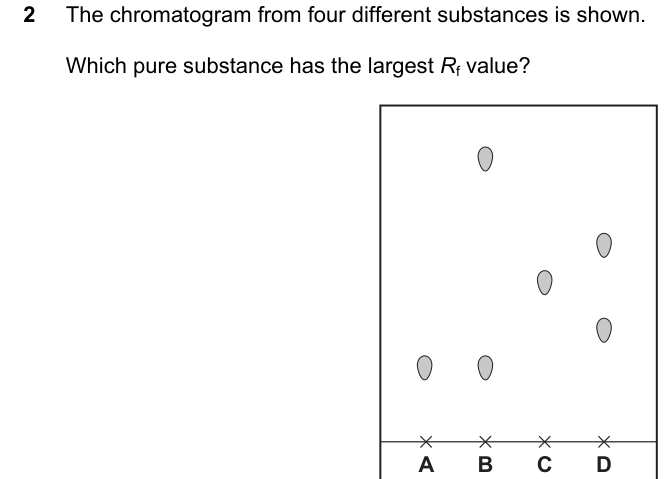
Supplement Rf = distance travelled by substance ÷ distance travelled by solvent
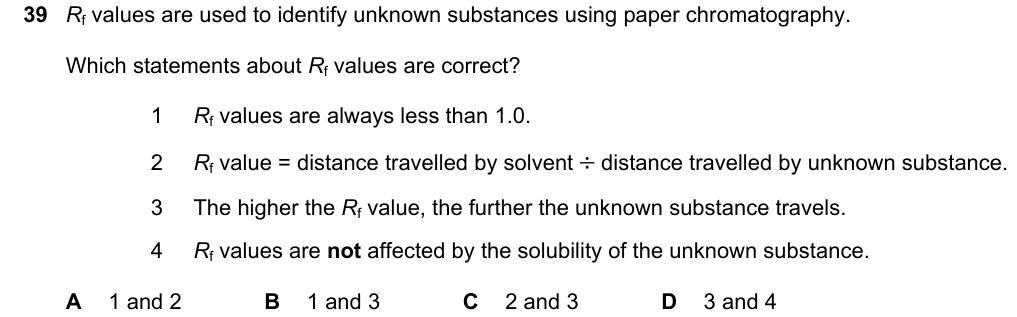
Both distances are measured from the baseline (to the centre of the spot, and to the solvent front). Rf has no units and is always less than 1. A higher Rf means the substance travelled further, because it is more soluble in the solvent. A substance has a characteristic Rf in a given solvent, so Rf values can identify unknowns by comparison with data.
Attempt these before opening the solutions. Each reference gives the component, session and question number of the original examination; the answers follow the published mark scheme.
Solutions and mark-scheme guidance · set C
C1 Answer D
The baseline is drawn in pencil. Many chose B — chromatography separates solutes, not solvents.
C2 Answer B
Count red spots at different heights: two different red dyes. A third of weaker candidates counted every red spot (4).
C3 Answer C
The sample must be pure (one spot) and have the highest spot. Many chose B, which has a high spot but is impure.
C4 Answer B
Rf is always less than 1 (1), and a higher Rf means the substance travels further (3). Rf depends on solubility in the solvent.
C5 Answer D
Only three spots for four substances: two have the same Rf. Without a locating agent no spots would be seen at all, and an insoluble one would still show on the baseline.
C6 [6]
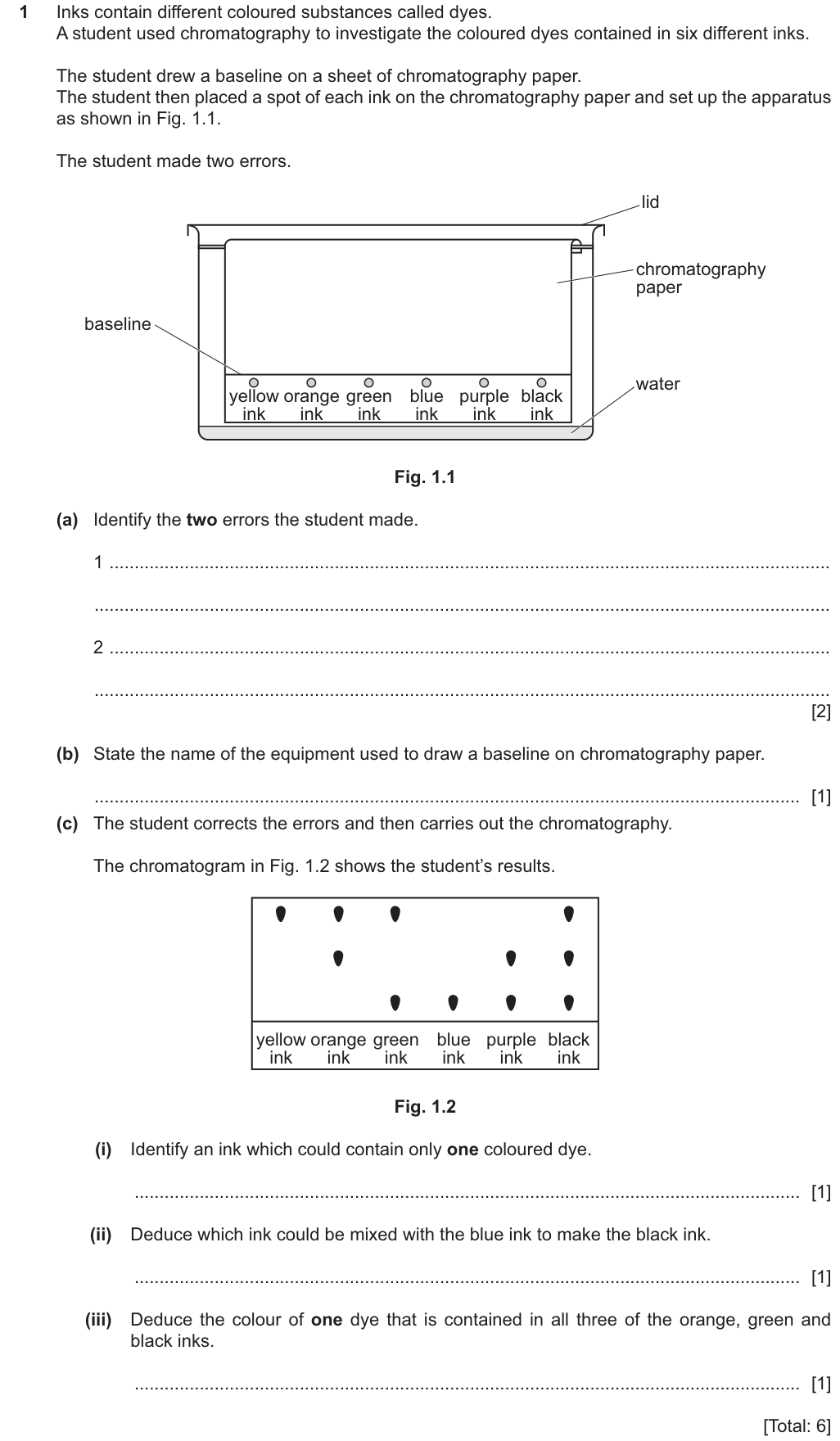
(a) The ink spots should be on the baseline ✓; the water should reach the paper but stay below the spots ✓.
(b) A pencil ✓.
(c)(i) yellow or blue (one spot) ✓. (ii) orange ✓. (iii) yellow ✓.
Examiner feedback: “a lid should not be used” and “no solvent front drawn” were common wrong answers; “ink dots” alone was too brief. Green was sometimes chosen as a single dye although it contains yellow and blue; purple + blue would lack the yellow dye.
12.4 · Separation and purification
4Separation and purification 12.4.1–12.4.3 Core
| Mixture | Method | How it works |
|---|---|---|
| soluble and insoluble solids | suitable solvent, then filtration | the solvent dissolves only one component (e.g. water dissolves salt from sand) |
| insoluble solid + liquid | filtration | solid remains as residue; liquid passes through as filtrate |
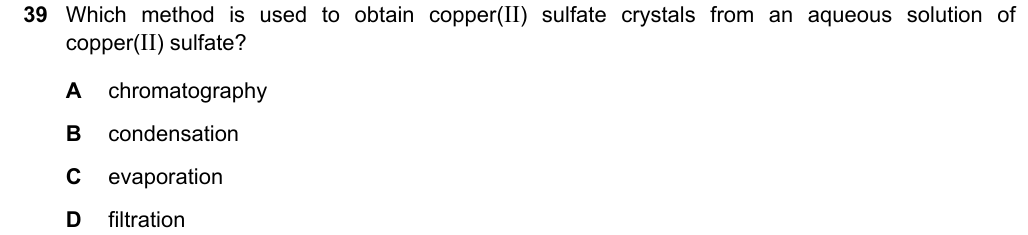
| soluble solid from its solution | crystallisation | heat to the point of crystallisation (saturated), then cool; filter and dry the crystals |
| solvent from a solution | simple distillation | the solvent boils off, is condensed in a condenser and collected; the solute remains |
| miscible liquids with different boiling points | fractional distillation | a fractionating column gives repeated evaporation and condensation; the liquid with the lowest boiling point distils first (e.g. ethanol from water; petroleum) |
| soluble coloured (or colourless) substances | chromatography | different substances move different distances |
To suggest a method, look at the information given: which components are soluble in which solvent, and their melting and boiling points.
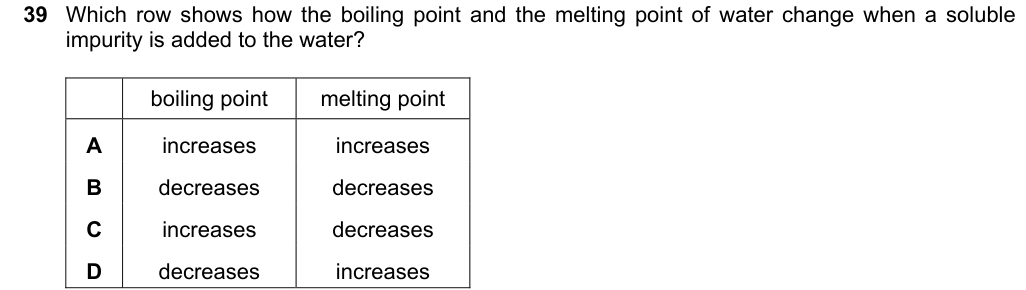
Purity. A pure substance has a sharp, fixed melting point and boiling point. Impurities lower and widen the melting point range and raise the boiling point. Comparing a measured melting or boiling point with data both identifies a substance and shows whether it is pure. Purity matters for drugs and foods, where impurities could be harmful.
Attempt these before opening the solutions. Each reference gives the component, session and question number of the original examination; the answers follow the published mark scheme.
Solutions and mark-scheme guidance · set D
D1 Answer C
A soluble impurity raises the boiling point and lowers the melting point. Most chose A, not recalling the melting point change.
D2 Answer C
Crystals are obtained by evaporation (to the point of crystallisation). Almost half of weaker candidates chose filtration.
D3 [3]
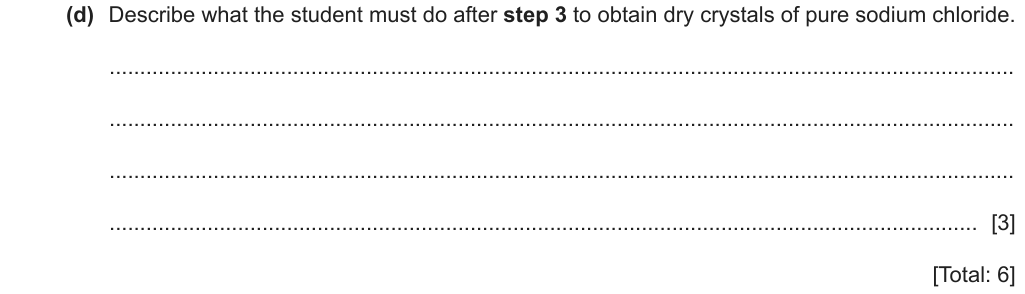
Heat the filtrate ✓ to the point of crystallisation (then leave to cool) ✓; dry the crystals with filter paper ✓.
Examiner feedback: many wrote “evaporate the water” without a method, or “dry the salt” without saying how. Only the strongest answers heated to the point of crystallisation.
12.5 · Identification of ions and gases
5Tests for anions 12.5.1 Core
| Anion | Test | Result |
|---|---|---|
| carbonate, CO32− | add dilute acid, then test the gas with limewater | effervescence; carbon dioxide produced (limewater turns milky) |
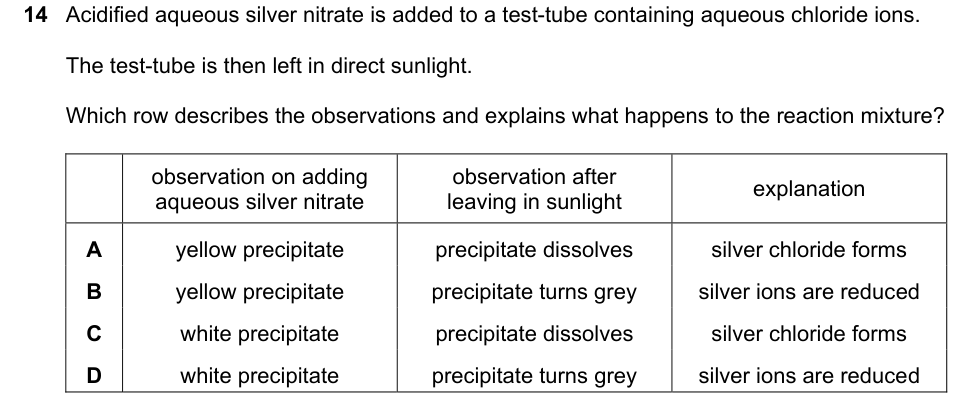
| chloride, Cl− | acidify with dilute nitric acid, then add aqueous silver nitrate | white ppt. |
| bromide, Br− | cream ppt. | |
| iodide, I− | yellow ppt. | |
| nitrate, NO3− | add aqueous sodium hydroxide, then aluminium foil; warm carefully | ammonia produced (damp red litmus turns blue) |
| sulfate, SO42− | acidify with dilute nitric acid, then add aqueous barium nitrate | white ppt. |
| sulfite, SO32− | add a small volume of acidified aqueous potassium manganate(VII) | purple → colourless |
The nitric acid is added first to remove carbonate ions, which would otherwise also give a precipitate. Nitric acid is used (not hydrochloric or sulfuric acid) because it adds no chloride or sulfate ions. The halide precipitates are silver halides, e.g. Ag+(aq) + Cl−(aq) → AgCl(s); the sulfate precipitate is barium sulfate, Ba2+(aq) + SO42−(aq) → BaSO4(s). Silver chloride left in sunlight turns grey as silver ions are reduced to silver.
6Tests for cations: hydroxides and flame tests 12.5.2, 12.5.4 Core
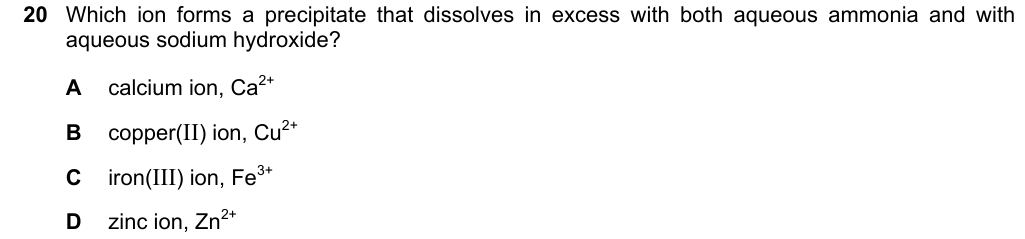
Add aqueous sodium hydroxide (or aqueous ammonia) drop by drop, then in excess. Most metal hydroxides are insoluble and form coloured precipitates; some dissolve in excess.
| Cation | Aqueous sodium hydroxide | Aqueous ammonia |
|---|---|---|
| aluminium, Al3+ | white ppt., soluble in excess, giving a colourless solution | white ppt., insoluble in excess |
| ammonium, NH4+ | ammonia produced on warming | — |
| calcium, Ca2+ | white ppt., insoluble in excess | no ppt. or very slight white ppt. |
| chromium(III), Cr3+ | green ppt., soluble in excess | green ppt., insoluble in excess |
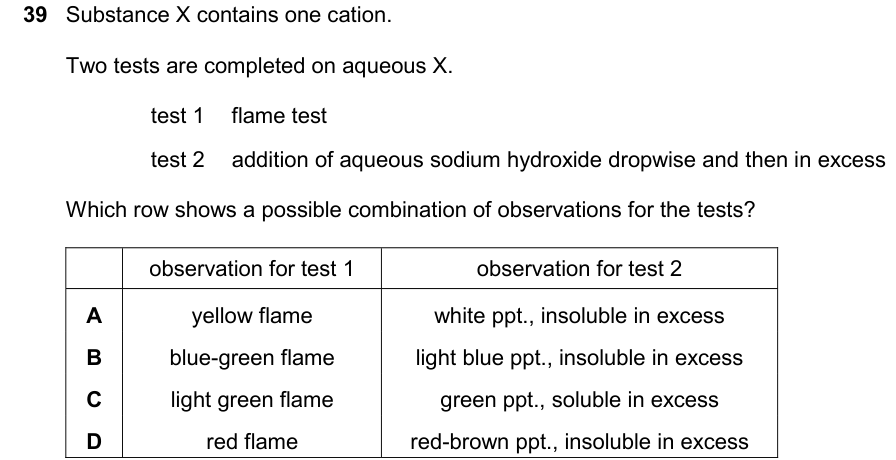
| copper(II), Cu2+ | light blue ppt., insoluble in excess | light blue ppt., soluble in excess, giving a dark blue solution |
| iron(II), Fe2+ | green ppt., insoluble in excess, ppt. turns brown near surface on standing (both reagents) | |
| iron(III), Fe3+ | red-brown ppt., insoluble in excess (both reagents) | |
| zinc, Zn2+ | white ppt., soluble in excess, giving a colourless solution (both reagents) | |
Distinguishing the white precipitates: Al3+ and Zn2+ both dissolve in excess NaOH; only Zn2+ also dissolves in excess ammonia. Ca2+ gives a white precipitate with NaOH but little or none with ammonia. Ionic equations: Cu2+(aq) + 2OH−(aq) → Cu(OH)2(s); Fe3+(aq) + 3OH−(aq) → Fe(OH)3(s).
Flame tests. Dip a clean nichrome (or platinum) wire in the solid (moistened with acid) and hold it in the edge of a hot, blue (roaring) Bunsen flame:
| Ion | Li+ | Na+ | K+ | Ca2+ | Ba2+ | Cu2+ |
|---|---|---|---|---|---|---|
| flame colour | red | yellow | lilac | orange-red | light green | blue-green |
7Tests for gases 12.5.3 Core
| Gas | Test and result |
|---|---|
| ammonia, NH3 | turns damp red litmus paper blue |
| carbon dioxide, CO2 | turns limewater milky |
| chlorine, Cl2 | bleaches damp litmus paper |
| hydrogen, H2 | “pops” with a lighted splint |
| oxygen, O2 | relights a glowing splint |
| sulfur dioxide, SO2 | turns acidified aqueous potassium manganate(VII) from purple to colourless |
Write observations, not conclusions: “fizzing; the gas turns limewater milky”, not “carbon dioxide is produced”. A lighted splint tests for hydrogen; a glowing splint for oxygen. “Pungent smell” is not a test for ammonia. For precipitates, give the colour and what happens in excess.
Attempt these before opening the solutions. Each reference gives the component, session and question number of the original examination; the answers follow the published mark scheme.
Solutions and mark-scheme guidance · set E
E1 Answer D
Only Zn2+ gives a precipitate soluble in excess of both reagents (Cu2+ dissolves only in excess ammonia). One of the most demanding questions on the paper.
E2 Answer D
Chloride gives a white precipitate of AgCl; in sunlight it turns grey as silver ions are reduced to silver. Most chose C, knowing the test but not the effect of light.
E3 Answer B
Blue-green flame and a light blue precipitate insoluble in excess NaOH both identify Cu2+. A (yellow flame) was the commonest error — sodium ions give no precipitate with NaOH.
E4 [10]
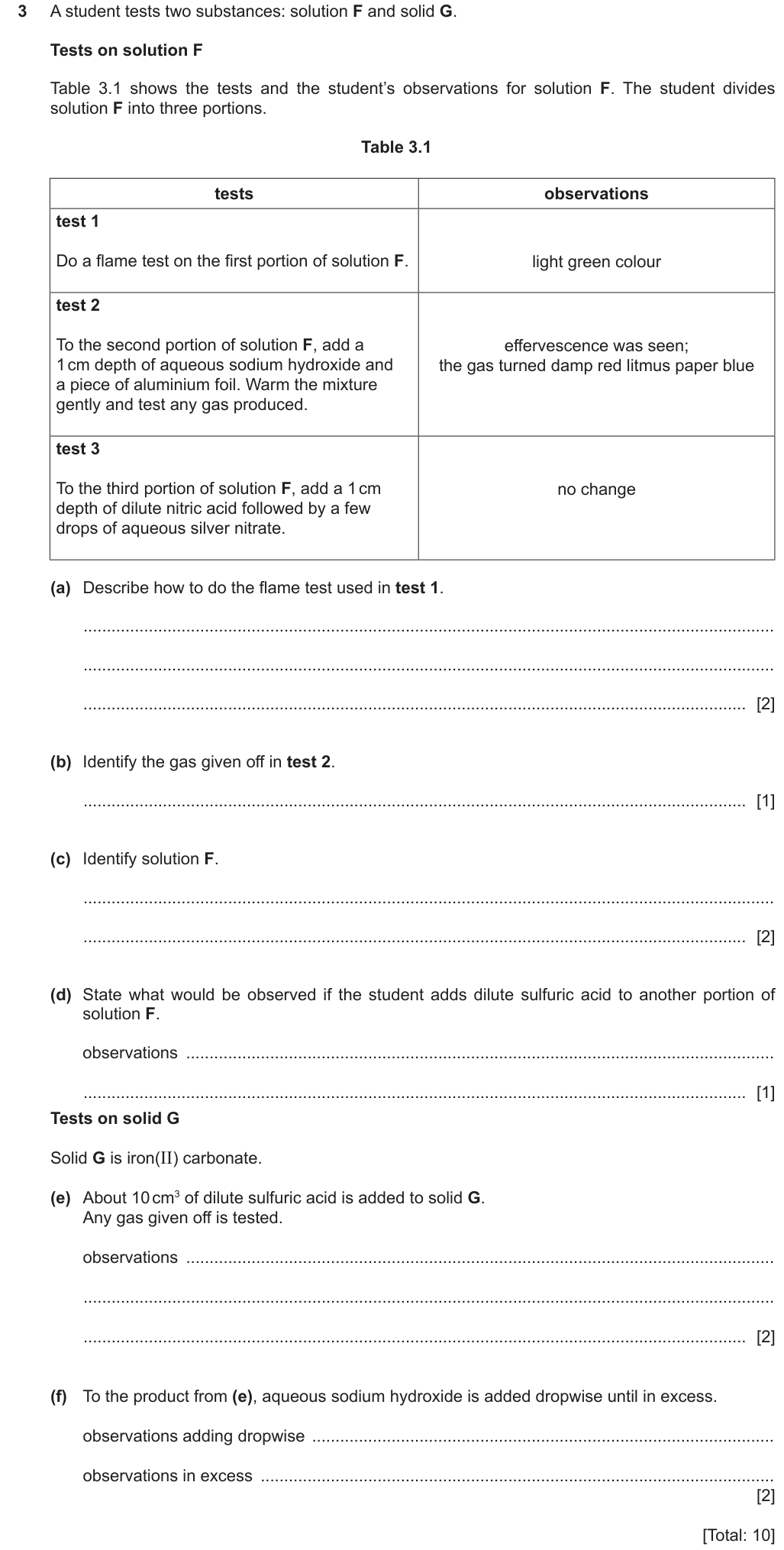
(a) Use a wire (or splint) to put the sample into a hot, blue (roaring) Bunsen flame ✓✓.
(b) ammonia ✓. (c) barium ions ✓ and nitrate ions ✓.
(d) White precipitate (barium sulfate) ✓.
(e) Fizzing ✓; the gas turns limewater milky ✓.
(f) Green precipitate ✓, insoluble in excess ✓.
Examiner feedback: many were unfamiliar with carrying out a flame test. Some gave ammonium as the anion. “A gas is given off” is not an observation; the limewater result must be stated.
E5 [6]
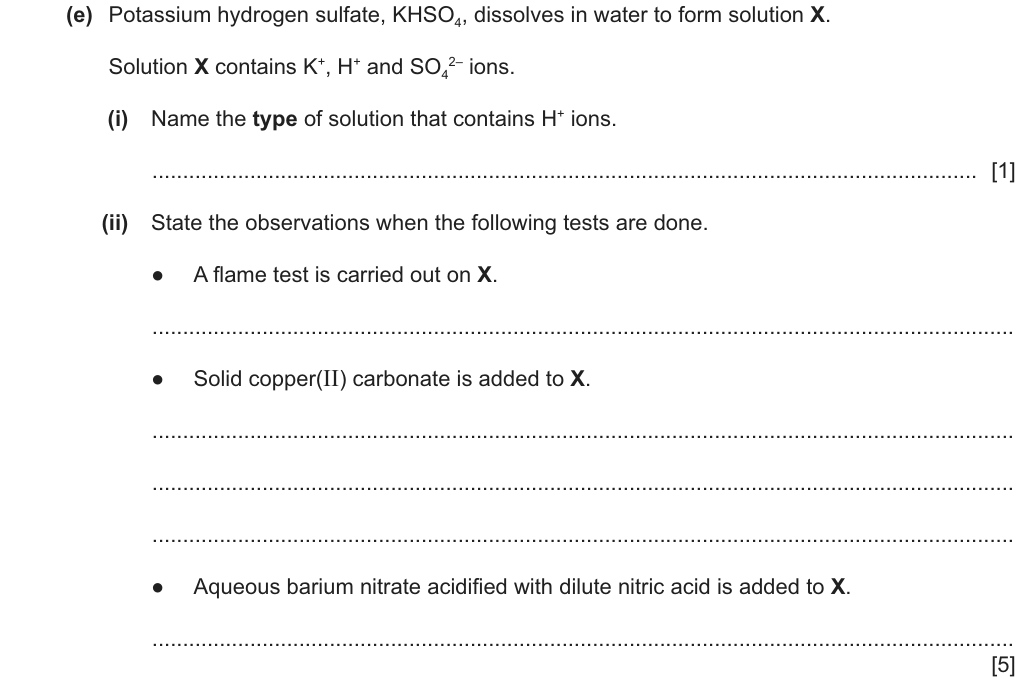
(i) acid(ic) ✓.
(ii) Flame test: lilac ✓. Copper(II) carbonate: fizzing ✓, the solid dissolves ✓, a blue solution forms ✓. Acidified barium nitrate: white precipitate ✓.
Examiner feedback: lilac was well known, but most answers ignored the instruction to state observations for the other tests.
Review · Topic 12
8Misconceptions and the examiner’s view
- “A pipette measures any volume.” A volumetric pipette delivers one fixed volume; a burette measures variable volumes precisely.
- “Universal indicator is fine for titrations.” It has no sharp end-point.
- “The baseline can be drawn in ink / the solvent should cover the spots.” Pencil; solvent below the baseline.
- “Every spot of the same colour is a different dye.” Same height = same substance.
- “Impurities raise the melting point.” They lower it (and raise the boiling point).
- “Evaporate the solution to dryness to get crystals.” Heat to the point of crystallisation, then cool.
- “A gas is given off.” That is not an observation — describe fizzing and the test result.
Practical questions are lost most often through imprecise description rather than lack of knowledge. Apparatus must be named correctly — a volumetric pipette is not a dropper, a funnel is not a filter — and chosen for the precision required. In titrations, candidates must explain that the indicator shows the end-point by changing colour, describe finding the volume from initial and final burette readings, and remember to swirl; universal indicator is unsuitable because it has no sharp end-point, and mole ratios other than 1 : 1 are frequently ignored. In chromatography, errors in method (spots not on the baseline, solvent not reaching the paper) are usually spotted, but chromatograms are misread when candidates count every coloured spot rather than spots at different heights, ignore the word “pure”, or think Rf is independent of solubility. Crystallisation answers often say “evaporate the water” or “dry the crystals” without a method. The effect of impurities on melting point is poorly recalled. In qualitative analysis, flame-test technique is unfamiliar to many, the white precipitates of Al3+, Zn2+ and Ca2+ are confused, and conclusions such as “carbon dioxide is produced” replace observations. Strong answers give the reagent, what is seen at each stage — including in excess — and the conclusion that follows.
9Summary and knowledge organiser
Essential knowledge
- Apparatus: stop-watch, thermometer, balance, burette, volumetric pipette, measuring cylinder, gas syringe.
- Titration: pipette alkali, indicator, burette acid, swirl, end-point colour change, concordant titres.
- Chromatography: pencil baseline, solvent below spots; pure = one spot; Rf = substance ÷ solvent distance; locating agent for colourless spots.
- Separation: solvent, filtration, crystallisation, simple and fractional distillation. Purity: sharp mp/bp.
- Ion and gas tests as in the syllabus notes for qualitative analysis.
Examination checklist
- Name apparatus exactly; match precision to the measurement.
- Titre = final − initial; use the mole ratio from the equation.
- Rf from the baseline; no units; less than 1.
- Crystallisation: heat to the point of crystallisation, cool, filter, dry with filter paper.
- State observations including behaviour in excess.
Knowledge organiser · experimental techniques and chemical analysis
| Idea | What to know | Must-remember distinctions and common errors |
|---|---|---|
| Apparatus, terms 12.1 | Seven measuring instruments; solvent, solute, solution, saturated, residue, filtrate. | Burette (variable) vs pipette (fixed). |
| Titration 12.2 | Pipette, burette, indicator; end-point. | No universal indicator; swirl; white tile. |
| Chromatography 12.3 | Method; interpretation; locating agent; Rf. | Pencil baseline; same height = same substance. |
| Separation 12.4 | Solvent, filtration, crystallisation, distillation (simple and fractional). | Impurity: mp ↓, bp ↑. |
| Anions 12.5.1 | CO32−, halides, NO3−, SO42−, SO32−. | White / cream / yellow for Cl / Br / I. |
| Cations 12.5.2, 12.5.4 | NaOH and NH3 tests; flame colours. | Zn2+ dissolves in both excesses; Cu2+ dark blue in excess NH3. |
| Gases 12.5.3 | NH3, CO2, Cl2, H2, O2, SO2. | Lighted vs glowing splint; bleaches vs turns blue. |