
Topic 4 of the syllabus: 4.1 Electrolysis and 4.2 Hydrogen–oxygen fuel cells. Core covers the definition, the electrodes, three standard electrolyses, molten binary compounds and electroplating; the Supplement adds charge transfer, copper(II) sulfate, dilute and concentrated halide solutions, ionic half-equations and the evaluation of fuel cells.
Central idea: an electric current can force a chemical reaction to happen. Positive ions gain electrons at one electrode and negative ions lose electrons at the other; which ions do so decides the products.
Before you start
- Ionic compounds conduct only when molten or aqueous, because only then can the ions move (Topic 2.4).
- Metals and graphite conduct because they have mobile electrons (Topics 2.6, 2.7).
- Writing ionic formulae and balancing equations (Topic 3).
Learning objectives
- Define electrolysis and identify the anode, cathode and electrolyte.
- Identify the products and observations for molten lead(II) bromide, concentrated aqueous sodium chloride and dilute sulfuric acid, and predict products for molten binary compounds.
- Describe electroplating and why it is used.
- Supplement Describe charge transfer; predict products for copper(II) sulfate and for halide solutions; construct ionic half-equations.
- State what a hydrogen–oxygen fuel cell does and, Supplement evaluate it against a petrol engine.
Introduction: breaking compounds with electricity
Aluminium is the most abundant metal in the Earth’s crust, yet it was once more expensive than gold, because no chemical reducing agent could pull aluminium out of its oxide cheaply. The solution, still used today, is to pass a large electric current through molten aluminium oxide. The same idea makes chlorine and sodium hydroxide from salt water, purifies copper for electrical wiring and coats steel with chromium or zinc. In each case the electricity supplies the energy to force electrons onto one kind of ion and off another.
4.1 · Electrolysis
1Electrolysis and the electrolytic cell 4.1.1–4.1.2 Core
Electrolysis is the decomposition of an ionic compound, when molten or in aqueous solution, by the passage of an electric current.
The anode is the positive electrode. The cathode is the negative electrode. The electrolyte is the molten or aqueous substance that undergoes electrolysis.
An electrolytic cell has a d.c. power supply connected to two electrodes dipping into the electrolyte. Inert electrodes, made of graphite (carbon) or platinum, conduct electricity but do not react. The ionic compound must be molten or dissolved so that its ions are free to move; a solid ionic compound does not conduct and is not electrolysed.
Opposites attract. Cations are positive, so they are attracted to the negative cathode; anions are negative, so they go to the positive anode. At the cathode ions gain electrons (reduction); at the anode ions lose electrons (oxidation). “OIL RIG” — Oxidation Is Loss, Reduction Is Gain.
2How charge is transferred during electrolysis 4.1.8 Supplement
A complete circuit needs charge to move all the way round, but different particles carry it in different parts of the circuit:
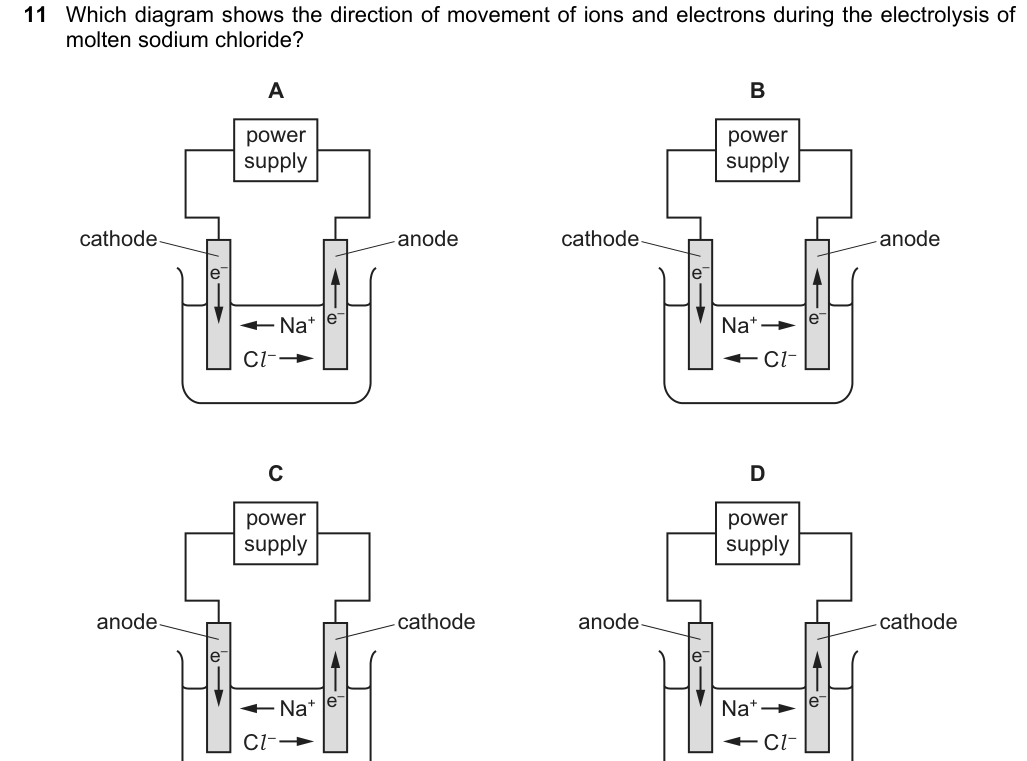
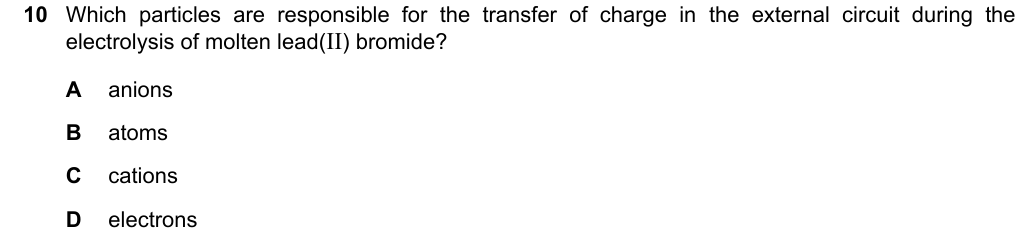
- In the external circuit (wires and electrodes), charge is carried by electrons. The power supply pushes electrons onto the cathode and pulls them away from the anode.
- At the electrodes, electrons are transferred: cations gain electrons at the cathode; anions (or water) lose electrons at the anode.
- In the electrolyte, charge is carried by ions moving: cations towards the cathode, anions towards the anode. Electrons do not travel through the electrolyte.
“Electrons flow through the electrolyte” is wrong: in the solution or melt the current is carried by moving ions. Equally, ions do not travel through the wires. In one multiple-choice question a third of weaker candidates had the ion movement right but the electron flow reversed.
3Electrolysis of molten compounds 4.1.3(a), 4.1.4–4.1.5 Core
A molten ionic compound contains only two kinds of ion, so there is no choice: the metal is formed at the cathode and the non-metal at the anode. This is why metals (and hydrogen) are always formed at the cathode, and non-metals other than hydrogen at the anode.
Molten lead(II) bromide, PbBr2, is the standard example. The solid is heated until it melts; only then does the bulb light. At the cathode, lead(II) ions gain electrons and a grey (silvery) liquid metal collects at the bottom. At the anode, bromide ions lose electrons and brown (orange-brown) bromine vapour is seen. The experiment is done in a fume cupboard because bromine vapour is toxic.
| Electrolyte | Cathode (−) | Anode (+) |
|---|---|---|
| lead(II) bromide, PbBr2 | lead | bromine |
| sodium chloride, NaCl | sodium | chlorine |
| potassium iodide, KI | potassium | iodine |
| zinc oxide, ZnO | zinc | oxygen |
| aluminium oxide, Al2O3 (Topic 9) | aluminium | oxygen |
When a question asks you to name the products, give the elements — lead, bromine, chlorine, potassium — not their ions (“chloride”, K+, Cl−) and not equations. The only possible products from molten potassium chloride are potassium and chlorine.
4Ionic half-equations 4.1.11 Supplement
A half-equation shows the change at one electrode, with electrons written in. It must balance for atoms and for charge.
- Cathode (reduction, electrons on the left): Pb2+ + 2e− → Pb; Na+ + e− → Na; Cu2+ + 2e− → Cu; 2H+ + 2e− → H2
- Anode (oxidation, electrons on the right): 2Br− → Br2 + 2e−; 2Cl− → Cl2 + 2e−; 4OH− → 2H2O + O2 + 4e−; 2O2− → O2 + 4e− (molten oxides)
Write the anode half-equation for the formation of oxygen from hydroxide ions.
| Species | OH− → O2 + H2O |
| Atoms | O2 needs 2 O and H2O needs 1 O; with 4OH−: 4OH− → O2 + 2H2O (4 O, 4 H each side) |
| Charge | left −4, right 0 → add 4e− on the right |
| Result | 4OH− → 2H2O + O2 + 4e− |
Half-equations for oxygen are found very challenging: O2− is often written as the ion discharged from an aqueous solution, when it is OH−. Chlorine is given as “Cl” or “Cl−”, the anode and cathode reactions are swapped, and Na+ + e− → Na is written for an aqueous solution, where sodium can never form.
5Electrolysis of aqueous solutions 4.1.3(b)(c), 4.1.10 CoreSupplement
An aqueous solution contains the ions of the compound and hydrogen ions, H+, and hydroxide ions, OH−, from water. Two cations compete at the cathode and two anions at the anode; only one of each is discharged.
Cathode: hydrogen is formed, unless the metal is less reactive than hydrogen (copper, silver), in which case the metal is deposited. Sodium, potassium, calcium and similar metals are never formed from aqueous solution.
Anode: from a concentrated halide (chloride, bromide, iodide) solution the halogen is formed; from a dilute halide solution, or from a solution with no halide (sulfate, nitrate), oxygen is formed.
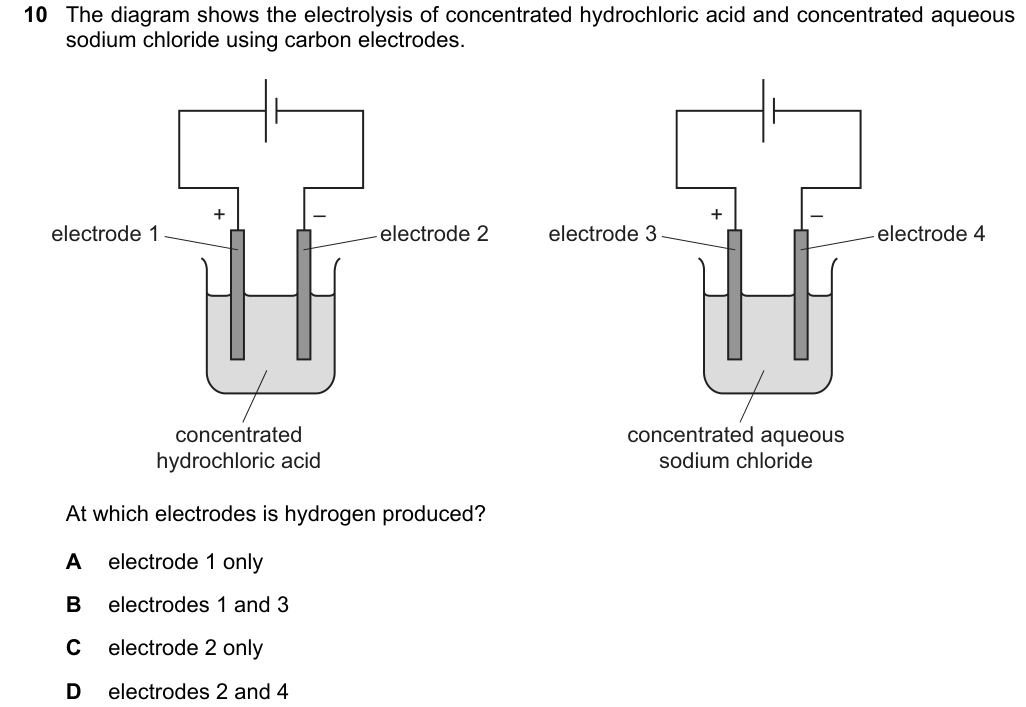
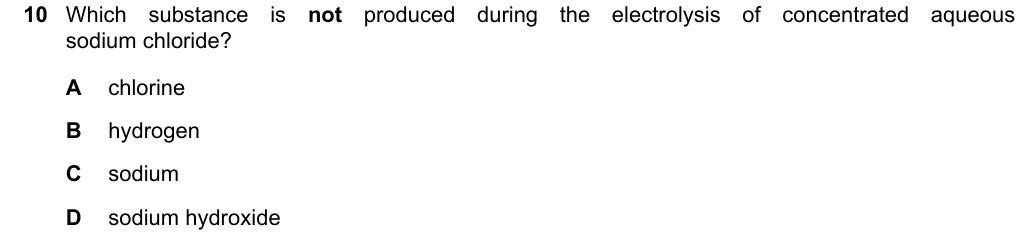
Concentrated aqueous sodium chloride (brine). At the cathode, hydrogen (bubbles of colourless gas) — sodium is too reactive to be discharged. At the anode, chlorine (bubbles of pale yellow-green gas), because the chloride ions are concentrated. Na+ and OH− ions are left behind, so the solution becomes sodium hydroxide. All three products are important industrial chemicals.
Dilute sulfuric acid. At the cathode, hydrogen; at the anode, oxygen — sulfate ions are not discharged. Both are colourless gases, with twice the volume of hydrogen as of oxygen. The net effect is the electrolysis of water, so the acid becomes more concentrated.
Supplement Dilute aqueous sodium chloride gives hydrogen and oxygen, not chlorine: when chloride ions are dilute, hydroxide ions are discharged instead. Concentrated hydrochloric acid gives hydrogen and chlorine; concentrated aqueous potassium bromide gives hydrogen and bromine (orange-brown solution near the anode); a concentrated iodide gives iodine (brown solution).
| Electrolyte | Cathode (−) | Anode (+) | Left in solution |
|---|---|---|---|
| concentrated NaCl(aq) | hydrogen | chlorine | sodium hydroxide |
| dilute NaCl(aq) S | hydrogen | oxygen | more concentrated NaCl |
| dilute H2SO4 | hydrogen | oxygen | more concentrated acid |
| concentrated HCl(aq) | hydrogen | chlorine | more dilute acid |
| CuSO4(aq) S | copper | oxygen | sulfuric acid; blue colour fades |
6Copper(II) sulfate with graphite and with copper electrodes 4.1.9 Supplement
With inert (graphite) electrodes. Copper is below hydrogen in reactivity, so at the cathode Cu2+ ions are discharged: a pink-brown layer of copper forms on the cathode (Cu2+ + 2e− → Cu). At the anode, sulfate ions are not discharged; hydroxide ions are, giving bubbles of oxygen (4OH− → 2H2O + O2 + 4e−). Because Cu2+ ions are removed, the blue colour of the solution fades, and the solution becomes acidic.
With copper electrodes. The cathode reaction is the same — copper is deposited and the cathode gains mass. But the copper anode is not inert: its atoms lose electrons and go into solution as Cu2+ ions (Cu → Cu2+ + 2e−), so the anode loses mass. Copper ions enter the solution at the same rate as they leave it, so the colour and concentration of the solution do not change. The mass lost by the anode equals the mass gained by the cathode. This is how copper is purified: an impure copper anode dissolves and pure copper builds up on the cathode.
Explaining why a copper anode loses mass was among the most challenging parts of one paper: candidates confused it with the carbon anode in aluminium extraction, which burns away in oxygen. The correct idea is that copper atoms form Cu2+ ions that go into the solution. “Copper(II)” was often given where the product is copper metal, and many thought the solution’s colour changes, when with copper electrodes there is no change.
7Electroplating 4.1.6–4.1.7 Core
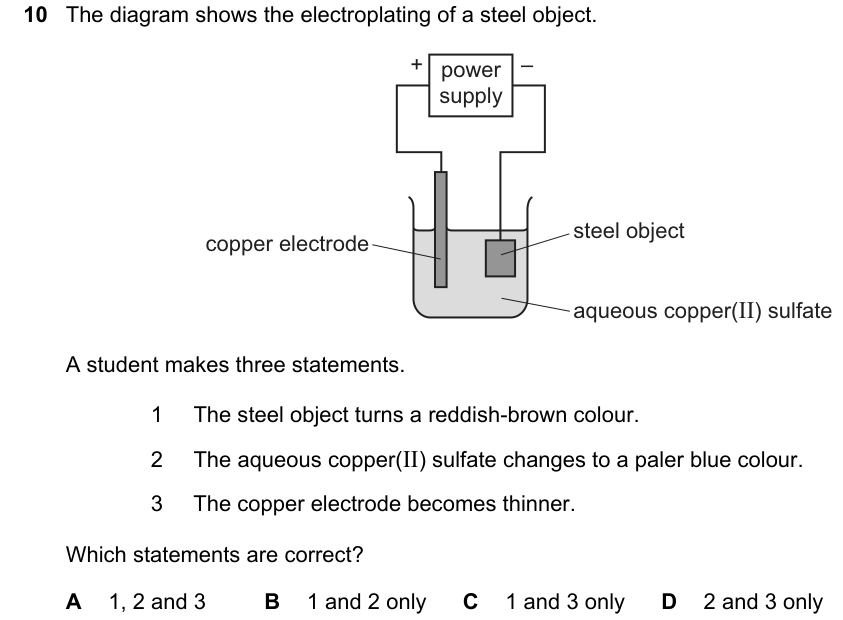
Metal objects are electroplated to improve their appearance (silver-plated cutlery, chromium-plated taps) and their resistance to corrosion (tin-plated steel cans, zinc or chromium on steel). Electroplating uses the same arrangement as copper purification:
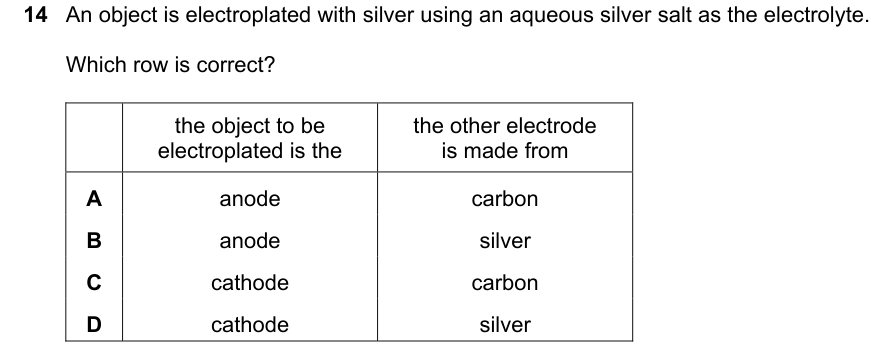
- the object to be plated is the cathode (negative electrode);
- the anode is made of the plating metal (silver, copper, nickel…);
- the electrolyte is an aqueous solution containing ions of the plating metal (silver nitrate, copper(II) sulfate…).
Metal ions are reduced and deposited on the object; the anode dissolves to replace them, so the electrolyte keeps its concentration. The object is cleaned first so the coating sticks, and washed and dried afterwards. The mass of metal deposited can be found by weighing the object before and after plating.
In planning questions on electroplating, common errors were omitting the power supply from the diagram, making the spoon the anode, using an inert electrode instead of the plating metal, and using molten instead of aqueous silver nitrate. Many forgot to wash and dry the object, or did not say how to find the mass of silver deposited (weigh before and after).
Attempt these before opening the solutions. Each reference gives the component, session and question number of the original examination; the answers follow the published mark scheme.

Solutions and mark-scheme guidance · set A
A1 Answer D
Hydrogen is formed at the cathodes (negative electrodes): in concentrated hydrochloric acid from H+, and in concentrated aqueous sodium chloride because sodium is too reactive to be discharged. Electrodes 2 and 4 are the cathodes. Option C forgets that brine also gives hydrogen.
A2 Answer A
In the external circuit electrons flow from the anode, through the power supply, to the cathode. In the melt, Na+ moves to the cathode and Cl− to the anode. Diagram A shows both. D had the ions right but the electrons reversed.
A3 Answer D
In the external circuit (wires), charge is carried by electrons. Ions carry charge only within the molten electrolyte.
A4 Answer C
Brine electrolysis gives chlorine, hydrogen and, left in solution, sodium hydroxide. Sodium is not produced: it is too reactive to be discharged from an aqueous solution. D was the most common wrong answer — read “not” carefully.
A5 Answer C
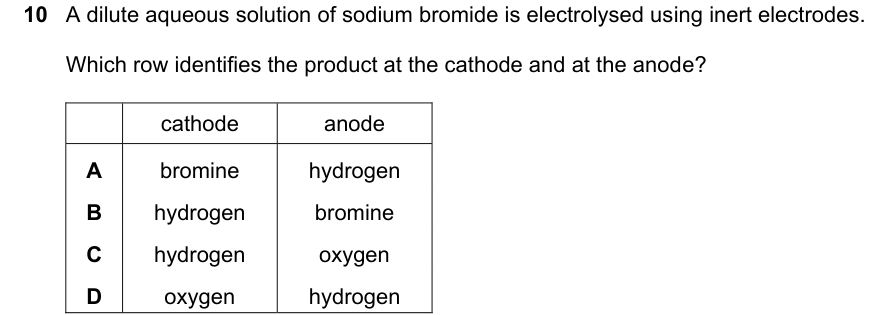
A dilute bromide gives oxygen at the anode, not bromine; the cathode gives hydrogen. Most chose B, treating the dilute solution as if it were concentrated.
A6 Answer A
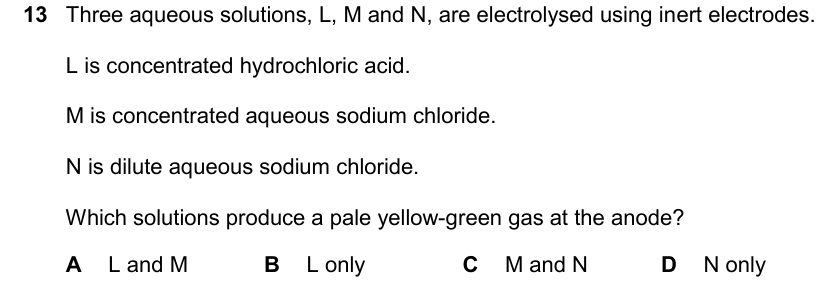
Chlorine (pale yellow-green) is formed from concentrated chloride solutions: L and M. Dilute sodium chloride (N) gives oxygen. C was the commonest error.
A7 Answer A
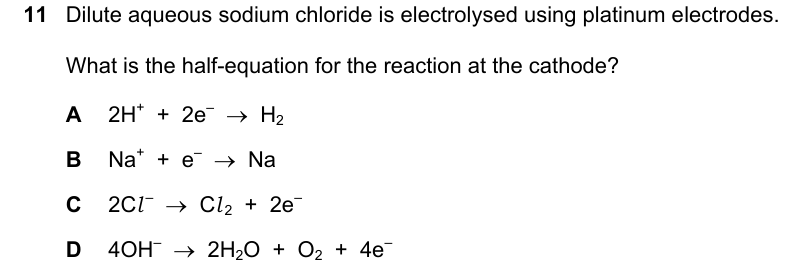
Cations go to the cathode; sodium cannot be formed in water, so hydrogen ions are reduced: 2H+ + 2e− → H2. B (sodium) and C (an anode reaction) were chosen by over half of weaker candidates.
A8 Answer A
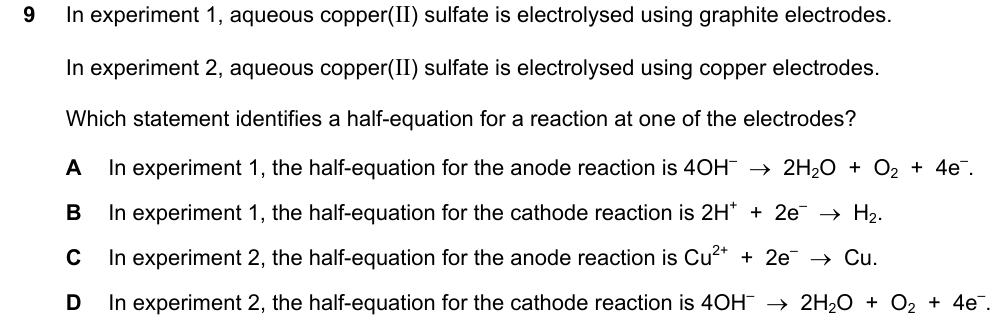
A is correct: in experiment 1 (graphite) oxygen forms at the anode from hydroxide ions. B is wrong because copper, not hydrogen, forms at the cathode in copper(II) sulfate. C gives a cathode reaction for the anode (with copper electrodes the anode reaction is Cu → Cu2+ + 2e−). D gives an anode reaction for the cathode.
A9 Answer D
The object is the cathode, where silver ions gain electrons and silver is deposited; the other electrode is silver, which dissolves to replenish the Ag+ ions. Only a third of the weaker candidates were correct.
A10 Answer C
(1) Copper is deposited on the steel: reddish-brown — correct. (3) The copper anode dissolves and becomes thinner — correct. (2) is wrong: the anode replaces the Cu2+ ions as fast as they are deposited, so the colour does not change.
A11 [7]
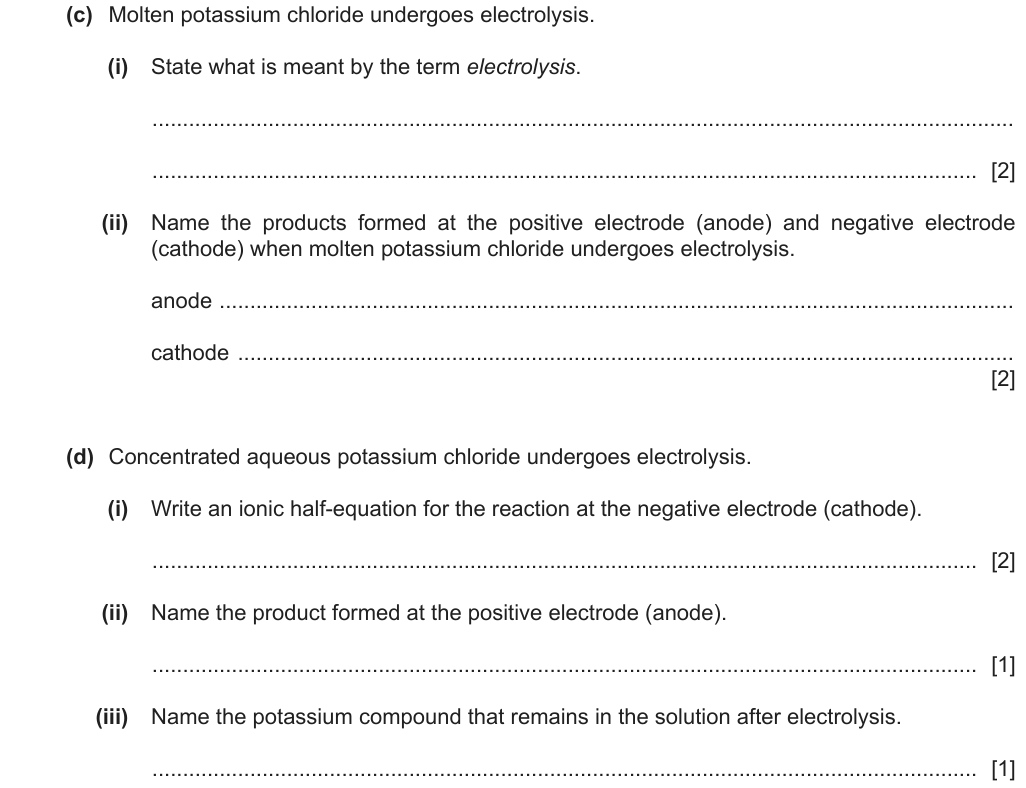
(c)(i) The breakdown by electricity ✓ of an ionic compound in the molten or aqueous state ✓. (ii) anode: chlorine; cathode: potassium ✓.
(d)(i) 2H+ + 2e− → H2: H+ and e− on the left ✓, fully correct ✓. (ii) chlorine ✓. (iii) potassium hydroxide ✓.
Examiner feedback: products were given as ions (chloride, K+, Cl−) or as equations, or reversed. In (d)(i) many wrote equations for discharging potassium or chloride ions. In (d)(iii) potassium oxide and potassium chloride were common wrong answers.
A12 [11]
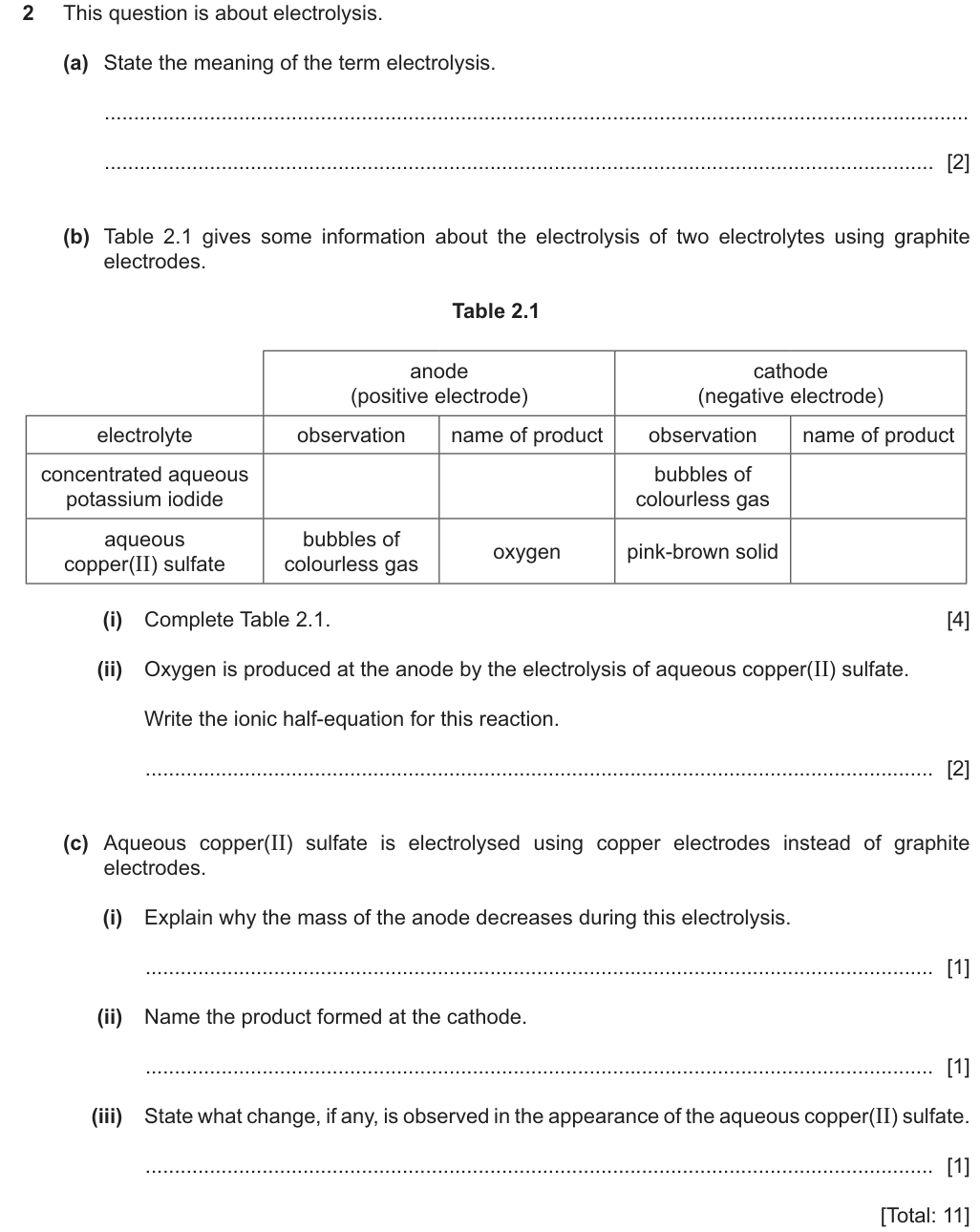
(a) The breakdown by electricity ✓ of an ionic compound in molten or aqueous state ✓.
(b)(i) KI anode: observation brown solution (or black solid) ✓, product iodine ✓; cathode product hydrogen ✓; CuSO4 cathode product copper ✓. (ii) 4OH− → 2H2O + O2 + 4e−: OH− and e− ✓, balanced ✓.
(c)(i) Copper atoms of the anode form Cu2+ ions which go into solution ✓. (ii) copper ✓. (iii) no change ✓.
Examiner feedback: “iodide” and “copper(II)” were written for iodine and copper. In (b)(ii) O2− was very often used instead of OH−. (c)(i) was one of the hardest items on the paper; in (c)(iii) “becomes colourless” and descriptions of the copper deposit were common.
A13 [6]
Any six of: weigh the spoon ✓; dissolve silver nitrate in distilled water ✓; a labelled diagram of a complete circuit with a power supply and both electrodes in the silver nitrate solution ✓; the spoon as the cathode (negative electrode) ✓; silver as the other electrode (anode) ✓; after electrolysis, wash and dry the spoon ✓; reweigh the spoon: mass of silver = new mass − original mass ✓.
Examiner feedback: common errors were no power supply in the diagram, the spoon as the anode, an inert electrode instead of silver, molten silver nitrate, and no washing, drying or reweighing.
4.2 · Hydrogen–oxygen fuel cells
8What a hydrogen–oxygen fuel cell does 4.2.1 Core
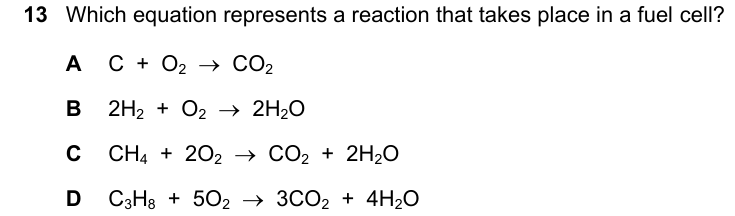
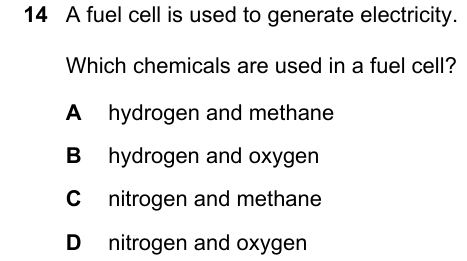
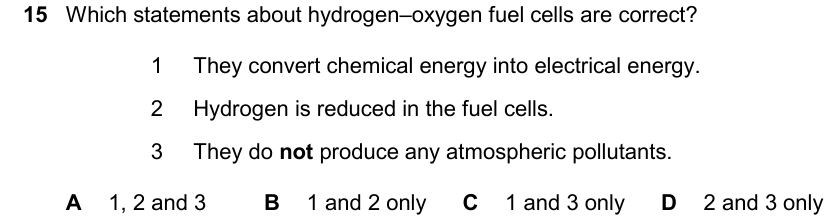
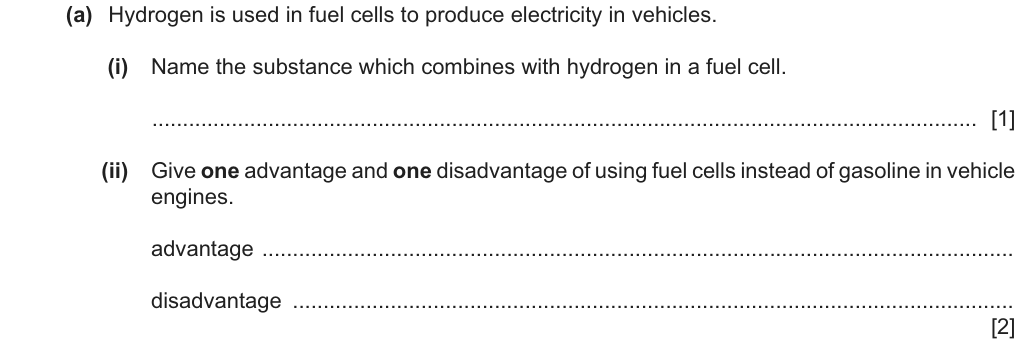
A hydrogen–oxygen fuel cell uses hydrogen and oxygen to produce electricity, with water as the only chemical product. It is the reverse of the electrolysis of water: instead of using electrical energy to split water, it releases the chemical energy of the reaction between hydrogen and oxygen directly as electrical energy, without burning.
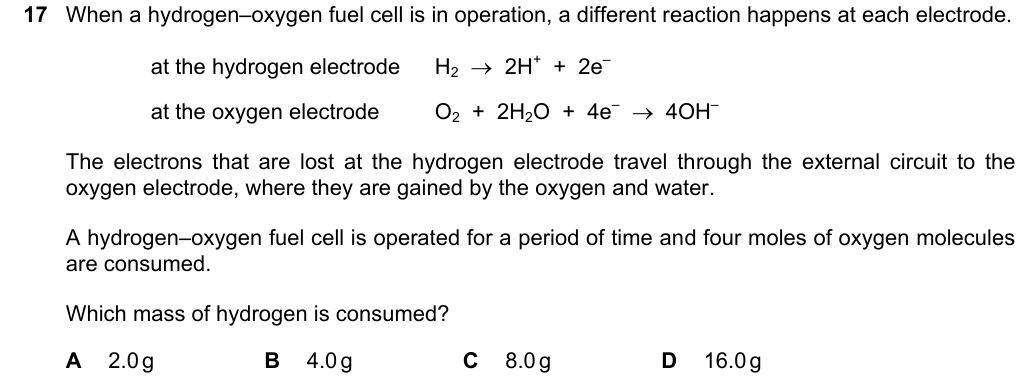
2H2(g) + O2(g) → 2H2O(l)
Hydrogen is supplied to one electrode, where it loses electrons (H2 → 2H+ + 2e−); the electrons travel round the external circuit to the oxygen electrode, where oxygen gains them. Hydrogen is oxidised and oxygen is reduced. As in all reactions, the ratio of hydrogen to oxygen consumed is 2 : 1.
9Fuel cells compared with petrol engines in vehicles 4.2.2 Supplement
| Advantages of fuel cells | Disadvantages of fuel cells |
|---|---|
| Water is the only product: no carbon dioxide (a greenhouse gas), carbon monoxide or oxides of nitrogen at the point of use. | Hydrogen is a gas that is difficult and expensive to store: it needs high pressure and heavy tanks. |
| They are more efficient at converting chemical energy into useful energy. | There are few hydrogen refuelling stations. |
| Fewer moving parts, so quieter and less maintenance. | Hydrogen is usually made from fossil fuels (natural gas) or by electrolysis powered by fossil-fuel electricity, which releases CO2. |
| Hydrogen can be made from water, a renewable resource. | Fuel cells are expensive to make and contain costly materials. |
Vague answers such as “less polluting”, “cheap” or “renewable” do not score. Give the chemistry: water is the only product (or no CO2 is produced) as the advantage; hydrogen is hard to store as the disadvantage. “Hydrogen is flammable” is not a valid disadvantage, because petrol is also flammable. A common error is to think the fuel cell combines hydrogen with carbon rather than oxygen.
Attempt these before opening the solutions. Each reference gives the component, session and question number of the original examination; the answers follow the published mark scheme.
Solutions and mark-scheme guidance · set B
B1 Answer B
A hydrogen–oxygen fuel cell combines hydrogen with oxygen: 2H2 + O2 → 2H2O. C is the combustion of methane — a balanced equation, but not a fuel cell reaction.
B2 Answer B
The chemicals used are hydrogen and oxygen. Option A lists two fuels but no oxygen.
B3 Answer C
(1) Chemical energy → electrical energy — correct. (3) The only product is water, so no atmospheric pollutants — correct. (2) is wrong: hydrogen loses electrons, so it is oxidised; oxygen is reduced.
B4 Answer D
Overall 2H2 + O2 → 2H2O, so H2 : O2 = 2 : 1. 4 mol O2 needs 8 mol H2 = 8 × 2 = 16.0 g. The most common answer, C (8.0 g), used a 1 : 1 ratio of moles or took 8 mol as the mass.
B5 [3]
(i) oxygen ✓. (ii) Advantage: water is the only product / no carbon dioxide produced / more efficient ✓. Disadvantage: hydrogen is hard to store (high pressure, heavy tanks) / few filling stations ✓.
Examiner feedback: carbon was a common wrong answer in (i). In (ii) statements such as “less polluting”, “cheap” or “renewable” were too imprecise, and “hydrogen is flammable” is equally true of petrol.
Review · Topic 4
10Misconceptions and the examiner’s view
- “Electrons flow through the electrolyte.” Ions carry the current in the electrolyte; electrons in the wires.
- “Sodium forms at the cathode in brine.” From aqueous solutions, reactive metals are never formed; hydrogen is.
- “Any chloride solution gives chlorine.” Only a concentrated one; dilute gives oxygen.
- “Oxygen at the anode comes from O2−.” In aqueous solution it comes from OH−: 4OH− → 2H2O + O2 + 4e−.
- “The copper anode loses mass because it burns.” Its atoms form Cu2+ ions that go into solution.
- “In electroplating the object is the anode.” It is the cathode; the anode is the plating metal.
- “Fuel cells are better because they are less polluting.” Say why: water is the only product.
The definition of electrolysis and the identity of the products from molten compounds are generally known, although products are frequently named as ions (“chloride”, K+) or given as equations when names are asked for. The rules for aqueous solutions are the main difficulty: many candidates do not distinguish concentrated from dilute halide solutions, expect reactive metals to be deposited from water, forget that hydrogen forms in brine electrolysis, and cannot name what remains in solution (the hydroxide). Half-equations are weak — oxygen is written as coming from O2−, electrons are placed on the wrong side, and anode and cathode are confused. Electrolysis of copper(II) sulfate with copper electrodes is poorly understood: the dissolving anode is confused with the burning carbon anode of aluminium extraction, and a colour change is wrongly predicted. In practical planning of electroplating, the object is made the anode and power supplies, washing, drying and weighing are omitted. For fuel cells, answers are too vague; strong responses state that water is the only product and that hydrogen is difficult to store, and use the 2 : 1 ratio of hydrogen to oxygen.
11Summary and knowledge organiser
Essential knowledge
- Electrolysis: decomposition of an ionic compound, molten or aqueous, by an electric current. Anode +, cathode −.
- Electrons move in the external circuit; ions move in the electrolyte; electron transfer happens at the electrodes.
- Molten binary compound: metal at the cathode, non-metal at the anode. PbBr2 → grey lead, brown bromine vapour.
- Aqueous: cathode gives hydrogen unless the metal is below hydrogen (Cu, Ag); anode gives a halogen from a concentrated halide, otherwise oxygen.
- Brine → H2 + Cl2 + NaOH. Dilute H2SO4 → H2 + O2. CuSO4 (graphite) → Cu + O2, blue fades; (copper electrodes) → anode dissolves, no colour change.
- Electroplating: object = cathode, plating metal = anode, electrolyte contains ions of the plating metal. Improves appearance and corrosion resistance.
- Fuel cell: H2 + O2 → electricity, water only. Advantage: no CO2; disadvantage: hydrogen storage.
Examination checklist
- Name elements, not ions, when asked for products.
- Check concentrated vs dilute before predicting the anode product.
- Half-equations: electrons on the left at the cathode, on the right at the anode; balance charge.
- Oxygen from aqueous solution: 4OH− → 2H2O + O2 + 4e−.
- For fuel cells, give a chemical reason, not “less polluting”.
Knowledge organiser · electrochemistry
| Idea | What to know | Must-remember distinctions and common errors |
|---|---|---|
| Cell 4.1.1–2, 4.1.8 | Anode +, cathode −, electrolyte molten/aqueous; inert graphite/platinum. | Ions move in the electrolyte, electrons in the wires. |
| Molten 4.1.3–5 | Metal at cathode, non-metal at anode. PbBr2: Pb (grey liquid) + Br2 (brown vapour). | Name elements; fume cupboard for bromine. |
| Aqueous 4.1.3, 4.1.9–10 | Cathode: H2 unless Cu/Ag. Anode: halogen if concentrated halide, else O2. | Brine leaves NaOH. CuSO4: blue fades (graphite), no change (copper). |
| Half-equations 4.1.11 | Pb2+ + 2e− → Pb; 2Cl− → Cl2 + 2e−; 2H+ + 2e− → H2; 4OH− → 2H2O + O2 + 4e−. | Reduction at cathode, oxidation at anode. |
| Electroplating 4.1.6–7 | Object = cathode; plating metal = anode; solution of its ions. | Aqueous, not molten. Weigh before and after. |
| Fuel cells 4.2 | 2H2 + O2 → 2H2O; electricity; water only. | H2 storage problem; H2 : O2 = 2 : 1. |