
Topic 7 has three sub-topics: 7.1 The characteristic properties of acids and bases, 7.2 Oxides and 7.3 Preparation of salts. Core statements cover the reactions of acids and bases, indicators and pH, classifying oxides, the solubility rules and making soluble salts. Supplement statements add the proton-transfer definitions, strong and weak acids, amphoteric oxides, precipitation of insoluble salts and water of crystallisation.
Central idea: in water, acids release hydrogen ions and alkalis release hydroxide ions. When they meet, H⁺ and OH⁻ form water and the remaining ions form a salt. Knowing which salts dissolve tells you how to make any salt in pure form.
Before you start
- Formulae of ions and ionic compounds, including SO42−, NO3−, CO32−, OH− and NH4+ (Topic 2).
- Balanced and ionic equations with state symbols (Topic 3).
- Filtration, evaporation and crystallisation as separation methods (Topic 12).
- Hydrated and anhydrous copper(II) sulfate and cobalt(II) chloride (Topic 6).
Learning objectives
- Describe the reactions of acids with metals, bases and carbonates, and of bases with acids and ammonium salts.
- Describe the colours of litmus, thymolphthalein, methyl orange and universal indicator; compare solutions using pH.
- State that acids contain H⁺(aq) and alkalis OH⁻(aq); write the ionic equation for neutralisation.
- Supplement Define acids and bases in terms of protons and strong and weak acids in terms of dissociation.
- Classify oxides as acidic or basic; Supplement describe amphoteric oxides.
- Describe the preparation of soluble salts and apply the solubility rules; Supplement describe precipitation of insoluble salts and define water of crystallisation.
Introduction: salts you use every day
An indigestion tablet containing magnesium hydroxide or calcium carbonate neutralises excess stomach acid. Farmers spread lime on acidic soil so that crops grow well. Ammonium sulfate and potassium nitrate fertilisers are salts made by neutralising acids. Even the white precipitate that shows sulfate ions in a test tube is a salt: barium sulfate. This chapter explains what acids and bases are, how their strength is measured, and how chemists choose a method to make a pure salt.
7.1 · The characteristic properties of acids and bases
1Acids, bases and alkalis 7.1.3, 7.1.6 Core
An acid is a substance whose aqueous solution contains hydrogen ions, H+(aq). Hydrochloric acid, sulfuric acid and nitric acid are common laboratory acids; ethanoic acid (in vinegar) and citric acid are found in food.
A base is an oxide or hydroxide of a metal, such as copper(II) oxide, CuO, or magnesium hydroxide, Mg(OH)2. Bases react with acids and neutralise them. An alkali is a soluble base; its aqueous solution contains hydroxide ions, OH−(aq). Sodium hydroxide, potassium hydroxide and calcium hydroxide (limewater, only partially soluble) are alkalis, and aqueous ammonia is also alkaline.
NaOH(aq) → Na+(aq) + OH−(aq) HCl(aq) → H+(aq) + Cl−(aq)
All alkalis are bases, but not all bases are alkalis: copper(II) oxide neutralises acids but does not dissolve in water, so it is a base and not an alkali.
2Characteristic reactions of acids and bases 7.1.1, 7.1.4, 7.1.8 Core
| Reaction | General equation | Example | Observations |
|---|---|---|---|
| acid + metal | salt + hydrogen | Mg(s) + 2HCl(aq) → MgCl2(aq) + H2(g) | fizzing; metal dissolves; hydrogen gives a squeaky pop with a lighted splint |
| acid + base | salt + water | CuO(s) + H2SO4(aq) → CuSO4(aq) + H2O(l) | black solid dissolves on warming; blue solution |
| acid + alkali | salt + water | NaOH(aq) + HCl(aq) → NaCl(aq) + H2O(l) | no visible change; temperature rises; indicator changes colour |
| acid + carbonate | salt + water + carbon dioxide | CaCO3(s) + 2HCl(aq) → CaCl2(aq) + H2O(l) + CO2(g) | fizzing; the gas turns limewater milky |
| base + ammonium salt (warm) | salt + water + ammonia | NH4Cl(s) + NaOH(aq) → NaCl(aq) + H2O(l) + NH3(g) | pungent gas turns damp red litmus paper blue |
The reaction between an acid and an alkali is neutralisation. Whatever the acid and alkali, the ions that actually react are the same, and the ionic equation is:
H+(aq) + OH−(aq) → H2O(l)
The other ions (Na+ and Cl− above) are spectator ions: they stay in solution and form the salt when the water is evaporated. The reaction of an ammonium salt with a base is the basis of the test for ammonium ions (Topic 12); it also explains why lime should not be spread at the same time as an ammonium fertiliser, since ammonia would be lost.
Acids react with metals to give hydrogen and with carbonates to give carbon dioxide. Metal oxides and hydroxides do not fizz with acids — they give only a salt and water. Candidates often predict fizzing when a metal oxide such as zinc oxide is added to acid.
3Indicators and the pH scale 7.1.2, 7.1.5, 7.1.7 Core
An indicator is a dye whose colour depends on whether a solution is acidic or alkaline. Three single indicators must be known:
| Indicator | In acid | In alkali |
|---|---|---|
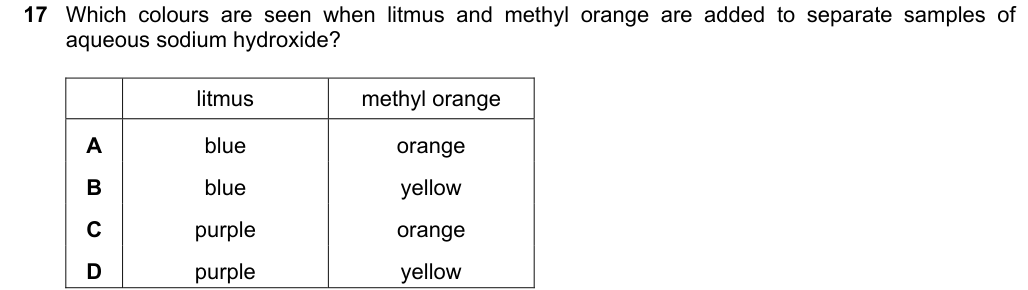
| litmus | red (blue litmus turns red) | blue (red litmus turns blue) |
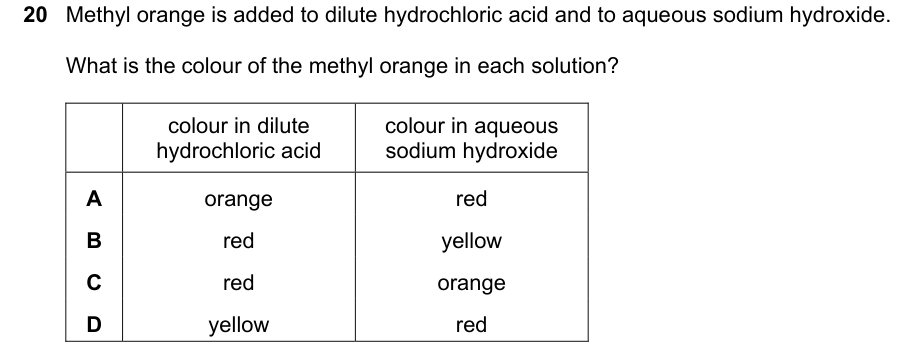
| methyl orange | red | yellow |
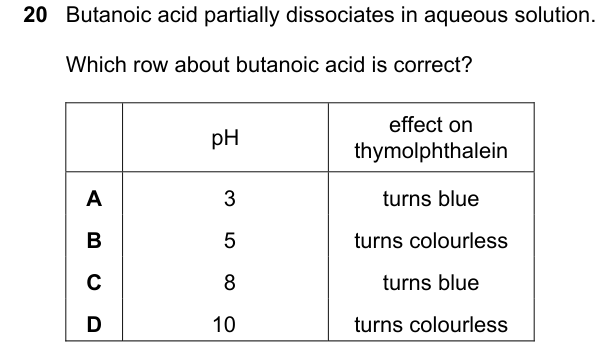
| thymolphthalein | colourless | blue |
The pH scale (0–14) measures how acidic or alkaline a solution is. pH 7 is neutral; below 7 is acidic; above 7 is alkaline. The lower the pH, the higher the concentration of hydrogen ions and the more acidic the solution; the higher the pH above 7, the more alkaline. Universal indicator is a mixture of indicators that shows a range of colours: red for strongly acidic, orange–yellow for weakly acidic, green for neutral, blue for weakly alkaline and purple for strongly alkaline. To measure pH, a drop of the solution is placed on universal indicator paper and the colour is compared with a colour chart. A single indicator such as methyl orange shows only whether a solution is on one side or the other of its colour change; it cannot give a pH value.
Indicator colours must be learnt exactly; thymolphthalein is colourless in all acids, including weak ones. Universal indicator is not used in a titration because it does not give a sharp colour change at the end-point.
4Acids as proton donors; strong and weak acids 7.1.9–7.1.12 Supplement
A hydrogen atom that has lost its electron is just a proton, so H+ is a proton. This gives a more general definition:
An acid is a proton donor. A base is a proton acceptor.
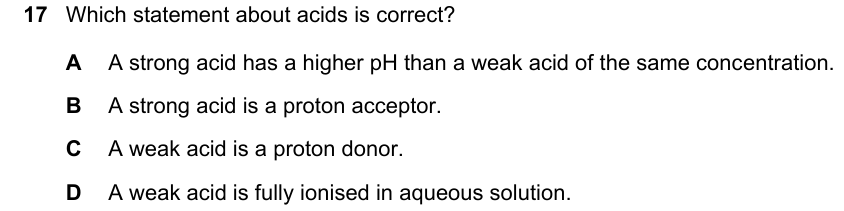
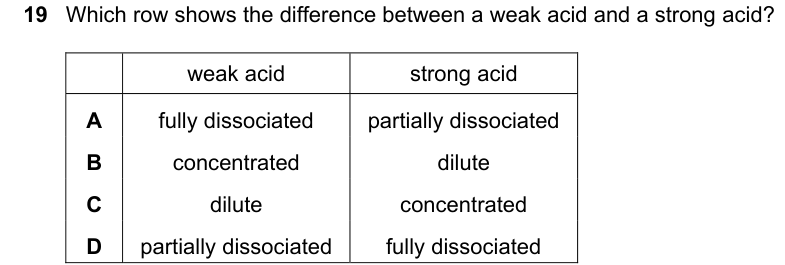
A strong acid is an acid that is completely dissociated in aqueous solution. A weak acid is an acid that is partially dissociated in aqueous solution.
In neutralisation the acid donates H+ and the hydroxide ion accepts it to form water. Ammonia acts as a base by accepting a proton: NH3 + H+ → NH4+. Aluminium hydroxide reacts with nitric acid as a base (a proton acceptor) even though it is insoluble and therefore not an alkali.
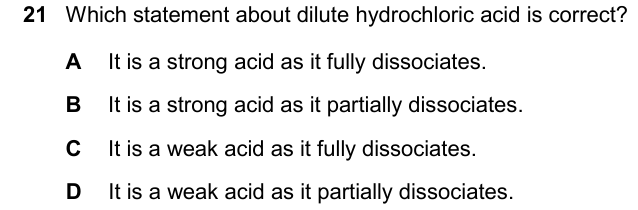
Hydrochloric acid is a strong acid: every HCl molecule releases its proton, shown by a single arrow:
HCl(aq) → H+(aq) + Cl−(aq)
Ethanoic acid is a weak acid: only a small fraction of the molecules release a proton, and the reaction is reversible, shown by ⇌:
CH3COOH(aq) ⇌ H+(aq) + CH3COO−(aq)
Nitric and sulfuric acids are also strong acids. At the same concentration, a weak acid has a lower concentration of H+ ions than a strong acid, so its pH is higher (though still below 7) and it reacts more slowly with magnesium or a carbonate. Both acids still neutralise the same amount of alkali, because the weak acid's molecules continue to dissociate as the H+ ions are removed.
Strong ≠ concentrated. “Strong” and “weak” describe the degree of dissociation; “concentrated” and “dilute” describe how much acid is dissolved per dm3. Dilute hydrochloric acid is still a strong acid. When explaining, it is the acid molecules that dissociate — “more H+ ions” or “strong dissociation” only repeats the question.
Attempt these before opening the solutions. Each reference gives the component, session and question number of the original examination; the answers follow the published mark scheme.
Solutions and mark-scheme guidance · set A
A1 Answer B
Methyl orange is red in acid and yellow in alkali.
A2 Answer B
Sodium hydroxide is an alkali: litmus is blue and methyl orange yellow.
A3 Answer B
A weak acid has a pH below 7 but not very low — pH 5 — and thymolphthalein is colourless in any acid.
A4 Answer D
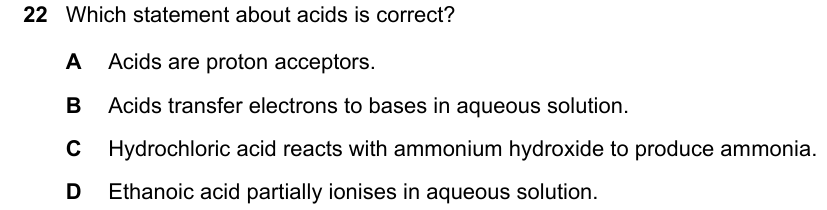
Ethanoic acid is weak: it partially ionises. Acids are proton donors, and they transfer protons, not electrons. Weaker candidates often chose C, confusing it with the release of ammonia from an ammonium salt by an alkali.
A5 Answer C
Every acid, weak or strong, is a proton donor. At the same concentration a strong acid has the lower pH; a weak acid is only partially ionised. Some chose A, confusing acid strength with pH.
A6 Answer D
Weak: partially dissociated; strong: fully dissociated. Weaker candidates linked strength with concentration (C).
A7 Answer A
Hydrochloric acid is strong because it fully dissociates — its being dilute does not change this. The commonest wrong answer (D) called it weak and partially dissociated.
A8 [15]
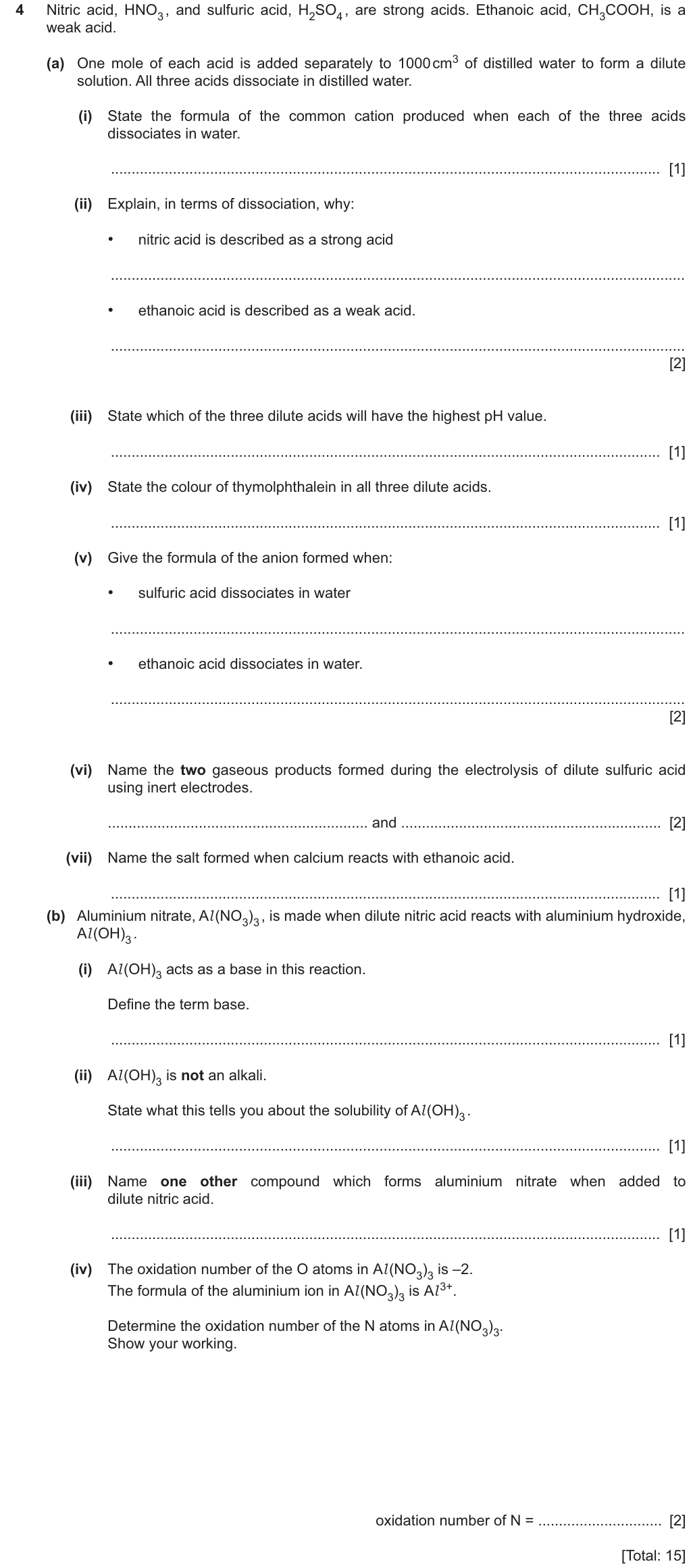
(a)(i) H+ ✓. (ii) Nitric acid is completely dissociated ✓; ethanoic acid is partially dissociated ✓. (iii) ethanoic acid ✓ — the weakest acid has the fewest H+ ions and so the highest pH. (iv) colourless ✓. (v) SO42− ✓; CH3COO− ✓. (vi) hydrogen ✓ and oxygen ✓. (vii) calcium ethanoate ✓.
(b)(i) A proton acceptor ✓. (ii) It is insoluble ✓. (iii) aluminium oxide ✓ (or aluminium carbonate). (iv) Using 9 × (−2) = −18 and +3: 3N = +15 ✓ → N = +5 ✓.
Examiner feedback: “strong dissociation”, “more H+ ions” or “the ions dissociate” did not explain strength. Most chose sulfuric acid in (iii) because it has two hydrogens. Ions in (v) needed charges. Aluminium hydroxide, already in the question, was a common wrong answer in (b)(iii); “low solubility” was not accepted in (b)(ii).
7.2 · Oxides
5Acidic and basic oxides 7.2.1 Core
Most elements form oxides, and the character of the oxide follows the character of the element.
- Metals form basic oxides, such as copper(II) oxide, CuO, and calcium oxide, CaO. A basic oxide reacts with an acid to form a salt and water: CaO + 2HCl → CaCl2 + H2O. Soluble basic oxides give alkaline solutions: CaO + H2O → Ca(OH)2.
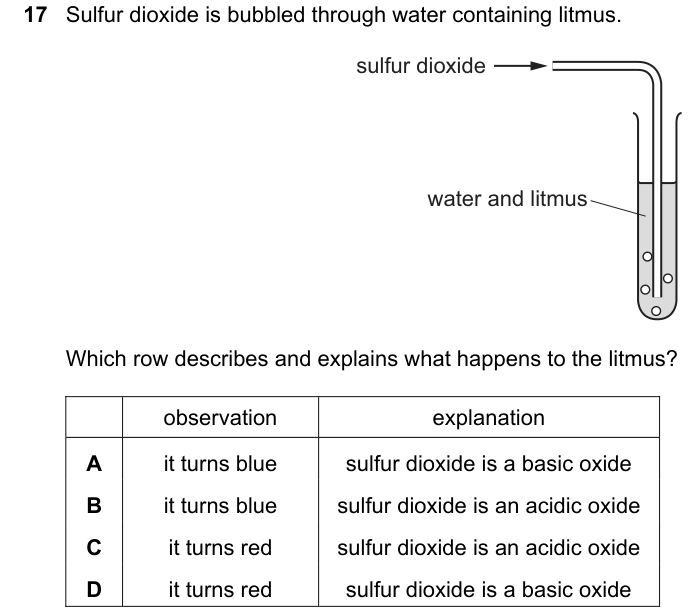
- Non-metals form acidic oxides, such as sulfur dioxide, SO2, and carbon dioxide, CO2. An acidic oxide reacts with a base or alkali to form a salt and water: CO2 + 2NaOH → Na2CO3 + H2O. Many dissolve in water to give acidic solutions, turning litmus red; sulfur dioxide dissolving in rain causes acid rain.
Because acidic and basic oxides react with each other, calcium oxide (basic) removes silicon(IV) oxide (acidic) as slag in the blast furnace (Topic 9), and is used to neutralise acidic gases. Some oxides — carbon monoxide, for example — are neutral and react with neither.
6Amphoteric oxides 7.2.2–7.2.3 Supplement
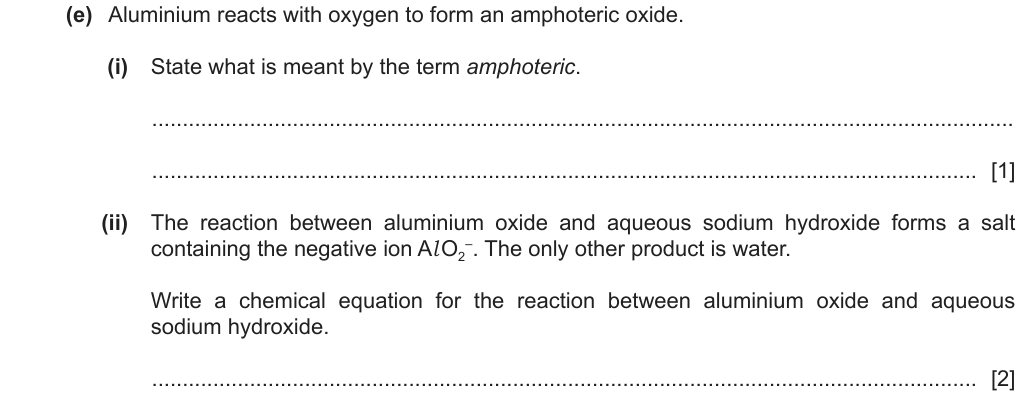
Amphoteric oxides are oxides that react with acids and with bases to produce a salt and water. Aluminium oxide, Al2O3, and zinc oxide, ZnO, are amphoteric.
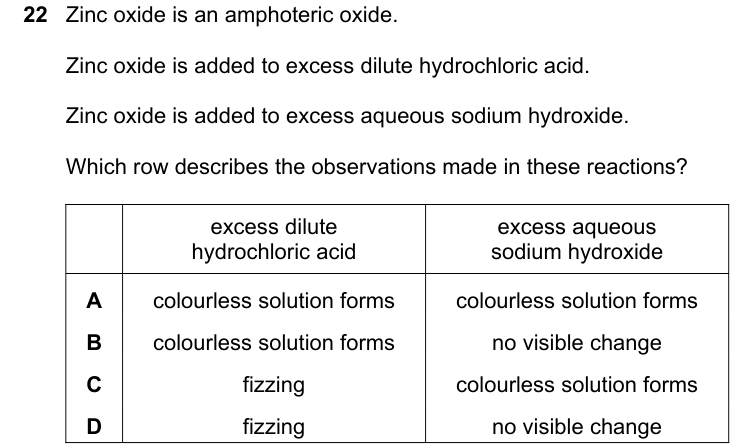
ZnO(s) + 2HCl(aq) → ZnCl2(aq) + H2O(l)
Al2O3(s) + 2NaOH(aq) → 2NaAlO2(aq) + H2O(l)
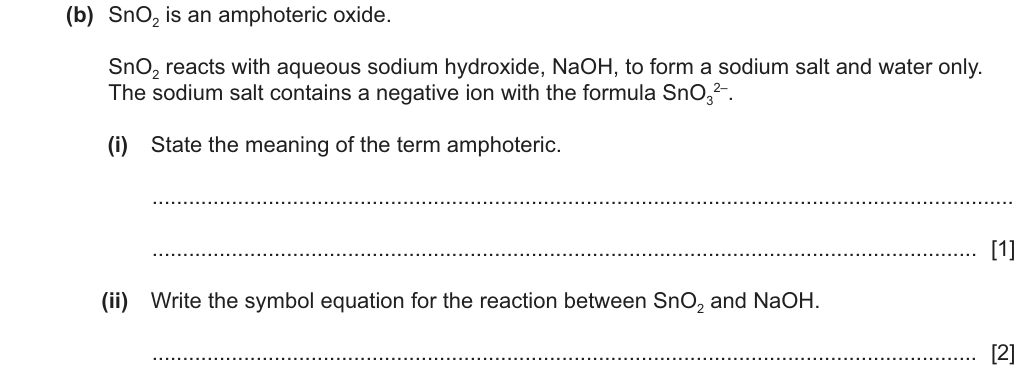
In each case the white solid dissolves to give a colourless solution; no gas is produced. Examination questions give the formula of the unfamiliar negative ion formed with the alkali (AlO2−, ZnO22− or, for tin(IV) oxide, SnO32−); the sodium salt is then written by balancing the charges — Na2SnO3, not NaSnO3.
| Type | Typical element | Reacts with acids? | Reacts with bases? | Examples |
|---|---|---|---|---|
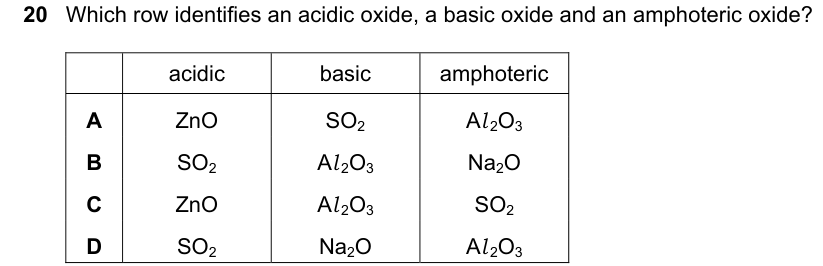
| basic | metal | yes | no | CuO, CaO, MgO, Na2O |
| acidic | non-metal | no | yes | SO2, CO2 |
| amphoteric | metals near the metal/non-metal boundary | yes | yes | Al2O3, ZnO |
Attempt these before opening the solutions. Each reference gives the component, session and question number of the original examination; the answers follow the published mark scheme.
Solutions and mark-scheme guidance · set B
B1 Answer C
SO2 is a non-metal oxide: an acidic oxide, so the litmus turns red.
B2 Answer D
SO2 acidic (non-metal), Na2O basic (metal), Al2O3 amphoteric.
B3 Answer A
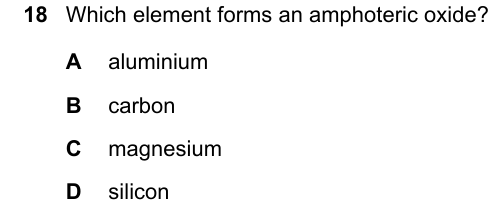
Aluminium forms the amphoteric oxide Al2O3. Magnesium oxide is basic; carbon and silicon form acidic oxides. Weaker candidates appeared to guess.
B4 Answer A
Zinc oxide reacts with both, forming a colourless solution each time. It is an oxide, not a metal or carbonate, so there is no fizzing — the error made by many who chose C.
B5 [3]
(i) It reacts with (neutralises) both acids and bases/alkalis ✓. (ii) 2NaOH + Al2O3 → 2NaAlO2 + H2O: NaAlO2 as product ✓; fully balanced ✓.
Examiner feedback: some thought amphoteric meant reacting with neither acids nor bases. The equation was fully correct for only a minority.
B6 [3]
(i) Reacts with acids and with bases to produce a salt and water ✓. (ii) SnO2 + 2NaOH → Na2SnO3 + H2O: Na2SnO3 ✓; balanced ✓.
Examiner feedback: NaSnO3 and formulae that did not use the SnO32− ion were seen; two Na+ ions balance one SnO32−.
7.3 · Preparation of salts
7The solubility rules 7.3.2 Core
A salt is the compound formed when the hydrogen of an acid is replaced by a metal (or ammonium) ion. The method used to make a salt depends on whether it is soluble in water. Six general rules must be learnt:
| Compounds | Soluble | Insoluble (exceptions) |
|---|---|---|
| sodium, potassium and ammonium salts | all | none |
| nitrates | all | none |
| chlorides | most | lead(II) chloride, silver chloride |
| sulfates | most | barium sulfate, calcium sulfate, lead(II) sulfate |
| carbonates | only sodium, potassium and ammonium carbonates | all others |
| hydroxides | only sodium, potassium, ammonium (and calcium, partially) | all others |
8Preparing soluble salts 7.3.1 Core
A soluble salt is made by reacting an acid with a suitable substance, then separating the salt solution and crystallising the salt. Two routes are used, depending on whether the other reactant is soluble.
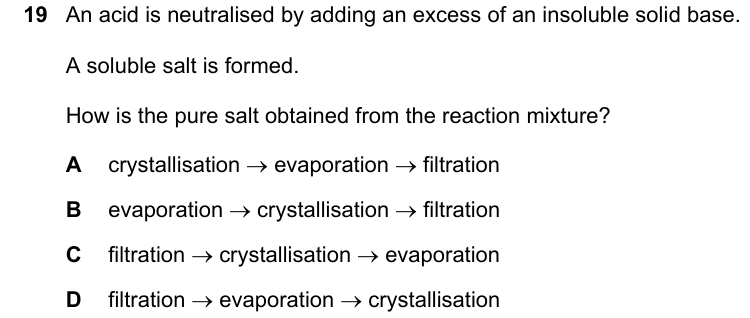
Method 1: acid + excess insoluble solid (metal, base or carbonate)
Example: copper(II) sulfate from copper(II) oxide and dilute sulfuric acid.
- Warm the dilute sulfuric acid in a beaker (to increase the rate).
- Add copper(II) oxide a little at a time, stirring, until no more dissolves and some black solid remains: the oxide is in excess. With a metal or carbonate the sign is that fizzing stops and solid no longer disappears.
- Filter to remove the excess solid. The blue filtrate is copper(II) sulfate solution.
- Heat the filtrate in an evaporating basin to the point of crystallisation (until a drop taken out on a glass rod forms crystals on cooling) — do not evaporate to dryness, which would destroy the water of crystallisation.
- Leave the saturated solution to cool so that crystals form; filter them off, wash with a little cold distilled water and dry between filter papers.
CuO(s) + H2SO4(aq) → CuSO4(aq) + H2O(l)
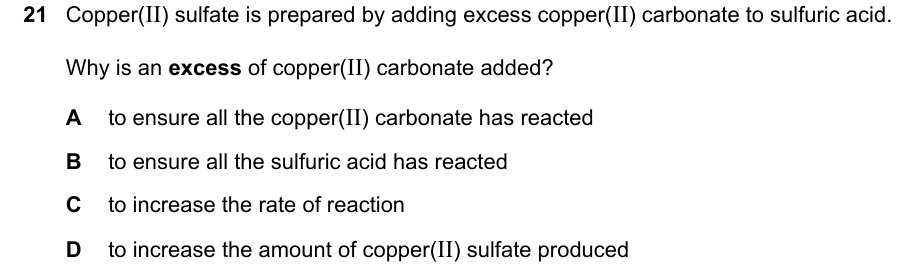
The solid is used in excess so that all of the acid reacts: the product then contains no acid, and unreacted solid is easily removed by filtration. The metal must be one that reacts with dilute acid (magnesium, zinc, iron) — copper, for example, does not, so copper salts are made from copper(II) oxide or carbonate.
Method 2: titration (acid + alkali)
Sodium, potassium and ammonium salts are made from an alkali (or soluble carbonate) and an acid. Both reactants are soluble, so an excess cannot be filtered off; instead the exact volumes that react are found by titration.
- Measure 25.0 cm3 of the alkali into a conical flask with a pipette; add a few drops of indicator (methyl orange or thymolphthalein).
- Add the acid from a burette, swirling, until the indicator just changes colour. Record the volume of acid.
- Repeat with the same volumes but no indicator, so that the salt is not contaminated.
- Evaporate to the point of crystallisation, cool, filter and dry the crystals.
In planning answers, the commonest omissions are stating that the solid is added in excess, naming a suitable container, and warming the acid. Observations that show the excess must be observations: “the solid stops dissolving” and “no more fizzing when more solid is added” — “the reaction stops” is not an observation. The solution passing through the filter paper is the filtrate; the solid left on the paper is the residue.
9Preparing insoluble salts by precipitation 7.3.4 Supplement
An insoluble salt is made by mixing two aqueous solutions: one containing its positive ion and one containing its negative ion. The salt forms immediately as a precipitate. Choose reactants that are soluble — nitrates and sodium or potassium salts are the safe choices.
Example: barium sulfate from aqueous barium chloride and aqueous sodium sulfate.
BaCl2(aq) + Na2SO4(aq) → BaSO4(s) + 2NaCl(aq)
Ba2+(aq) + SO42−(aq) → BaSO4(s)
- Mix the two solutions; a white precipitate forms.
- Filter; the barium sulfate is the residue on the filter paper.
- Wash the residue with distilled water to remove the soluble sodium chloride.
- Dry the solid between filter papers or in a warm oven.
The ionic equation for any precipitation has the two ions that make up the solid as the only reactants and the solid as the only product, with state symbols (aq) + (aq) → (s). An insoluble salt is not made by adding an excess solid to an acid, because the insoluble product could not be separated from the unreacted solid; and it is never crystallised from a solution.
10Hydrated and anhydrous salts 7.3.3, 7.3.5 CoreSupplement
A hydrated substance is a substance that is chemically combined with water. An anhydrous substance is a substance containing no water.
Supplement Water of crystallisation is the water molecules present in hydrated crystals, for example CuSO4·5H2O and CoCl2·6H2O.
The dot in CuSO4·5H2O shows that five water molecules are part of the crystal for every CuSO4; they are included when calculating Mr (250). Heating drives off the water of crystallisation and leaves the anhydrous salt (Topic 6). The number of water molecules can be found by heating a weighed sample to constant mass — so that all the water is removed — and comparing the moles of water lost with the moles of anhydrous salt left.
A sample of ZnSO4·xH2O of mass 0.574 g is heated to constant mass, leaving 0.322 g of ZnSO4 (Mr 161). Find x.
| Moles ZnSO4 | 0.322 ÷ 161 = 0.00200 mol |
| Mass of water | 0.574 − 0.322 = 0.252 g |
| Moles of water | 0.252 ÷ 18 = 0.0140 mol |
| Ratio | 0.0140 ÷ 0.00200 = x = 7 — ZnSO4·7H2O |
Attempt these before opening the solutions. Each reference gives the component, session and question number of the original examination; the answers follow the published mark scheme.
Solutions and mark-scheme guidance · set C
C1 Answer B
The carbonate is in excess to make sure all the sulfuric acid reacts, so no acid contaminates the salt; the excess is filtered off.
C2 Answer D
Filter off the excess base, evaporate the filtrate to the point of crystallisation, then crystallise.
C3 Answer B
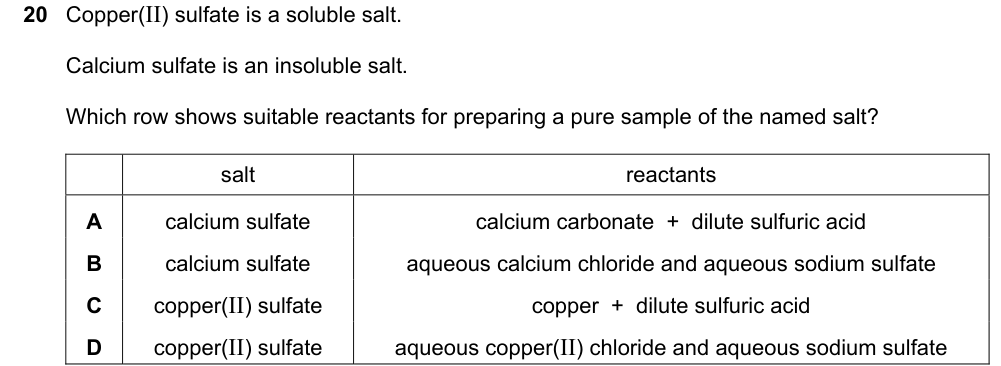
Calcium sulfate is insoluble, so it is made by precipitation from two solutions: aqueous calcium chloride and aqueous sodium sulfate. Copper does not react with dilute sulfuric acid. The most common answer, A, ignored the information that calcium sulfate is insoluble.
C4 Answer D
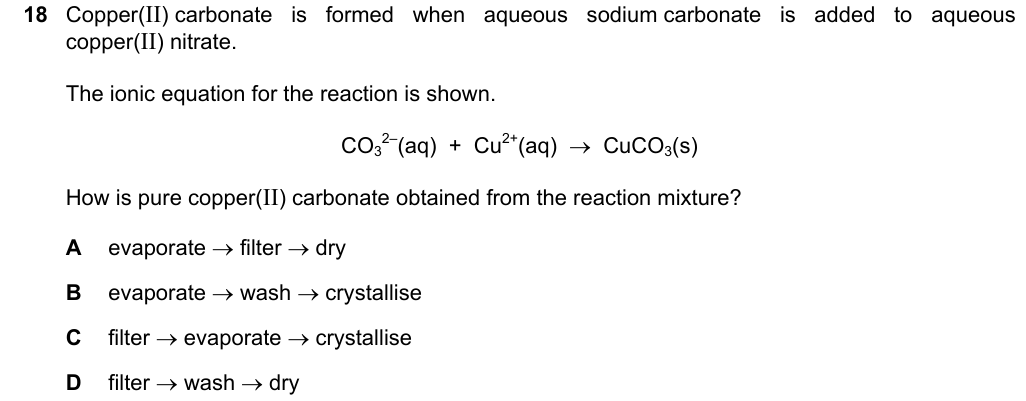
Copper(II) carbonate is a precipitate: filter, wash, dry the residue. Weaker candidates chose C, confusing the residue with the filtrate and crystallising.
C5 Answer A
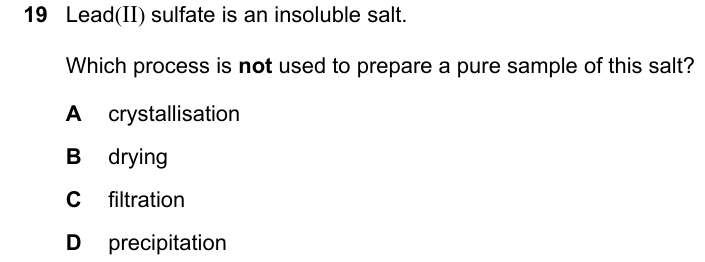
Crystallisation is used only for soluble salts. Lead(II) sulfate is made by precipitation, then filtered and dried. Most weaker candidates chose D.
C6 Answer C
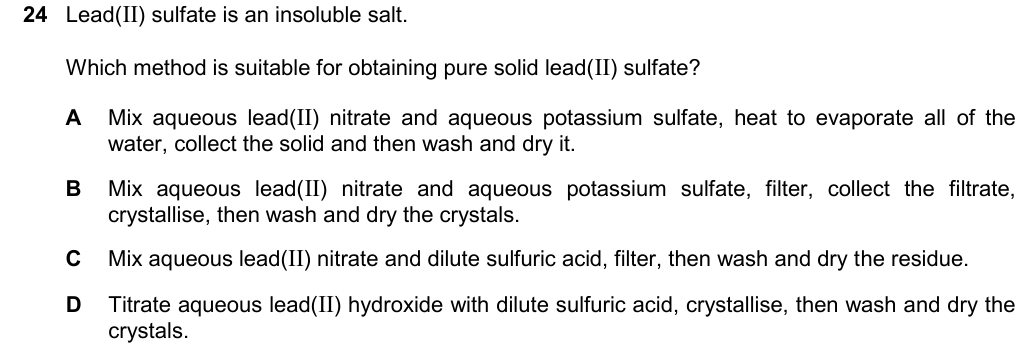
Mix two solutions containing Pb2+ and SO42−, filter, then wash and dry the residue. Option B, the commonest wrong answer, keeps the filtrate and crystallises it — the method for a soluble salt.
C7 [9]
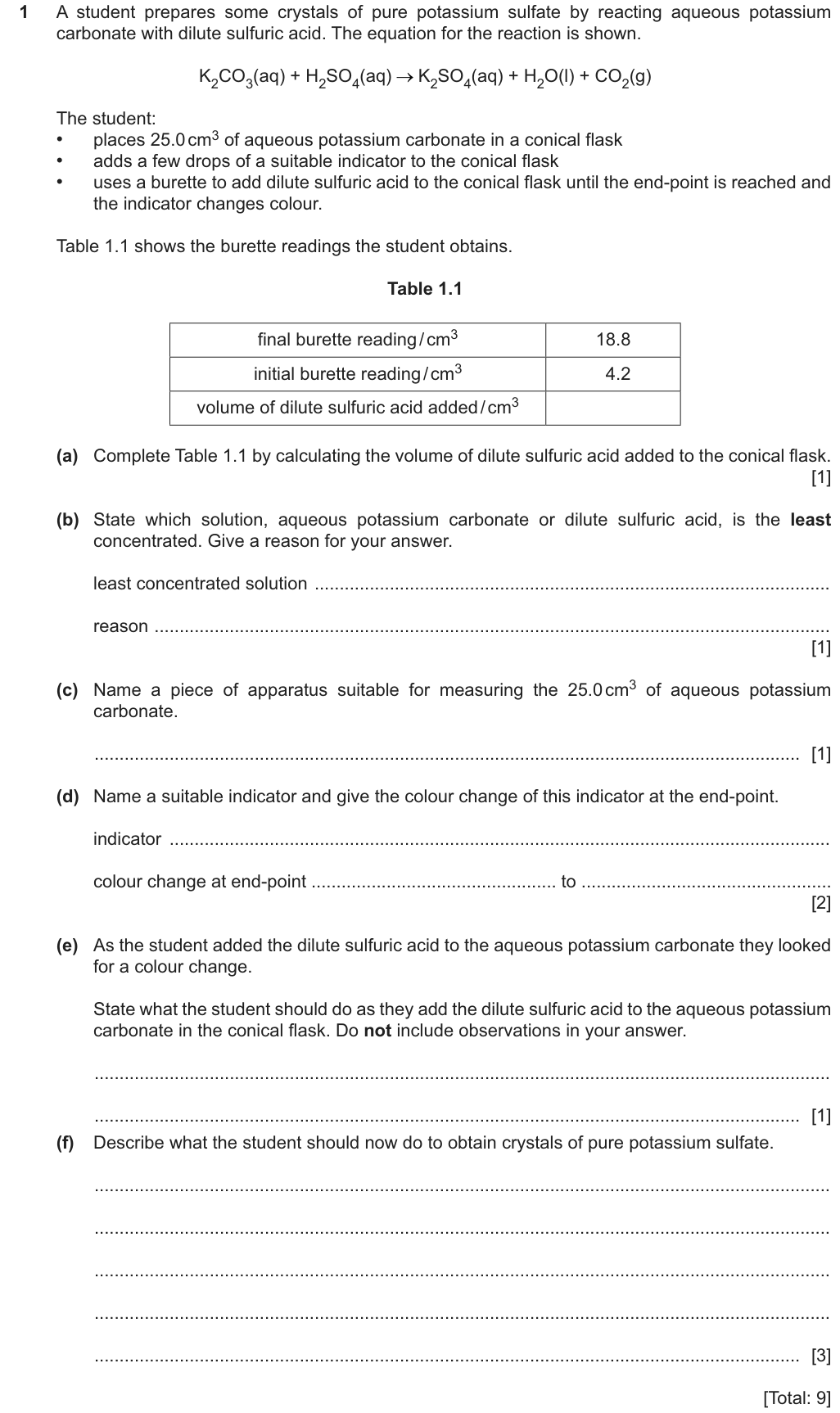
(a) 18.8 − 4.2 = 14.6 cm3 ✓.
(b) Potassium carbonate, because a larger volume of it was needed to react (25.0 cm3 against 14.6 cm3 in a 1 : 1 reaction) ✓.
(c) A (volumetric) pipette or burette ✓.
(d) Methyl orange ✓; yellow to orange ✓ at the end-point.
(e) Swirl the flask ✓.
(f) Mix 25.0 cm3 of potassium carbonate with 14.6 cm3 of acid without indicator ✓; warm until crystals start to form (point of crystallisation) ✓; leave to cool so crystals form ✓.
Examiner feedback: some added the burette readings. In (b) many named sulfuric acid, or argued from “dilute”, instead of using the volumes. Universal indicator is not suitable for a titration. In (f) many forgot to repeat without the indicator.
C8 [9]
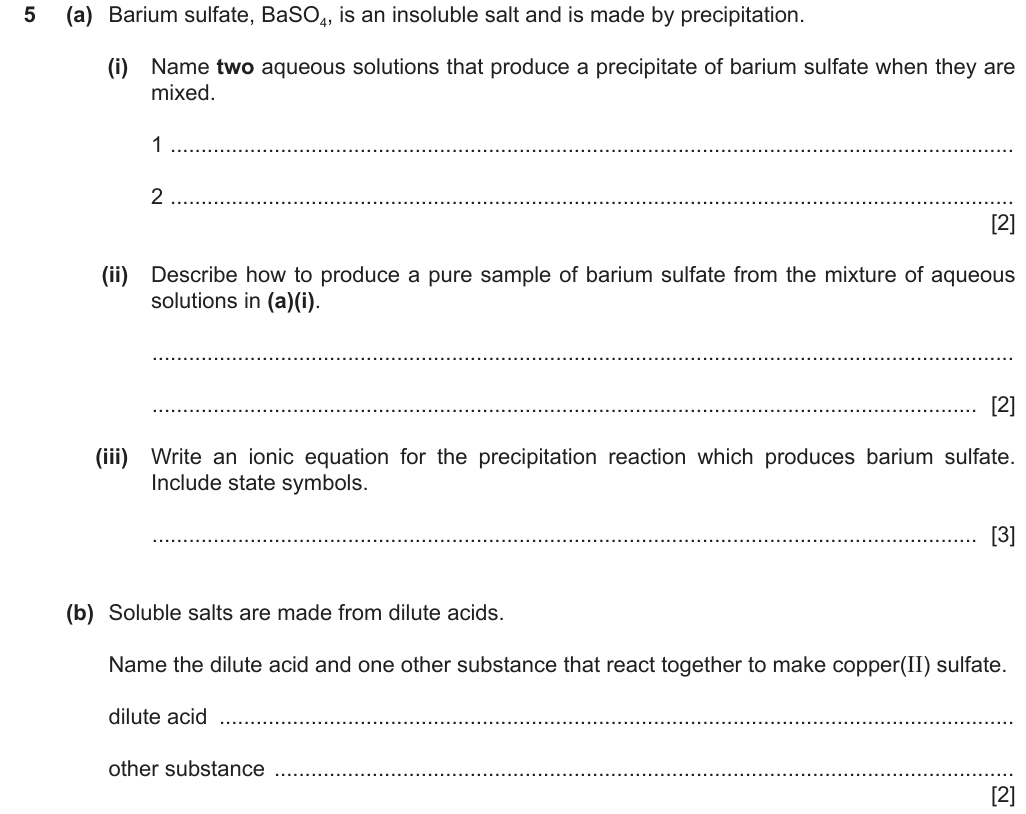
(a)(i) A soluble barium salt, e.g. barium chloride or barium nitrate ✓, and a soluble sulfate, e.g. sodium sulfate (or sulfuric acid) ✓.
(ii) Filter ✓; wash the residue with water and dry it ✓.
(iii) Ba2+(aq) + SO42−(aq) → BaSO4(s): BaSO4 only product ✓; Ba2+ and SO42− only reactants ✓; state symbols ✓.
(b) Sulfuric acid ✓ and copper(II) oxide, hydroxide or carbonate ✓.
Examiner feedback: many named solutions containing neither ion, insoluble barium compounds, or “barium and sulfur”. Many described crystallisation instead of filtering, washing and drying. Copper metal was a very common wrong answer in (b).
C9 [9]
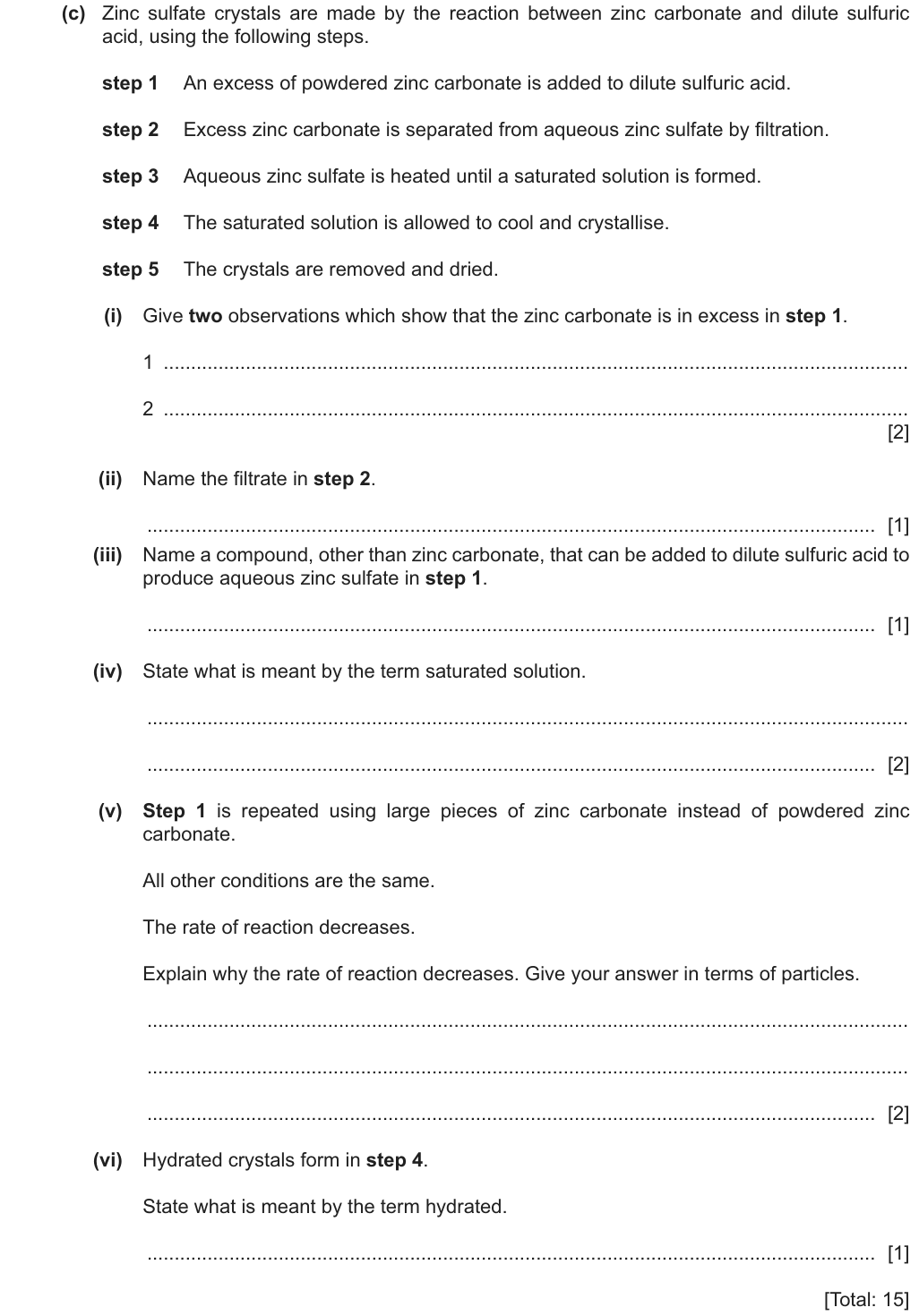
(i) The solid stops dissolving (remains) ✓; no more fizzing when more solid is added ✓.
(ii) Aqueous zinc sulfate ✓. (iii) Zinc oxide or zinc hydroxide ✓.
(iv) A solution containing the maximum concentration of solute dissolved in the solvent ✓ at a specified temperature ✓.
(v) Large pieces have a smaller surface area ✓, so the frequency of collisions between particles decreases ✓.
(vi) Chemically combined with water ✓.
Examiner feedback: “no more gas is produced” and “the reaction stops” are not observations; many wrote “bubbling” instead of “bubbling stops”. Zinc carbonate was often given as the filtrate. Zinc nitrate and zinc chloride were common wrong answers in (iii). The temperature condition was often missing from the definition of saturated.
C10 [3]
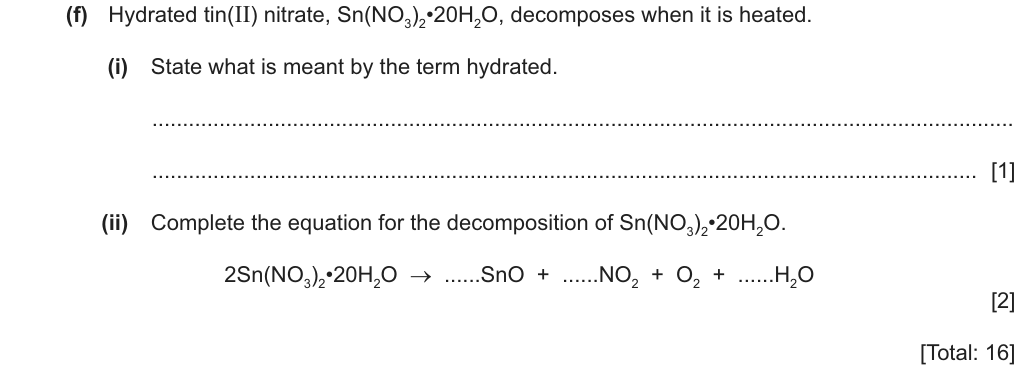
(i) Chemically combined with water (contains water of crystallisation) ✓.
(ii) 2Sn(NO3)2·20H2O → 2SnO + 4NO2 + O2 + 40H2O: 2 and 4 ✓; 40 ✓.
Examiner feedback: very few referred to the water being chemically combined.
Review · Topic 7
11Misconceptions and the examiner’s view
- “A strong acid is a concentrated acid.” Strength is the degree of dissociation; concentration is the amount per dm3.
- “Sulfuric acid has the lowest pH because it has two hydrogens.” Compare dissociation: the weak acid has the highest pH.
- “Metal oxides fizz with acids.” Only metals (hydrogen) and carbonates (carbon dioxide) produce gas.
- “All bases are alkalis.” Only soluble bases are alkalis.
- “Amphoteric means it reacts with neither acids nor bases.” It reacts with both, forming a salt and water.
- “Every salt is crystallised from the filtrate.” Insoluble salts are collected as the residue, washed and dried.
- “Copper sulfate can be made from copper and dilute sulfuric acid.” Copper does not react with dilute acids; use copper(II) oxide or carbonate.
- “The excess solid increases the yield.” The excess ensures all the acid is used up so that the salt is pure.
Candidates generally know the definitions of strong and weak acids in terms of complete and partial dissociation, but many still link strength with concentration or with the number of hydrogen atoms in the formula, and explanations that say “more H+ ions” or “strong dissociation” simply repeat the question. Indicator colours are mostly known, but observations for acid reactions are insecure: metal oxides are wrongly expected to fizz. Amphoteric is usually defined correctly, but equations using an unfamiliar oxo-anion are rarely balanced. Salt preparation is the area of greatest weakness: plans omit the excess, the container or warming; observations are replaced by statements such as “the reaction stops”; filtrate and residue are confused; insoluble salts are crystallised; copper metal is suggested as a reactant; and ionic equations for precipitation are written with atoms or full formulae instead of the two ions and the solid, with state symbols (aq) + (aq) → (s). Definitions from the syllabus — saturated solution, hydrated — lose marks when a key phrase such as “at a specified temperature” or “chemically combined” is omitted. Strong answers name substances fully, use the data given, and choose a method by first deciding whether the salt is soluble.
12Summary and knowledge organiser
Essential knowledge
- Acids: H+(aq), proton donors. Alkalis: OH−(aq), soluble bases. Bases: metal oxides and hydroxides, proton acceptors.
- Acid + metal → salt + H2; acid + base → salt + water; acid + carbonate → salt + water + CO2; base + ammonium salt → salt + water + NH3.
- Neutralisation: H+(aq) + OH−(aq) → H2O(l).
- Strong acid completely dissociated (HCl → H+ + Cl−); weak acid partially (CH3COOH ⇌ H+ + CH3COO−).
- Metal oxides basic; non-metal oxides acidic; Al2O3 and ZnO amphoteric.
- Soluble salt: excess insoluble solid + acid, or titration; then crystallise. Insoluble salt: precipitation, filter, wash, dry.
Examination checklist
- Indicator colours: litmus red/blue; methyl orange red/yellow; thymolphthalein colourless/blue.
- Explain strength with “completely / partially dissociated”.
- Decide soluble or insoluble first, using the six rules.
- Say “in excess”, “filter”, “point of crystallisation”, “cool”; for precipitates “filter, wash, dry”.
- Precipitation ionic equation: two ions → one solid, (aq) + (aq) → (s).
- Definitions: hydrated = chemically combined with water; saturated = maximum solute at a specified temperature.
Knowledge organiser · acids, bases and salts
| Idea | What to know | Must-remember distinctions and common errors |
|---|---|---|
| Acid reactions 7.1.1, 7.1.4 | With metals, bases, carbonates; bases with ammonium salts. | Only metals and carbonates fizz. |
| Indicators, pH 7.1.2, 7.1.5, 7.1.7 | Three indicators; universal indicator and pH 0–14. | Lower pH = higher [H+]; UI not for titrations. |
| Ions, neutralisation 7.1.3, 7.1.6, 7.1.8 | H+(aq), OH−(aq); H+ + OH− → H2O. | Alkali = soluble base. |
| Proton transfer, strength 7.1.9–12 | Donor / acceptor; complete / partial dissociation. | Strength ≠ concentration; → for HCl, ⇌ for CH3COOH. |
| Oxides 7.2.1–3 | Basic (CuO, CaO), acidic (SO2, CO2), amphoteric (Al2O3, ZnO). | Amphoteric: acids and bases → salt + water. |
| Soluble salts 7.3.1–2 | Excess solid + acid, filter, crystallise; titration for Na, K, NH4. | Excess uses up all the acid. |
| Insoluble salts 7.3.4 | Mix two solutions; filter, wash, dry. | Residue, not filtrate; never crystallise. |
| Hydrates 7.3.3, 7.3.5 | Hydrated, anhydrous, water of crystallisation. | Heat to constant mass to find x. |