
Topic 1 of the syllabus: 1.1 Solids, liquids and gases and 1.2 Diffusion. Core statements 1.1.1–1.1.4 and 1.2.1 are required of every candidate; Supplement statements 1.1.5, 1.1.6 and 1.2.2 are required for the Extended papers.
Central idea: every property of a solid, a liquid or a gas — its shape, its volume, whether it can be squashed, how it spreads — follows from how far apart its particles are, how they are arranged and how they move.
Before you start
- All matter is made of tiny particles: atoms, molecules or ions. In this topic the word particle stands for whichever of these the substance contains.
- Particles attract one another. The strength of these attractions differs from substance to substance.
- Particles are always moving. Heating a substance transfers energy to its particles.
Learning objectives
- State the distinguishing properties of solids, liquids and gases.
- Describe each state in terms of particle separation, arrangement and motion.
- Describe melting, boiling, evaporating, freezing and condensing.
- Describe how temperature and pressure change the volume of a gas, and explain these changes with kinetic particle theory. Supplement
- Explain changes of state with kinetic particle theory and interpret heating and cooling curves. Supplement
- Describe and explain diffusion, and the effect of relative molecular mass on the rate of diffusion of gases. Supplement
Introduction: one substance, three sets of properties
Water in a freezer is a hard block that keeps its shape. Poured from a jug it flows and takes the shape of the glass. Boiled in a kettle it becomes an invisible gas that escapes and spreads through the whole kitchen. Nothing about the water molecules themselves has changed — each is still one oxygen atom bonded to two hydrogen atoms. What has changed is how close the molecules are, how they are arranged and how fast they move. The kinetic particle theory uses exactly these three ideas to explain the properties of the three states and what happens when one state changes into another.
1.1 · Solids, liquids and gases
1The distinguishing properties of the three states 1.1.1 Core
The three states can be told apart by three observable properties: whether the sample has a fixed shape, whether it has a fixed volume, and whether it can be compressed (squashed into a smaller volume). A fourth property, whether the sample can flow, follows from the first.
| Property | Solid | Liquid | Gas |
|---|---|---|---|
| Shape | fixed | takes the shape of the bottom of its container | takes the shape of the whole container |
| Volume | fixed | fixed | no fixed volume — fills any container it is put in |
| Can it flow? | no | yes | yes |
| Can it be compressed? | no (very slightly) | no (very slightly) | yes, easily |
| Density | high | high, usually a little lower than the solid | very low |
Notice the pattern. The solid and the liquid have nearly the same density and neither can be squashed; the gas is about a thousand times less dense and is easily squashed. The solid and the liquid differ in something else — whether the particles can move past one another. These two observations point directly to the particle model in the next section.
2Separation, arrangement and motion of particles 1.1.2 Core
Describe a state using three separate ideas, and keep them separate in your answers:
- Separation — how far apart the particles are (touching, or far apart).
- Arrangement — how organised the particles are (a regular pattern, or random).
- Motion — how the particles move (vibrating about fixed positions, sliding past each other, or moving rapidly in all directions).
| State | Separation | Arrangement | Motion | Property explained |
|---|---|---|---|---|
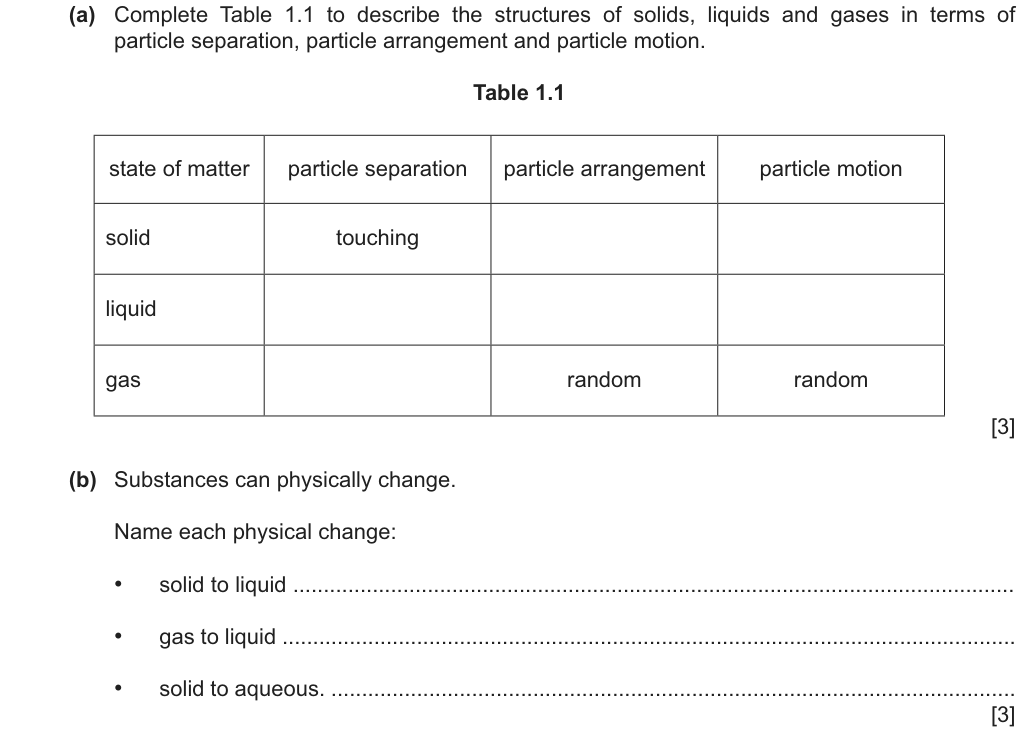
| Solid | touching (very close) | regular | vibrate about fixed positions | Fixed shape: particles cannot move out of position. Cannot be compressed: no space between particles. |
| Liquid | touching (very close) | random | move around, sliding past each other | Flows and takes the container's shape: particles can move past each other. Fixed volume and cannot be compressed: particles still touching. |
| Gas | far apart | random | move rapidly and randomly in all directions | Fills its container: particles move freely in every direction. Easily compressed: large spaces between particles. |
When a table asks for separation, arrangement and motion, a single term in each box is enough: touching / far apart for separation; regular (or uniform) / random for arrangement; vibrate / move (slide) past each other / move randomly and fast for motion. Long descriptions are not needed, and a word that belongs in another column earns nothing.
“Particles in a solid do not move.” They do — they vibrate about fixed positions. “Fixed positions” describes where the particles are held, not an absence of motion. Their vibration increases as the solid is heated.
The regular arrangement is the usual school model of a solid. Some solids, such as glass, have particles that are close together but not in a regular pattern; the model still explains why they keep their shape.
3Changes of state 1.1.3 Core
Heating or cooling a substance can change its state. Each change has its own name, and each can be reversed. A change of state is a physical change: the particles themselves are unchanged, so no new substance is formed.
Melting: solid → liquid, at the melting point. Freezing: liquid → solid; a pure substance freezes at the same temperature as it melts. Boiling: liquid → gas, taking place throughout the liquid, with bubbles of gas forming inside it, at the boiling point. Evaporation: liquid → gas, taking place only at the surface of the liquid, at any temperature below the boiling point. Condensation: gas → liquid; a pure substance condenses at the same temperature as it boils.
Boiling compared with evaporation
A puddle dries on a cool day, and wet washing dries on a line, without the water ever reaching 100 °C. This is evaporation. The two processes give the same product but differ in where and when they happen:
| Boiling | Evaporation | |
|---|---|---|
| Where | throughout the liquid (bubbles form inside) | at the surface only |
| Temperature | only at the boiling point | at any temperature below the boiling point |
| Rate | fast | slow; faster when warmer, when the surface area is larger and in a draught |
Melting points and boiling points are useful as a test of purity. A pure substance melts and boils at fixed temperatures; an impurity lowers the melting point and raises the boiling point, and makes the substance melt over a range of temperatures. This idea returns in Topic 12.
Water, H2O, melts at 0 °C and boils at 100 °C. State its physical state at −10 °C, at 25 °C and at 120 °C. Answer: solid, liquid, gas. At exactly 0 °C solid and liquid can exist together; at exactly 100 °C liquid and gas can exist together.
4Explaining changes of state with kinetic particle theory 1.1.5 Supplement
Two quantities describe the particles in a sample. Their kinetic energy is the energy of their motion; temperature is a measure of the average kinetic energy of the particles. The forces of attraction between particles hold them together; separating particles means overcoming these attractions, and that needs energy.
Melting. Heating a solid makes its particles vibrate more strongly. At the melting point they have enough energy to overcome some of the attractive forces that hold them in fixed positions. The particles are still touching, but the regular arrangement breaks down and they can move past one another.
Boiling. Heating a liquid makes its particles move faster. At the boiling point they have enough energy to overcome the remaining attractive forces completely. The particles separate and move far apart, forming bubbles of gas throughout the liquid.
Evaporation. At any temperature the particles of a liquid have a range of energies. Some particles at the surface have enough energy to overcome the attractions of their neighbours and escape. Because the most energetic particles leave, the average kinetic energy of those that remain falls, so the liquid cools — this is why evaporating sweat cools the skin.
Condensation and freezing are the reverse. As a gas cools, its particles slow down; attractive forces pull them together into a liquid, and energy is released to the surroundings. As a liquid cools further, the particles slow until the attractions hold them in fixed positions in a regular arrangement: the liquid freezes, again releasing energy.
Ask two questions of any change: does the average kinetic energy change? (then the temperature changes) and are attractions being overcome or formed? (then the state changes). During a change of state the first answer is “no” and the second is “yes”.
“When water boils the molecules break up into hydrogen and oxygen.” A change of state overcomes the forces between molecules; the covalent bonds within each molecule are untouched. Steam is still H2O.
5Interpreting heating and cooling curves 1.1.5 Supplement
If a pure solid is heated at a steady rate and its temperature is recorded every minute, a graph of temperature against time — a heating curve — has a characteristic shape of sloping sections separated by flat sections (Figure 1.3).
Sloping sections. Only one state is present. The energy supplied increases the kinetic energy of the particles, so the temperature rises.
Flat sections. Two states are present together. Energy is still being supplied, but it is used to overcome the attractive forces between particles rather than to increase their kinetic energy, so the temperature stays constant until the change of state is complete.
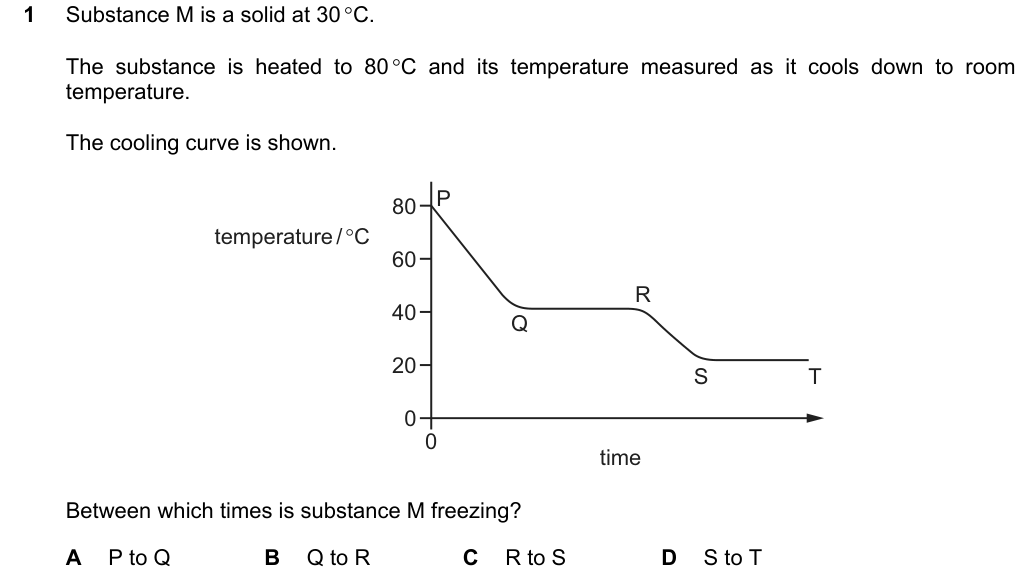
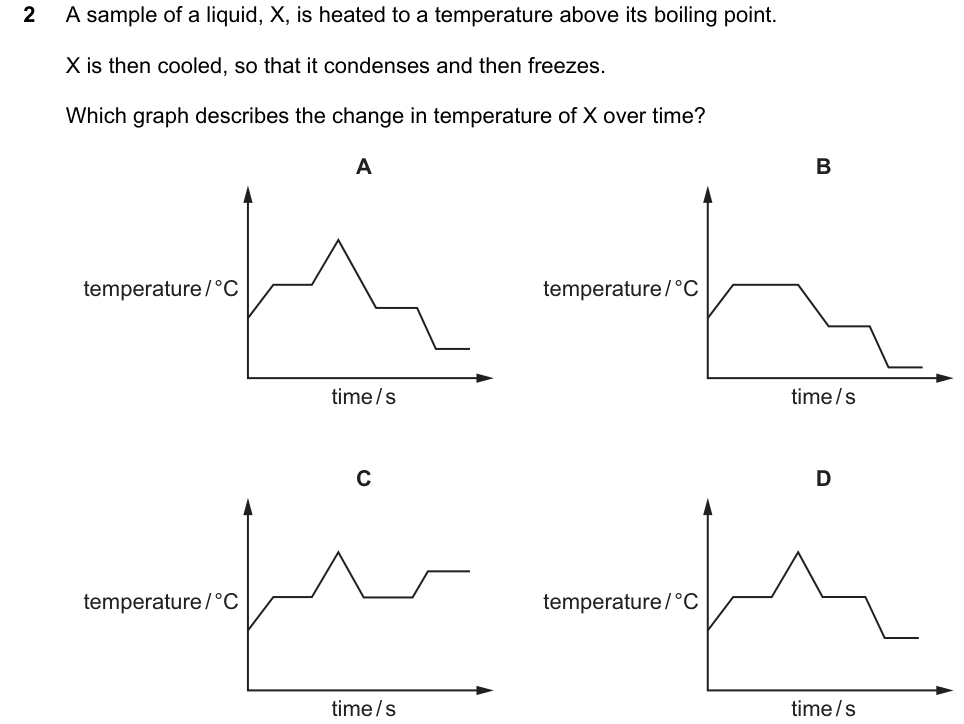
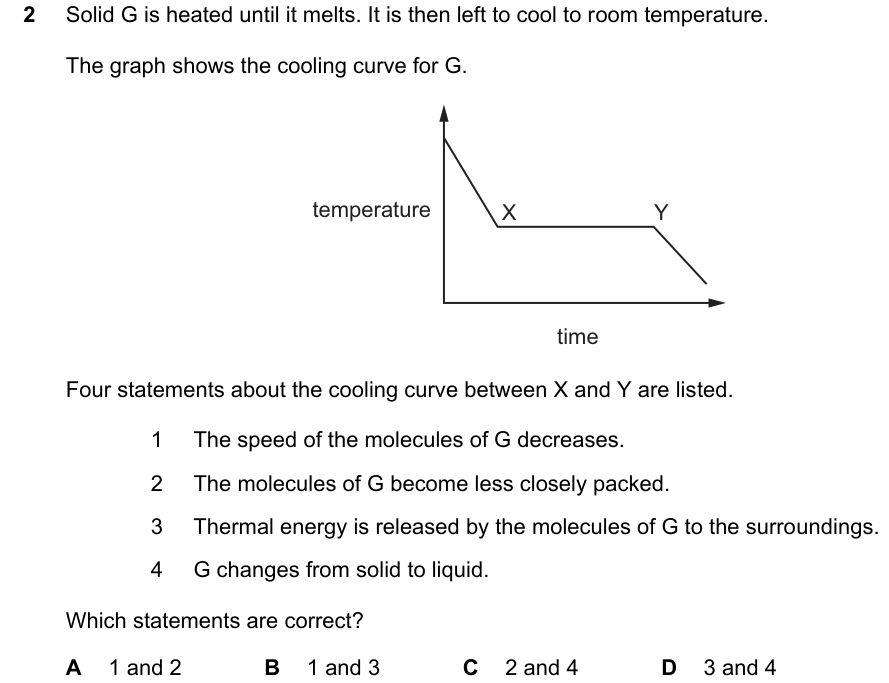
A cooling curve is the reverse: temperature falls on the sloping sections, and stays constant during condensation (at the boiling point) and during freezing (at the melting point). On the flat sections energy is being released to the surroundings as attractive forces form, which is why the temperature does not fall even though heat is being lost. A flat section at the very end of a cooling curve simply means the sample has reached room temperature — it is not a change of state.
Cooling curves have been found hard. Weaker answers pick sections where the temperature is changing as the places where the state changes; others do not realise that the temperature at which a liquid boils is the same temperature at which its gas condenses, so the two flat sections on a heating and a cooling curve must be at the same height. Horizontal sections are either a change of state or, at the end of a cooling curve, a sample that has reached room temperature.
A liquid is cooled from 90 °C. Its temperature falls to 44 °C, stays at 44 °C for four minutes, then falls to 22 °C and stays there. (a) What happens at 44 °C? (b) What is happening in the last section? (c) The substance was pure — how do you know?
| (a) | The liquid is freezing. The temperature is constant because energy released as attractions form between the particles balances the energy lost to the surroundings. |
| (b) | The solid has reached room temperature (22 °C); there is no further change of state. |
| (c) | It froze at a single, sharp temperature. An impure substance freezes over a range of temperatures. |
6The effect of temperature and pressure on the volume of a gas 1.1.4 Core
Because a gas has no fixed volume, its volume depends on the conditions. For a fixed amount of gas:
- increasing the temperature at constant pressure increases the volume of the gas; cooling decreases it;
- increasing the pressure at constant temperature decreases the volume of the gas; reducing the pressure increases it.
Both statements need the other condition to be held constant. A gas in a sealed, rigid container cannot change its volume at all: heating it increases its pressure instead. This is why gas volumes are always quoted at a stated temperature and pressure — in Topic 3 you will use the molar volume, 24 dm3 at room temperature and pressure.
7Explaining the effect of temperature and pressure on gas volume 1.1.6 Supplement
A gas exerts a pressure because its particles are constantly colliding with the walls of the container. Each collision pushes on the wall; the pressure depends on how often the particles hit each unit of area of the wall and how hard they hit it.
Raising the temperature at constant pressure. The particles gain kinetic energy and move faster. They collide with the walls and the piston more often and with more force, so the gas pushes the piston outwards. As the volume increases, the particles have further to travel between collisions and the collisions with each unit of area of wall become less frequent, until the pressure of the gas again matches the external pressure. The result is a larger volume.
Raising the pressure at constant temperature. The piston is pushed inwards. The same number of particles, moving at the same average speed, now occupy a smaller space, so they collide with each unit of area of the walls more frequently. The piston stops moving when the gas pressure has risen to match the new external pressure. The result is a smaller volume.
The particles do not expand when a gas is heated, and they do not shrink when it is compressed. The spaces between the particles change. The number of particles does not change either — the amount of gas is fixed.
A sealed plastic bottle of air is taken from a warm room into a freezer and becomes slightly crushed. Explain why. Answer: the air particles lose kinetic energy and move more slowly, so they hit the walls less often and with less force; the gas pressure inside falls below the atmospheric pressure outside, which pushes the walls in and reduces the volume.
Attempt these before opening the solutions. Each reference gives the component, session and question number of the original examination; the answers follow the published mark scheme.
Solutions and mark-scheme guidance · set A
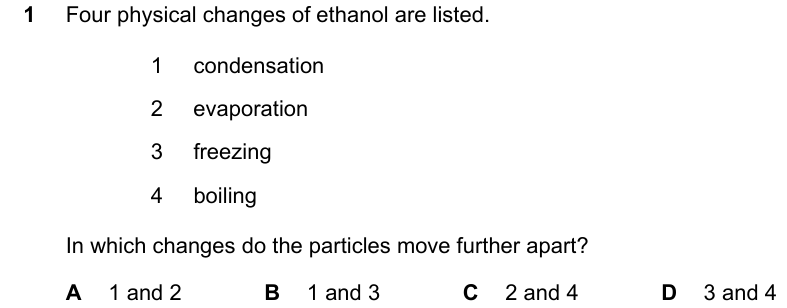
A1 Answer C
Particles move further apart when a liquid becomes a gas: evaporation (2) and boiling (4). Condensation brings gas particles together and freezing locks liquid particles into fixed positions, so both bring particles closer or keep them touching.
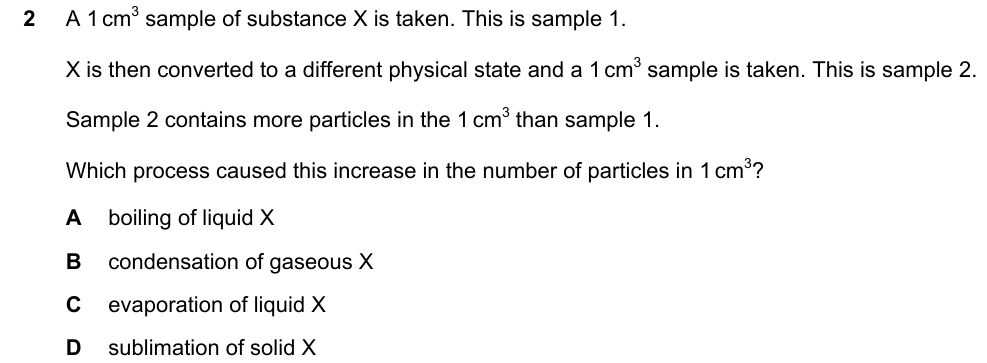
A2 Answer B
More particles in the same 1 cm3 means the particles have become closer together. Only condensation of gaseous X does this: gas particles are far apart, liquid particles touch. Boiling, evaporation and sublimation all produce a gas, so the particles move further apart.
A3 Answer B
A pure substance freezes at constant temperature, so freezing is a horizontal section. The first horizontal section, Q to R, is freezing. The final horizontal section, S to T, is at about 20 °C: the solid has reached room temperature, which is not a change of state. Options C and D, both sloping or at room temperature, were the most common wrong answers.
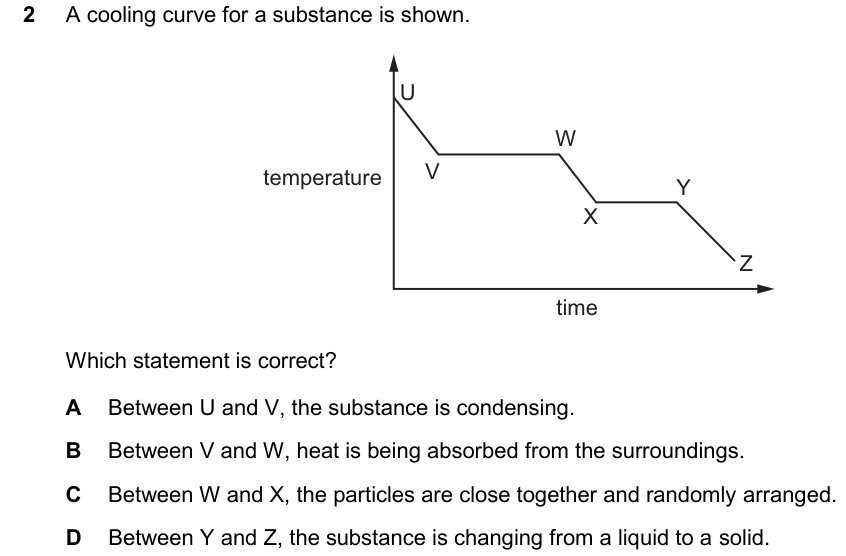
A4 Answer C
Between W and X the temperature is falling after the first flat section. On a cooling curve, the first flat section (V to W) is condensation, so W to X is liquid cooling: particles close together and randomly arranged. U to V is gas cooling, not condensing (A); V to W releases heat to the surroundings rather than absorbing it (B); the substance freezes on the next flat section (X to Y), not from Y to Z (D). Choosing a section where the temperature is changing as the place where the state changes was the most common error.
A5 Answer D
The graph must show: temperature falling (gas cooling), a flat section at the boiling point while it condenses, falling again (liquid cooling), and a second flat section at the melting point while it freezes, then falling (solid cooling). The flat condensation section must be at the same temperature as the boiling point the liquid was heated through. D is the only graph with this shape. Just over a third of candidates chose it.
A6 Answer B
X to Y is a sloping section: the liquid is cooling. (1) The molecules slow down — correct. (3) Thermal energy is lost to the surroundings — correct. (2) is wrong: cooling brings the molecules closer together. (4) is wrong: G changes from liquid to solid, and that happens on a flat section, not here.
A7 [6]
(a) Solid: separation touching, arrangement regular (uniform), motion vibrate. Liquid: separation touching, arrangement random, motion random / slide past each other. Gas: separation far apart, arrangement random, motion random. One mark for each correctly completed row ✓✓✓.
(b) solid → liquid: melting ✓; gas → liquid: condensing (condensation) ✓; solid → aqueous: dissolving ✓.
Examiner feedback: many candidates wrote long descriptions where one word was needed, and put descriptions in the wrong column — “touching” (a separation) under arrangement. “Solid to aqueous” was often answered as sublimation or melting.
1.2 · Diffusion
8Diffusion and kinetic particle theory 1.2.1 Core
Open a bottle of perfume at one side of a room and it can soon be smelled on the other side, although nothing has blown it there. Drop a crystal of purple potassium manganate(VII) into a beaker of still water and, over an hour or so, the purple colour spreads until the whole solution is evenly coloured. Both are examples of diffusion.
Diffusion is the net movement of particles from a region of higher concentration to a region of lower concentration, as a result of the random motion of the particles.
Diffusion needs no stirring and no pumping; it happens because particles are always moving in random directions and colliding with each other. Consider an imaginary boundary between a region with many perfume molecules and a region with few. Molecules cross the boundary in both directions, but because there are more of them on the concentrated side, more cross from that side than return in the same time. The net effect is a spreading out. When the concentration is the same everywhere, the particles are still moving and still crossing any boundary, but equal numbers cross each way, so there is no further overall change.
Diffusion is fast in gases and slow in liquids. In a gas the particles move rapidly and are far apart, so each travels a relatively long way between collisions. In a liquid the particles are touching, so a particle collides with its neighbours constantly and its progress in any one direction is very slow. Diffusion through a solid is negligible at room temperature because the particles only vibrate about fixed positions. At a higher temperature, particles move faster and diffusion is faster.
Asked why gases diffuse, many candidates describe the result (“the gases spread out and mix”) instead of the cause. The explanation needs both ideas together: particles and their random movement. “Random movement of gases” and “particles move” on their own have each been judged insufficient. Diffusion should not be confused with Brownian motion.
9Relative molecular mass and the rate of diffusion of gases 1.2.2 Supplement
At the same temperature, the particles of all gases have the same average kinetic energy. Kinetic energy depends on both mass and speed, so lighter molecules must move faster on average than heavier ones. The gas with the lower relative molecular mass, Mr, therefore diffuses faster.
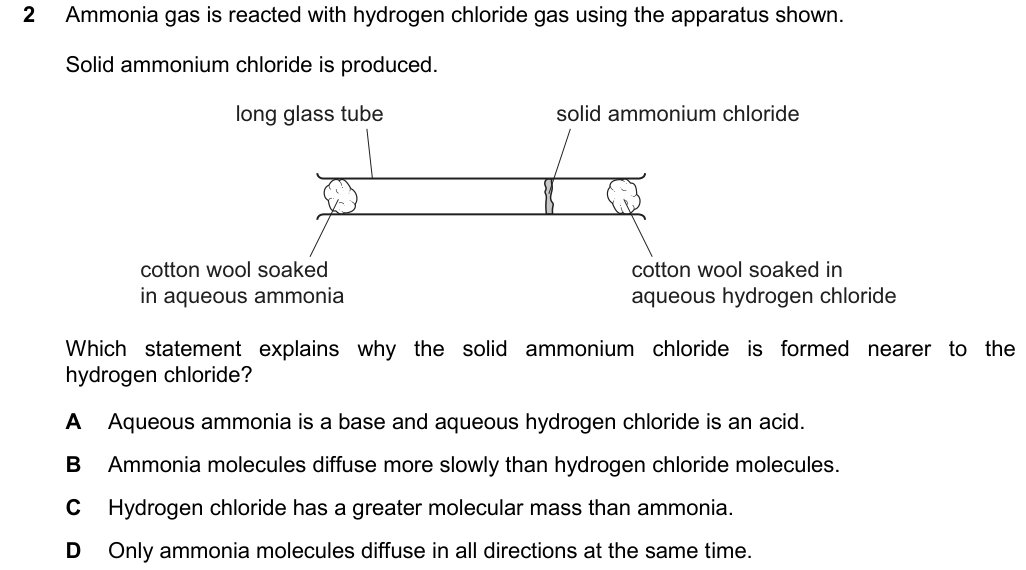
The classic demonstration uses a long glass tube with cotton wool soaked in concentrated aqueous ammonia at one end and cotton wool soaked in concentrated hydrochloric acid at the other. Ammonia gas, NH3, and hydrogen chloride gas, HCl, diffuse along the tube towards each other. Where they meet, they react to form a white ring of solid ammonium chloride:
NH3(g) + HCl(g) → NH4Cl(s)
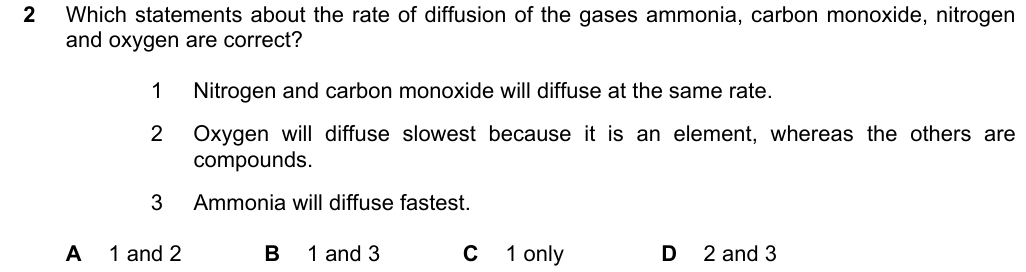
The accepted reason is that the faster gas has a lower relative molecular mass (lower Mr). Answers such as “it is lighter”, “it is less dense”, “it has a lower Ar” or “it has fewer atoms” have not been credited. Two gases with the same Mr — carbon monoxide and nitrogen, both 28 — diffuse at the same rate.
The white ring forms near the end with the slower gas. Candidates who remember that “diffusion rate matters” but reverse the direction choose the answer that ammonia diffuses more slowly, the opposite of what is observed.
Put CO2, CH4, H2 and SO2 in order of rate of diffusion, fastest first, at the same temperature.
| Mr values | H2 = 2; CH4 = 12 + 4 = 16; CO2 = 12 + 32 = 44; SO2 = 32 + 32 = 64 |
| Rule | lower Mr → faster average speed → faster diffusion |
| Order | H2 > CH4 > CO2 > SO2 |
| Check | The number of atoms in the molecule is irrelevant: CH4 has five atoms but diffuses faster than CO (Mr 28), which has two. |
Attempt these before opening the solutions. Each reference gives the component, session and question number of the original examination; the answers follow the published mark scheme.

Solutions and mark-scheme guidance · set B
B1 Answer C
Ammonia (Mr 17) has a lower relative molecular mass than hydrogen chloride (Mr 36.5), so its molecules move faster and it travels further in the same time; the solid forms nearer the HCl end. The reason offered in C — hydrogen chloride has the greater molecular mass — is the correct explanation. Fewer than half of candidates chose it; many picked B, which recalls that diffusion rate matters but states the opposite of what happens.
B2 Answer B
Mr: NH3 17, CO 28, N2 28, O2 32. (1) N2 and CO have the same Mr, so they diffuse at the same rate — correct. (3) NH3 has the lowest Mr, so it diffuses fastest — correct. (2) is wrong: whether a substance is an element or a compound has no bearing on its rate of diffusion; only Mr does.
B3 Answer A
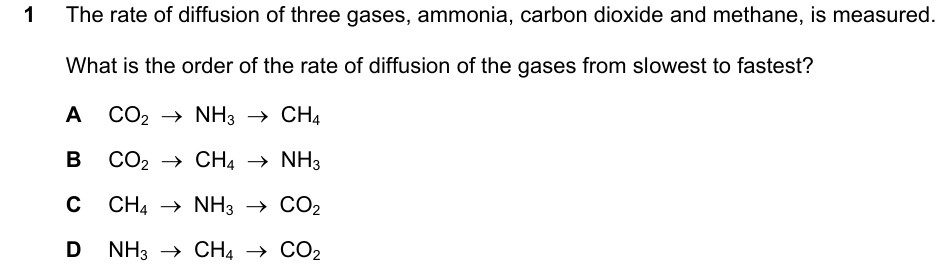
Mr: CO2 44, NH3 17, CH4 16. Slowest to fastest is highest to lowest Mr: CO2, NH3, CH4. NH3 and CH4 differ by only 1, but the rule still decides the order.
B4 [2]
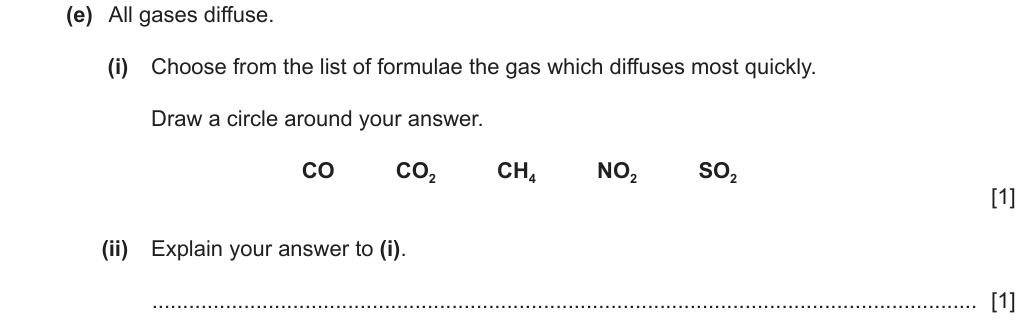
(i) CH4 ✓ (Mr values: CO 28, CO2 44, CH4 16, NO2 46, SO2 64).
(ii) It has the lowest relative molecular mass ✓.
Examiner feedback: many chose CO, presumably because it has the fewest atoms. “Lightest gas” and “lowest relative atomic mass” were not accepted.
B5 [1]
But-1-ene has a lower relative molecular mass than butane ✓ (C4H8 = 56, C4H10 = 58).
Examiner feedback: “lighter”, “less dense”, “lower Ar”, “two fewer H atoms” and “it has a double bond” were all seen and not credited.
B6 [2]
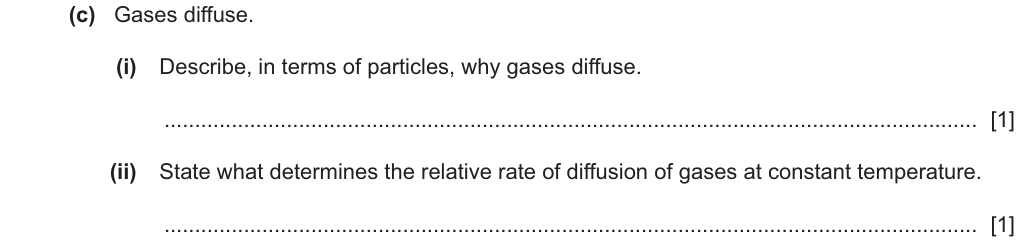
(i) The particles are in random motion (movement) ✓.
(ii) Their relative molecular mass ✓.
Examiner feedback: many answers described gases “spreading” instead of explaining how diffusion happens; very few gave relative molecular mass for (ii).
The published papers in this collection contain no question on the effect of temperature and pressure on the volume of a gas (1.1.4 and 1.1.6), so no past-paper item is given for those two statements; the quick check and the piston model above cover them.
Review · Topic 1
10Misconceptions and the examiner’s view
- “Particles in a solid are not moving.” They vibrate about fixed positions. Answers that say solids have “no motion” lose the motion mark.
- “Particles expand when heated.” The spaces between particles change; the particles themselves do not. A gas expands on heating because its particles move faster and push the piston out, not because each particle grows.
- “The temperature rises all the time while a substance is heated.” During a change of state the energy overcomes attractive forces, so the temperature stays constant.
- “The last flat part of a cooling curve is freezing.” It may simply be room temperature. Freezing is the flat section at the melting point.
- “Heavier gases diffuse faster because they have more energy.” At the same temperature all gases have the same average kinetic energy; the lighter molecules move faster.
- “Lighter gas” as an explanation. The accepted comparison is lower relative molecular mass.
Candidates generally name the changes of state correctly, but many cannot keep particle separation, arrangement and motion apart: descriptions appear in the wrong column, and long sentences are written where a single word such as “touching” or “random” is all that is required. “Solid to aqueous” (dissolving) is poorly known. Heating and cooling curves — new to this syllabus — have proved demanding: weaker candidates identify sloping sections as changes of state, confuse a final plateau at room temperature with freezing, and do not recognise that boiling and condensation occur at the same temperature. In diffusion questions the commonest weakness is describing the outcome (“the gas spreads out”) rather than the cause, which must mention particles and their random movement. The link between diffusion rate and relative molecular mass is often reversed or replaced by vague terms such as “lighter” or “lower Ar”; strong answers state that the gas with the lower Mr diffuses faster and use that to predict where the ammonium chloride ring forms.
11Summary and knowledge organiser
Essential knowledge
- Solids have a fixed shape and volume; liquids have a fixed volume but take the shape of their container; gases have neither and are easily compressed.
- Solid: particles touching, regular, vibrating. Liquid: touching, random, sliding past each other. Gas: far apart, random, moving fast in all directions.
- Melting, boiling and evaporating take in energy; freezing and condensing give it out. Boiling happens throughout a liquid at the boiling point; evaporation happens at the surface below it.
- On a heating or cooling curve, sloping sections change the kinetic energy of the particles; flat sections are changes of state, where attractive forces are overcome or formed at constant temperature.
- For a fixed amount of gas: volume increases with temperature (constant pressure) and decreases with pressure (constant temperature), because of changes in the frequency and force of collisions with the walls.
- Diffusion is the net movement of particles from high to low concentration by random motion. Gases with a lower Mr diffuse faster.
Examination checklist
- Give separation, arrangement and motion as three separate ideas, one word each where a table asks for it.
- On a curve, a change of state is a horizontal section; state that energy is used to overcome (or is released as) attractive forces between particles.
- Explain gas volume changes with collisions: how often and how hard particles hit the walls.
- Explain diffusion with particles + random movement; explain rate with lower relative molecular mass.
Knowledge organiser · states of matter
| Idea | What to know | Must-remember distinctions and common errors |
|---|---|---|
| Three states 1.1.1–2 | Solid: touching · regular · vibrate. Liquid: touching · random · slide. Gas: far apart · random · fast, all directions. | Solid particles do move (vibrate). Liquids and solids cannot be compressed; gases can. |
| Changes of state 1.1.3, 1.1.5 | Melting, freezing, boiling, evaporating, condensing. Energy overcomes attractions (in) or is released as attractions form (out). | Boiling: throughout, at b.p. Evaporation: surface, below b.p. No bonds inside molecules break. |
| Heating and cooling curves 1.1.5 | Slope: one state, temperature changing. Plateau: two states, temperature constant. | Condensing plateau = boiling point. Final plateau on cooling may be room temperature. |
| Gas volume 1.1.4, 1.1.6 | T ↑ (p constant) → V ↑. p ↑ (T constant) → V ↓. Pressure comes from collisions with walls. | Particles do not change size or number; the spaces change. |
| Diffusion 1.2.1–2 | Net movement high → low concentration by random motion. Lower Mr → faster. | Say “lower relative molecular mass”, not “lighter”. NH4Cl ring forms near the HCl end. |