
Topic 3 of the syllabus: 3.1 Formulae; 3.2 Relative masses of atoms and molecules; 3.3 The mole and the Avogadro constant. Nearly all of 3.3 is Supplement: Core candidates calculate reacting masses by simple proportion, without moles, and state the units of concentration.
Central idea: atoms are too small to count one by one, so chemists count them by weighing. The mole links the mass you can measure on a balance to the number of particles that react.
Before you start
- Symbols of the elements, and the charges of the common ions (Topic 2).
- Covalent substances are molecules; ionic substances are lattices whose formula gives the ratio of ions (Topic 2).
- Relative atomic mass, Ar, is a weighted average of isotope masses (Topic 2.3).
Learning objectives
- State formulae; define molecular formula and, Supplement empirical formula; deduce formulae from diagrams or ionic charges.
- Construct word and symbol equations with state symbols, and Supplement ionic equations.
- Describe Ar and define Mr; calculate reacting masses in simple proportion.
- Supplement Use the mole, the Avogadro constant and the molar gas volume; calculate reacting masses, limiting reactants, gas volumes, concentrations, titration results, empirical and molecular formulae, percentage yield, composition and purity.
Introduction: counting by weighing
A bank does not count coins one at a time: it weighs them, because every coin of one type has the same mass. Chemists face the same problem with atoms, but on an unimaginable scale — a teaspoon of water contains about 1.7 × 10²³ molecules. Because all atoms of one element (on average) have the same mass, weighing a sample tells you how many atoms it contains. A balanced equation tells you in what ratio particles react; the mole turns that ratio into grams, cubic decimetres of gas and cubic centimetres of solution.
3.1 · Formulae
1Formulae of elements and compounds 3.1.1–3.1.3 Core
A chemical formula shows which elements a substance contains and in what ratio. You are expected to know the formulae of all the elements and compounds named in the syllabus. For elements, remember that seven non-metals exist as diatomic molecules: H2, N2, O2, F2, Cl2, Br2, I2. Metals, carbon and silicon are written as single symbols (Cu, C, Si); the noble gases exist as single atoms (He, Ar).
The molecular formula of a compound is the number and type of different atoms in one molecule. Ethanol, C2H6O, has 2 carbon atoms, 6 hydrogen atoms and 1 oxygen atom in each molecule.
A formula can be read from a model or diagram by counting atoms. A ball-and-stick model with one carbon atom joined to four hydrogen atoms is CH4; a diagram with two nitrogen atoms joined to each other and four hydrogen atoms is N2H4. Write the symbols and put the number of each type of atom as a subscript after its symbol (the subscript 1 is never written).
2Ionic formulae and empirical formulae 3.1.5–3.1.6 Supplement
Ionic compounds have no molecules, so their formula is the simplest ratio of ions that makes the compound electrically neutral. Use the charges of the ions, including the polyatomic ions below. Brackets are needed when more than one polyatomic ion appears: calcium hydroxide is Ca(OH)2, not CaOH2.
| 1+ | 2+ | 3+ | 1− | 2− | 3− |
|---|---|---|---|---|---|
| H+, Li+, Na+, K+, Ag+, NH4+ | Mg2+, Ca2+, Ba2+, Cu2+, Fe2+, Zn2+, Pb2+ | Al3+, Fe3+, Cr3+ | F−, Cl−, Br−, I−, OH−, NO3− | O2−, S2−, SO42−, CO32−, SO32− | N3−, PO43− |
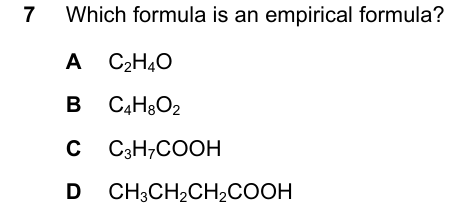
The empirical formula of a compound is the simplest whole-number ratio of the different atoms or ions in the compound.
For an ionic compound the formula is always an empirical formula. For a molecular compound the two can differ: ethene is C2H4 (molecular) but CH2 (empirical); glucose is C6H12O6 but CH2O. The molecular formula is always a whole-number multiple of the empirical formula.
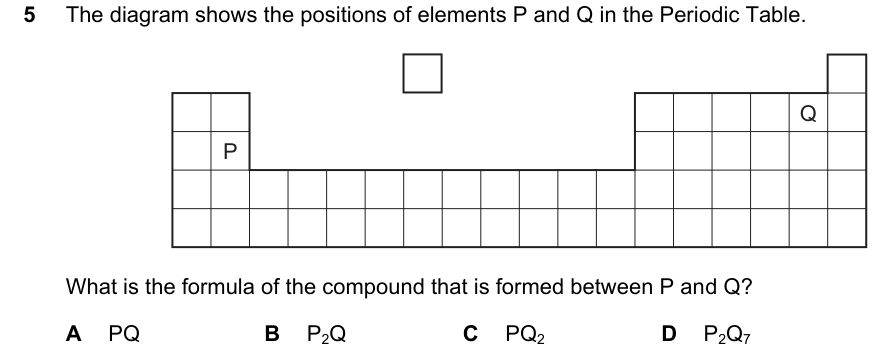
P is in Group II and Q in Group VII.
| Ions | P2+ (loses 2), Q− (gains 1) |
| Neutral | one P2+ balances two Q− → PQ2 |
| Trap | writing the group numbers as subscripts (P2Q7) ignores the charges |
3Word equations, symbol equations and ionic equations 3.1.4, 3.1.7–3.1.8 CoreSupplement
A word equation names the reactants and products: magnesium + oxygen → magnesium oxide. A symbol equation replaces names with formulae and is balanced so that the number of atoms of each element is the same on both sides, because atoms are neither created nor destroyed:
2Mg(s) + O2(g) → 2MgO(s)
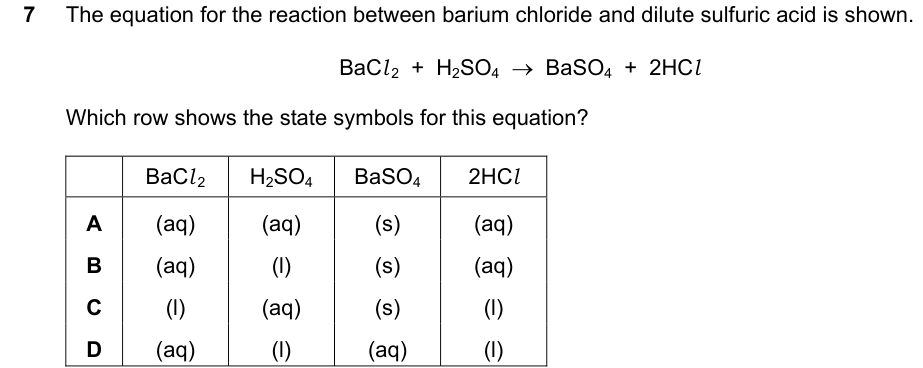
Balance by changing the numbers in front of formulae (coefficients), never the subscripts inside them — changing a subscript changes the substance. State symbols show the physical state: (s) solid, (l) liquid, (g) gas, (aq) aqueous, meaning dissolved in water. Solutions of acids are (aq), not (l); water itself is (l); a precipitate is (s).
Balance CH4 + O2 → CO2 + H2O.
| C | 1 on each side — leave it. |
| H | 4 on the left, so 2H2O on the right. |
| O | right side now has 2 + 2 = 4 O atoms, so 2O2 on the left. |
| Result | CH4(g) + 2O2(g) → CO2(g) + 2H2O(l) |
Supplement An ionic equation shows only the ions that take part in a reaction. Ions that are present in solution before and after the reaction without changing — spectator ions — are left out. To write one: write the full equation with state symbols; split every aqueous ionic compound into its ions; cancel ions that appear unchanged on both sides.
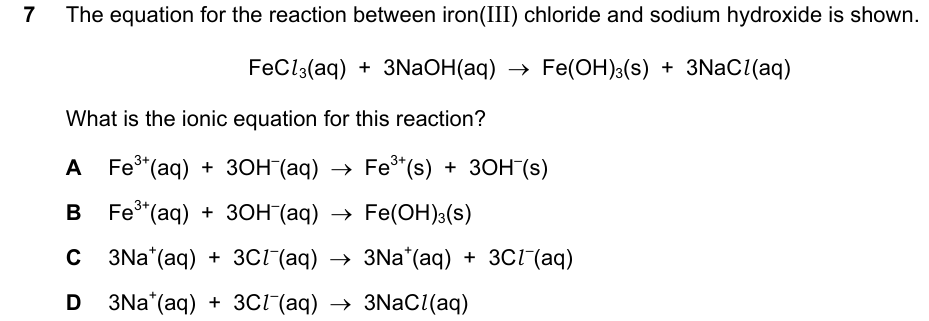
FeCl3(aq) + 3NaOH(aq) → Fe(OH)3(s) + 3NaCl(aq)
| Split | Fe3+ + 3Cl− + 3Na+ + 3OH− → Fe(OH)3(s) + 3Na+ + 3Cl− |
| Cancel | Na+ and Cl− are spectators |
| Ionic equation | Fe3+(aq) + 3OH−(aq) → Fe(OH)3(s) — the precipitate is a single solid formula, not separate ions |
Two ionic equations appear throughout the course: neutralisation, H+(aq) + OH−(aq) → H2O(l) (Topic 7), and metal displacement, for example Zn(s) + Cu2+(aq) → Zn2+(aq) + Cu(s) (Topic 9). When a question gives you information about a new reaction and asks you to “deduce” its equation, identify every reactant and product and its state from the information, write the formulae, then balance.
Ionic equations for precipitation are often written with the precipitate as ions, with the wrong charge on an ion (Pb+ for Pb2+), with the wrong formula for an ion (Br2−), unbalanced, or without state symbols. Symbols must be copied correctly from the Periodic Table — upper-case P for lead’s Pb. Acids in solution are aqueous, not liquid.
Attempt these before opening the solutions. Each reference gives the component, session and question number of the original examination; the answers follow the published mark scheme.
Solutions and mark-scheme guidance · set A
A1 Answer A
Barium chloride and sulfuric acid are solutions: (aq). Barium sulfate is the insoluble precipitate: (s). Hydrochloric acid is formed in solution: (aq). Most candidates answered correctly; the minority who thought the acids were liquids chose B or D.
A2 Answer C
P is in Group II (forms P2+) and Q is in Group VII (forms Q−). Two Q− ions balance one P2+: PQ2 (P is magnesium and Q fluorine: MgF2). Weaker candidates chose D, using the group numbers directly as subscripts.
A3 Answer A
An empirical formula cannot be simplified further. C2H4O (ratio 2 : 4 : 1) cannot be divided by a common factor, so it is empirical. C4H8O2 simplifies to C2H4O; C and D are structural formulae of C4H8O2.
A4 Answer B
The spectator ions Na+ and Cl− are removed; the product is the solid precipitate written as one formula: Fe3+(aq) + 3OH−(aq) → Fe(OH)3(s). A wrongly shows the precipitate as separate ions; C and D contain only spectator ions.
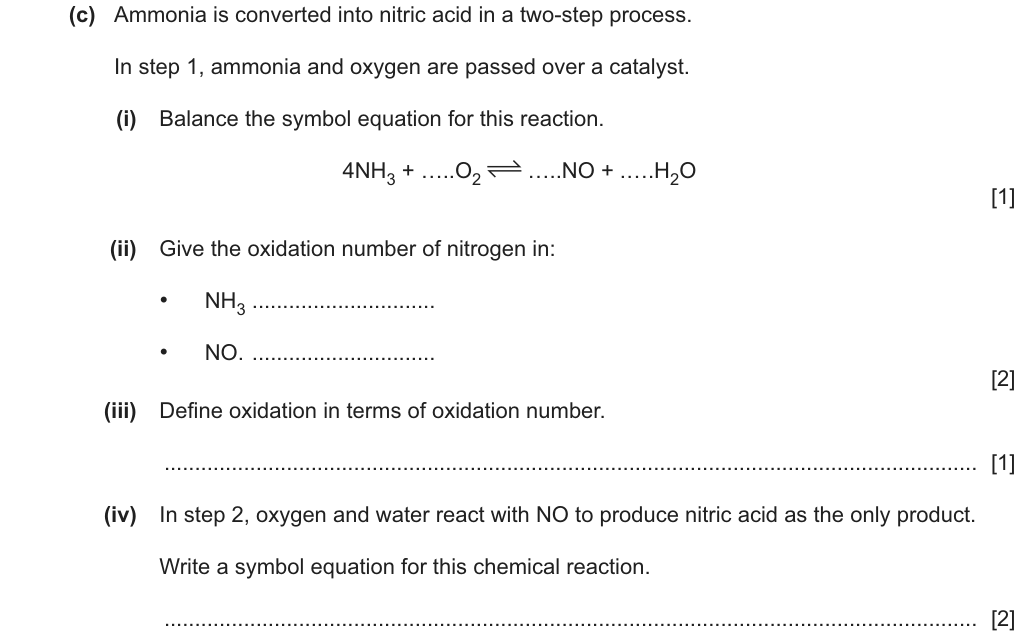
A5 [6]
(i) 4NH3 + 5O2 → 4NO + 6H2O ✓ (N: 4 = 4; H: 12 = 12; O: 10 = 4 + 6).
(ii) NH3: −3 ✓; NO: +2 ✓. (iii) An increase in oxidation number ✓. (iv) 4NO + 3O2 + 2H2O → 4HNO3: HNO3 ✓, fully correct equation ✓.
Examiner feedback: (i) was answered very well. In (ii) signs were often missing or written after the number (3− instead of −3). The formula of nitric acid in (iv) was often wrong.
3.2 · Relative masses of atoms and molecules
4Relative atomic mass and relative molecular mass 3.2.1–3.2.2 Core
Relative atomic mass, Ar, is the average mass of the isotopes of an element compared with 1/12th of the mass of an atom of carbon-12.
Relative molecular mass, Mr, is the sum of the relative atomic masses of all the atoms in a molecule. For ionic compounds the same quantity is called relative formula mass (also Mr).
Because these are ratios of masses, they have no units. The standard is carbon-12, whose mass is defined as exactly 12; on this scale hydrogen is 1 and oxygen 16. Ar values are printed on the Periodic Table in the examination; chlorine’s 35.5 reflects its two isotopes (Topic 2.3).
Mr = Σ (Ar × number of atoms of that element in the formula)
| CO2 | 12 + (2 × 16) = 44 |
| Ca(OH)2 | 40 + 2 × (16 + 1) = 74 — the bracket multiplies both O and H |
| (NH4)2SO4 | 2 × (14 + 4) + 32 + (4 × 16) = 36 + 32 + 64 = 132 |
| CuSO4•5H2O | 64 + 32 + 64 + 5 × 18 = 250 — water of crystallisation is included |
5Reacting masses by simple proportion 3.2.3 Core
A balanced equation, together with Mr values, gives the mass ratio in which substances react. Multiply each Mr by its coefficient in the equation, then scale to the actual masses. Mass is conserved: the total mass of the products equals the total mass of the reactants.
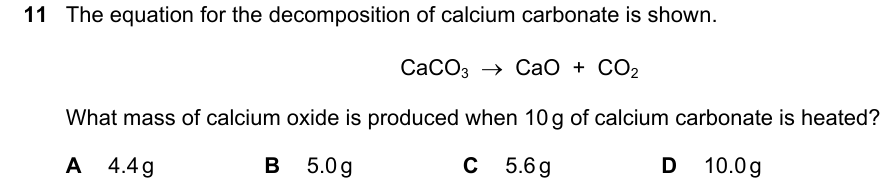
What mass of calcium oxide is made by heating 10 g of calcium carbonate? CaCO3 → CaO + CO2
| Mass ratio | CaCO3 : CaO = 100 : 56 |
| Scale | 10 g is 100 ÷ 10, so CaO = 56 ÷ 10 = 5.6 g |
| Check | mass of CO2 = 10 − 5.6 = 4.4 g, matching 44 ÷ 10. A common wrong answer, 5.0 g, simply halves the mass. |
When a reaction takes place in an open container and a gas escapes, the mass of the container falls; when a gas from the air is taken in (magnesium burning in oxygen), the mass of the solid increases. Neither contradicts conservation of mass — the gas has simply not been weighed.
Attempt these before opening the solutions. Each reference gives the component, session and question number of the original examination; the answers follow the published mark scheme.
Solutions and mark-scheme guidance · set B
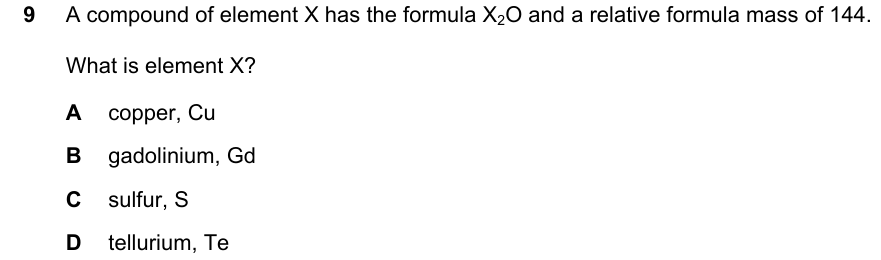
B1 Answer A
Mr(X2O) = 2Ar(X) + 16 = 144 → 2Ar(X) = 128 → Ar(X) = 64: copper.
B2 Answer C
CaCO3 (100) → CaO (56). 10 g is one tenth of 100 g, so 5.6 g of CaO. Option B (5.0 g) was commonly chosen — it assumes the mass simply halves.
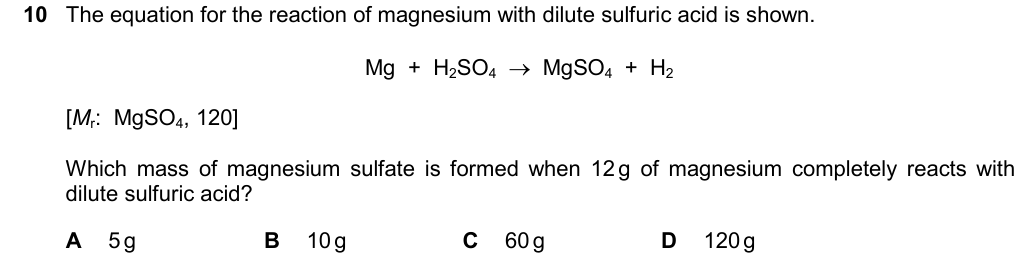
B3 Answer C
Mg (24) → MgSO4 (120) in a 1 : 1 ratio. 12 g of Mg is half of 24 g, so half of 120 g: 60 g.
3.3 · The mole and the Avogadro constant
6Measuring concentration 3.3.1 Core
The concentration of a solution tells you how much solute is dissolved in a given volume of solution. It can be measured in g/dm3 (grams of solute per cubic decimetre) or in mol/dm3 (moles of solute per cubic decimetre). One cubic decimetre, 1 dm3, is 1000 cm3 (one litre).
concentration (g/dm3) = mass of solute (g) ÷ volume of solution (dm3)
For example, 5.0 g of sodium chloride dissolved to make 250 cm3 (0.250 dm3) of solution has a concentration of 5.0 ÷ 0.250 = 20 g/dm3.
7The mole, the Avogadro constant and molar mass 3.3.2–3.3.3 Supplement
The mole (symbol mol) is the unit of amount of substance. One mole contains 6.02 × 10²³ particles (atoms, ions or molecules); this number is the Avogadro constant.
The mole is chosen so that the mass of one mole of a substance in grams — its molar mass, in g/mol — is numerically equal to its Ar or Mr. One mole of carbon atoms has a mass of 12 g; one mole of water molecules 18 g; one mole of CO2 44 g. Each contains 6.02 × 10²³ particles.
amount of substance (mol) = mass (g) ÷ molar mass (g/mol) n = m ÷ M; rearranged, m = n × M and M = m ÷ n
number of particles = amount (mol) × 6.02 × 10²³
How many molecules, and how many atoms, are in 11 g of carbon dioxide?
| Relationship | n = m ÷ M; M(CO2) = 44 g/mol |
| Moles | 11 ÷ 44 = 0.25 mol |
| Molecules | 0.25 × 6.02 × 1023 = 1.51 × 10²³ |
| Atoms | each CO2 has 3 atoms: 3 × 1.51 × 1023 = 4.52 × 10²³ |
| Check | “How many atoms?” is not the same question as “how many molecules?” — a common source of lost marks. |
Asked for the mass of 6.02 × 10²³ atoms of 34S, most candidates tried to multiply 6.02 × 1023 by 34; the answer is simply 34 g, because that is one mole. “Mole” or “mol” is accepted as the name of the amount; “moles” is not. When asked for the number of atoms in a sample of a compound, many give the number of molecules.
8The molar gas volume 3.3.4 Supplement
One mole of any gas occupies 24 dm3 (24 000 cm3) at room temperature and pressure (r.t.p.). This is true whatever the gas, because gas particles are so far apart that the volume depends on the number of particles, not on their size (Topic 1).
volume of gas (dm3) = amount (mol) × 24 or volume (cm3) = amount × 24 000; use this only for gases at r.t.p.
Match the units: 24 goes with dm3, 24 000 with cm3. The most frequent error in gas-volume questions is multiplying by 24 when the answer is asked for in cm3, or using 24 000 when dm3 is wanted. Never use the molar gas volume for a solid, a liquid or a solution.
9Reacting masses, gas volumes and limiting reactants 3.3.5 Supplement
Every stoichiometry calculation follows the same three steps:
- Convert what you know into moles (from a mass, a gas volume or a solution).
- Use the mole ratio from the balanced equation to find the moles of the substance you want.
- Convert those moles into the quantity asked for (mass, gas volume, concentration).
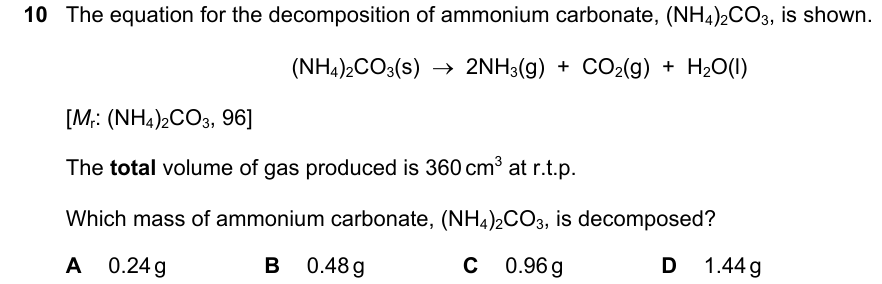
360 dm3 of ammonia at r.t.p. reacts with excess sulfuric acid: 2NH3(g) + H2SO4(aq) → (NH4)2SO4(s). What mass of ammonium sulfate forms? (Mr 132)
| 1 · moles | n(NH3) = 360 ÷ 24 = 15 mol |
| 2 · ratio | 2 NH3 : 1 (NH4)2SO4 → 15 ÷ 2 = 7.5 mol |
| 3 · mass | 7.5 × 132 = 990 g |
Limiting reactants. When amounts of two reactants are given, the reaction stops when one of them is used up: this is the limiting reactant, and it alone decides how much product forms. The other reactant is in excess. To find the limiting reactant, divide the moles of each reactant by its coefficient in the equation; the smaller answer identifies the limiting reactant.
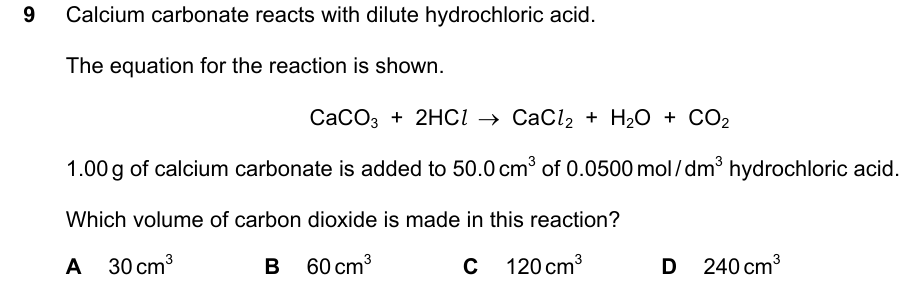
1.00 g of calcium carbonate is added to 50.0 cm3 of 0.0500 mol/dm3 hydrochloric acid. CaCO3 + 2HCl → CaCl2 + H2O + CO2. Find the volume of CO2 at r.t.p.
| CaCO3 | 1.00 ÷ 100 = 0.0100 mol (÷ 1 = 0.0100) |
| HCl | 0.0500 × 50.0 ÷ 1000 = 0.00250 mol (÷ 2 = 0.00125) |
| Limiting | HCl gives the smaller value, so HCl is limiting; CaCO3 is in excess |
| CO2 | 0.00250 ÷ 2 = 0.00125 mol → 0.00125 × 24 000 = 30 cm3 |
| Trap | 60 cm3 forgets to halve; 240 cm3 uses the calcium carbonate, which is not limiting |
In a practical, the observations that show a solid reactant is in excess are that some solid remains undissolved and that the fizzing stops. The other reactant — usually the acid — is then the limiting reactant.
10Concentration in mol/dm³ and titration calculations 3.3.5–3.3.6 Supplement
amount (mol) = concentration (mol/dm3) × volume (dm3) volume in dm3 = volume in cm3 ÷ 1000
To convert between the two concentration units, multiply or divide by the molar mass: concentration (g/dm3) = concentration (mol/dm3) × M. A titration (Topic 12) measures exactly the volume of one solution needed to react with a known volume of another. If the concentration of one is known, the moles in it can be calculated; the equation’s mole ratio then gives the moles, and hence the concentration, of the other.
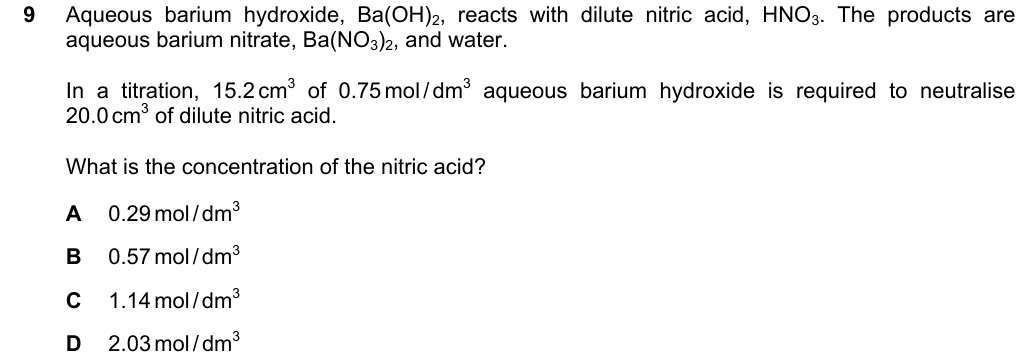
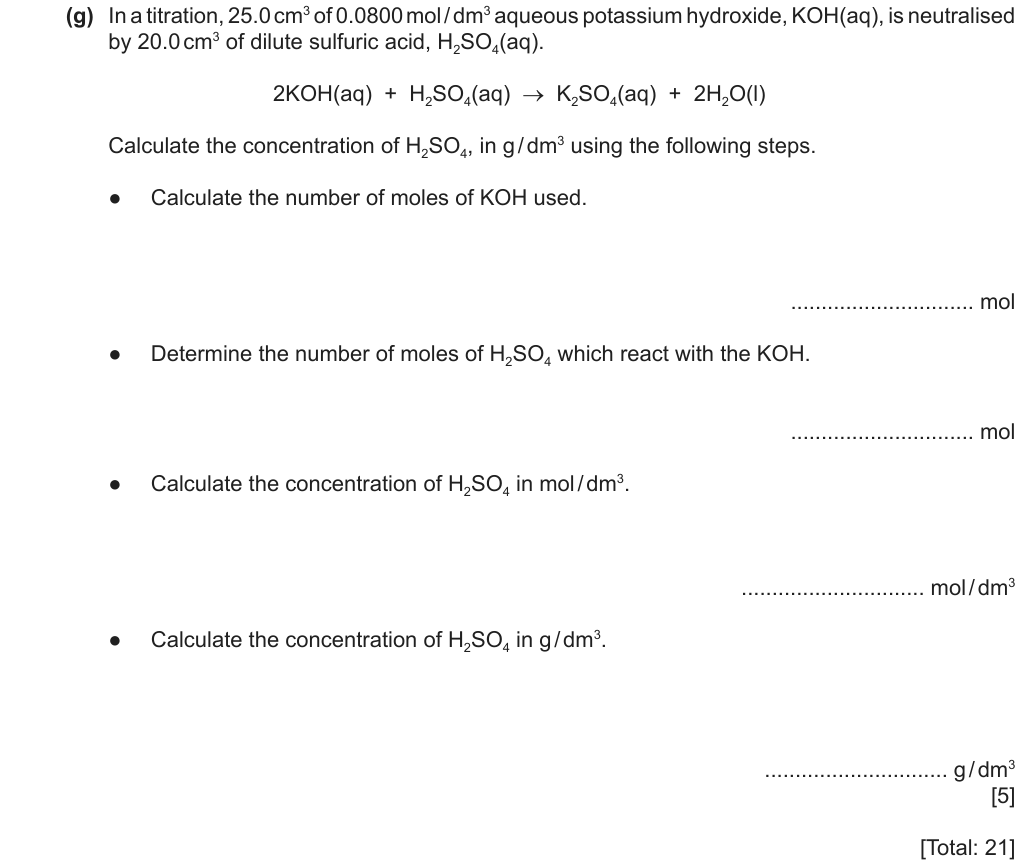
25.0 cm3 of 0.0800 mol/dm3 KOH is neutralised by 20.0 cm3 of dilute H2SO4. 2KOH + H2SO4 → K2SO4 + 2H2O. Find the acid’s concentration in g/dm3.
| 1 · KOH | 0.0800 × 25.0 ÷ 1000 = 0.00200 mol |
| 2 · ratio 2 : 1 | n(H2SO4) = 0.00200 ÷ 2 = 0.00100 mol |
| 3 · mol/dm3 | 0.00100 ÷ (20.0 ÷ 1000) = 0.0500 mol/dm3 |
| 4 · g/dm3 | Mr(H2SO4) = 2 + 32 + 64 = 98; 0.0500 × 98 = 4.90 g/dm3 |
The commonest error in titration calculations is to assume a 1 : 1 ratio when the equation shows otherwise — in one multiple-choice question most candidates did so. Answers must be decimal numbers, not fractions, and an Mr left as a sum (“2 + 32 + 64”) may not earn the mark.
11Calculating empirical and molecular formulae 3.3.7 Supplement
An empirical formula is found from the mass (or percentage by mass) of each element in a compound. Convert each mass to moles of atoms, then find the simplest whole-number ratio.
A compound contains 85.7% carbon and 14.3% hydrogen. Find its empirical formula.
| ÷ Ar | C: 85.7 ÷ 12 = 7.14; H: 14.3 ÷ 1 = 14.3 |
| ÷ smallest | C: 7.14 ÷ 7.14 = 1; H: 14.3 ÷ 7.14 = 2.00 |
| Formula | CH2 |
| Trap | dividing 85.7 by 14.3 compares masses, giving “C6H” — over a third of candidates did this in one session |
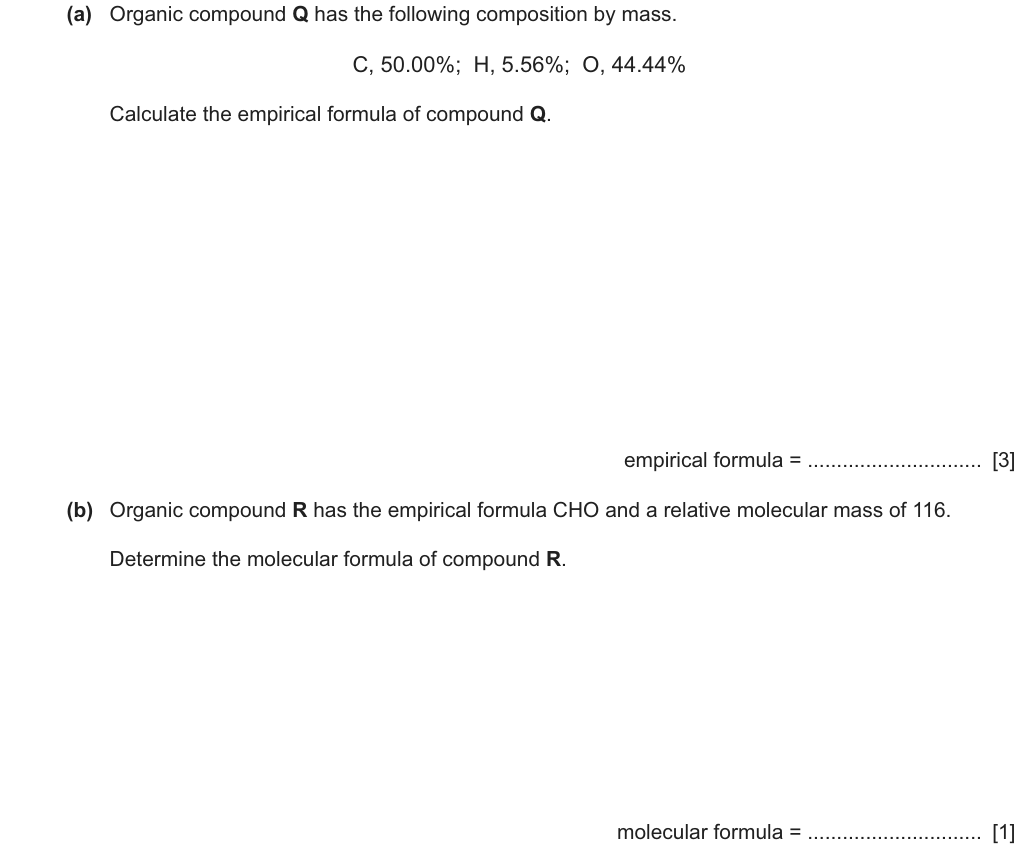
C 50.00%, H 5.56%, O 44.44%.
| ÷ Ar | 4.17 : 5.56 : 2.78 |
| ÷ smallest | 1.5 : 2 : 1 |
| × 2 | 3 : 4 : 2 → C3H4O2 (never round 1.5 to 2) |
The molecular formula is found from the empirical formula and Mr: divide Mr by the empirical formula mass and multiply every subscript by the answer. A compound with empirical formula CHO (mass 29) and Mr 116 has 116 ÷ 29 = 4 empirical units: C4H4O4 — not “(CHO)4” or “4CHO”.
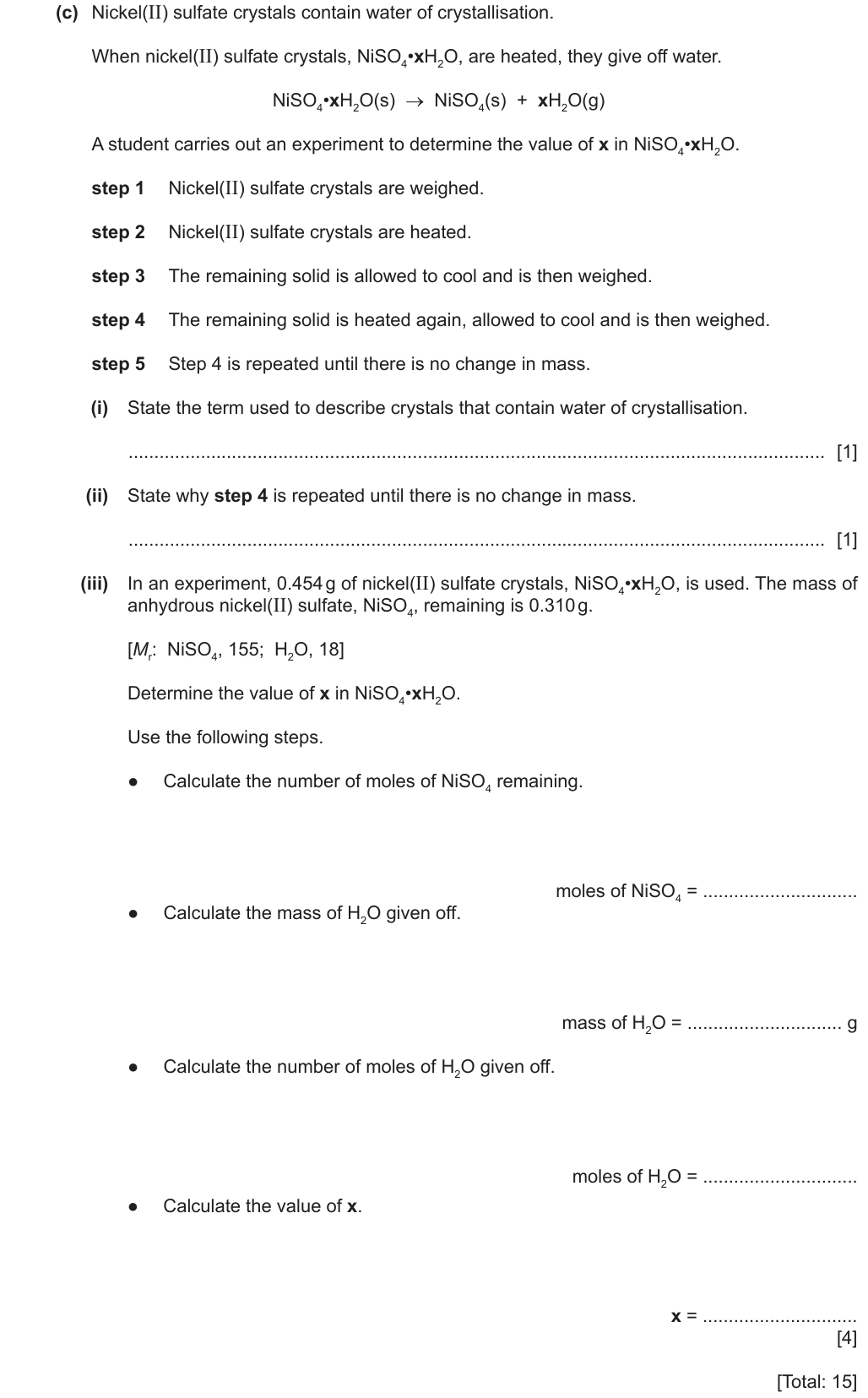
The same method finds the water of crystallisation in a hydrated salt, MSO4•xH2O: heat to constant mass, find moles of anhydrous salt and moles of water lost, and divide.
12Percentage yield, percentage composition and percentage purity 3.3.8 Supplement
percentage yield = (actual yield ÷ theoretical yield) × 100
percentage composition by mass of an element = (Ar × number of atoms ÷ Mr) × 100
percentage purity = (mass of pure substance ÷ mass of impure sample) × 100
The theoretical yield is the mass (or moles) of product calculated from the limiting reactant, assuming complete reaction. The actual yield is almost always less, because the reaction may be reversible, some product is lost during separation and purification (on filter paper, in transfers), and side-reactions may form other products.
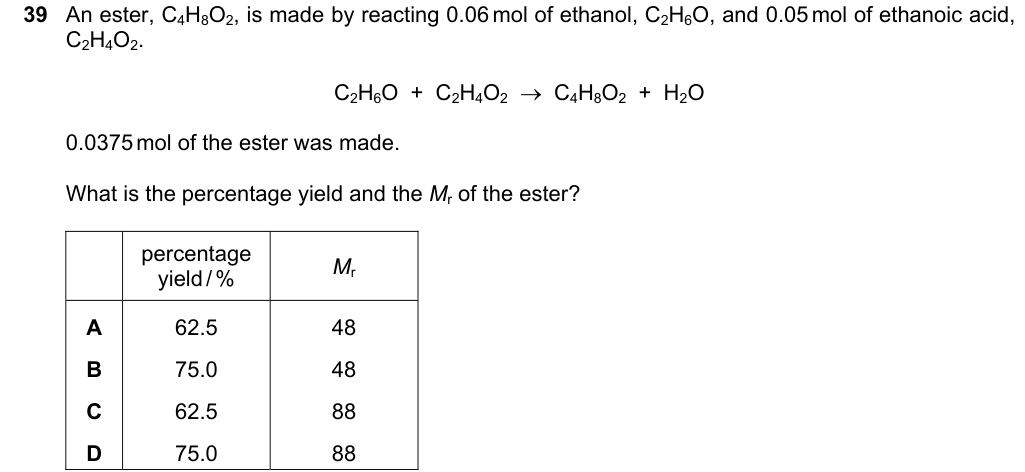
0.06 mol of ethanol and 0.05 mol of ethanoic acid react (1 : 1) to make an ester C4H8O2. 0.0375 mol of ester is obtained.
| Limiting | ethanoic acid, 0.05 mol → theoretical 0.05 mol of ester |
| Yield | 0.0375 ÷ 0.05 × 100 = 75.0% |
| Mr | (4 × 12) + (8 × 1) + (2 × 16) = 88 |
| Trap | using 0.06 mol (the reactant in excess) gives 62.5% |
Percentage of nitrogen in ammonium nitrate, NH4NO3 (Mr 80): (2 × 14 ÷ 80) × 100 = 35%. Count both nitrogen atoms.
Attempt these before opening the solutions. Each reference gives the component, session and question number of the original examination; the answers follow the published mark scheme.


Solutions and mark-scheme guidance · set C
C1 Answer C
2.00 mol NH3 contains 2.00 × 6.02 × 1023 = 1.204 × 1024 molecules; each molecule has 4 atoms: 4 × 1.204 × 1024 = 4.82 × 1024 atoms. Option A (the number of molecules) was the most common wrong answer.
C2 Answer A
n(CaCO3) = 0.0100 mol; n(HCl) = 0.00250 mol, which needs only 0.00125 mol of CaCO3 — so HCl is limiting. n(CO2) = 0.00250 ÷ 2 = 0.00125 mol → × 24 000 = 30 cm3. Most identified the limiting reactant; weaker candidates went wrong in the ratio (B or C).
C3 Answer B
Each (NH4)2CO3 gives 2NH3 + 1CO2 = 3 mol of gas (water is liquid). Gas: 360 ÷ 24 000 = 0.0150 mol → salt: 0.0150 ÷ 3 = 0.00500 mol → 0.00500 × 96 = 0.48 g. Option D assumed a 1 : 1 ratio.
C4 Answer C
Ba(OH)2 + 2HNO3 → Ba(NO3)2 + 2H2O. n(Ba(OH)2) = 0.75 × 15.2 ÷ 1000 = 0.0114 mol; n(HNO3) = 2 × 0.0114 = 0.0228 mol; c = 0.0228 ÷ 0.0200 = 1.14 mol/dm3. Most chose B, assuming a 1 : 1 ratio.
C5 Answer B
C: 85.7 ÷ 12 = 7.14; H: 14.3 ÷ 1 = 14.3; ratio 1 : 2 → CH2. Over a third chose D by dividing the percentages instead of the moles.
C6 Answer D
Ethanoic acid (0.05 mol) is limiting, so the theoretical yield is 0.05 mol; 0.0375 ÷ 0.05 × 100 = 75.0%. Mr(C4H8O2) = 88. Some candidates found the Mr but did not use the limiting reactant.
C7 [5]
n(KOH) = 0.0800 × 25.0 ÷ 1000 = 0.00200 mol ✓; n(H2SO4) = 0.00200 ÷ 2 = 0.00100 mol ✓; c = 0.00100 × 1000 ÷ 20.0 = 0.0500 mol/dm3 ✓; Mr(H2SO4) = 98 ✓; 98 × 0.0500 = 4.90 g/dm3 ✓.
Examiner feedback: a wide range of marks. Fractions as answers and Mr values left as sums did not receive full credit.
C8 [6]
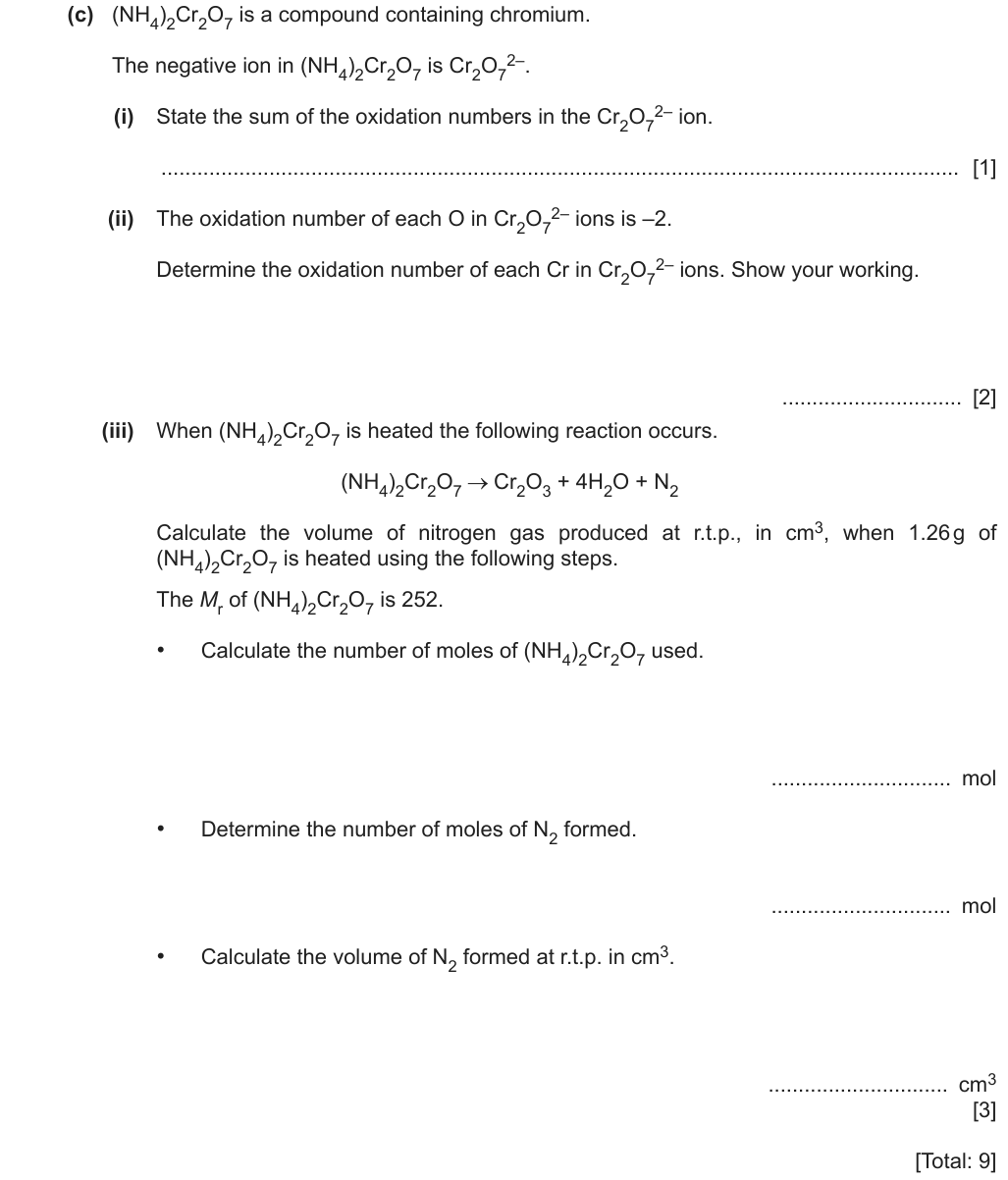
(i) The sum of the oxidation numbers in an ion equals its charge: −2 ✓. (ii) 7 × (−2) = −14; 2Cr − 14 = −2 → each Cr is +6 ✓✓. (iii) n = 1.26 ÷ 252 = 0.00500 mol ✓; 1 : 1 → 0.00500 mol N2 ✓; 0.00500 × 24 000 = 120 cm3 ✓.
Examiner feedback: the calculation was well practised; the common errors were multiplying by 24 instead of 24 000, or dividing. In (ii) “6” was often given for “+6”.
C9 [4]
(a) C 50.00 ÷ 12 = 4.17; H 5.56 ÷ 1 = 5.56; O 44.44 ÷ 16 = 2.78 ✓; ÷ smallest: 1.5 : 2 : 1 ✓; × 2 → C3H4O2 ✓.
(b) Mr(CHO) = 29; 116 ÷ 29 = 4 → C4H4O4 ✓.
Examiner feedback: (a) answered very well, though 1.5 was sometimes rounded to 2. In (b), (CHO)4, 4CHO or just “4” were given instead of the molecular formula.
C10 [6]
(i) hydrated ✓. (ii) To make sure all the water of crystallisation has been removed ✓. (iii) n(NiSO4) = 0.310 ÷ 155 = 0.00200 ✓; mass of water = 0.454 − 0.310 = 0.144 g ✓; n(H2O) = 0.144 ÷ 18 = 0.00800 ✓; x = 0.00800 ÷ 0.00200 = 4 ✓.
Examiner feedback: very few knew the term “hydrated” (anhydrous, hydrous and aqueous were given) or explained heating to constant mass; the calculation itself was done well.
Review · Topic 3
13Misconceptions and the examiner’s view
- “To balance an equation, change the subscripts.” That changes the substances; change only the coefficients.
- “Acids are liquids.” Dilute acids are solutions: (aq).
- “Reacting quantities are always 1 : 1.” Always use the coefficients of the balanced equation.
- “Moles of molecules = moles of atoms.” Multiply by the number of atoms in each molecule when atoms are asked for.
- “Empirical formula = ratio of percentages.” Divide each percentage by Ar first.
- “The reactant with fewer moles is limiting.” Divide by the coefficients first.
- “24 dm3 works for anything.” Only for gases, and 24 000 is for cm3.
Structured calculations with the steps laid out are generally well done: moles from mass, from gas volume and from solution data, and empirical formulae from percentages, are frequently fully correct. Marks are lost when the reasoning changes shape. In multiple-choice items without scaffolding, a large proportion of candidates assume a 1 : 1 mole ratio, ignore which reactant is limiting, compare percentages rather than moles, or give the number of molecules when atoms are asked for. Unit handling causes repeated errors — 24 used where 24 000 is needed, cm3 not converted to dm3 — and answers given as fractions, or with an Mr left as an unfinished sum, do not earn full credit. In formula and equation work, oxidation numbers lose their signs, ionic equations are written with precipitates as ions or without state symbols, and a molecular formula is written as “(CHO)4” instead of C4H4O4. Practical context is weak: few candidates know to heat to constant mass or can name a hydrated salt. Successful responses write each step with its units, name the mole ratio explicitly and check the limiting reactant before calculating any product.
14Summary and knowledge organiser
Essential equations
| Relationship | Units | Use when |
|---|---|---|
| n = m ÷ M | mol, g, g/mol | any substance with a known mass |
| particles = n × 6.02 × 10²³ | — | counting atoms, ions or molecules |
| V = n × 24 (dm3) or n × 24 000 (cm3) | dm3 or cm3 | gases at r.t.p. only |
| n = c × V | mol, mol/dm3, dm3 | solutions; V(dm3) = V(cm3) ÷ 1000 |
| % yield = actual ÷ theoretical × 100 | % | theoretical from the limiting reactant |
| % by mass = (Ar × atoms ÷ Mr) × 100 | % | composition of a compound |
| % purity = pure mass ÷ sample mass × 100 | % | impure samples |
Examination checklist
- Balance by coefficients; include state symbols; (aq) for solutions.
- Ionic equations: cancel spectator ions, precipitate as one (s) formula, charges balance.
- Moles first → ratio → answer, with units at every step.
- Limiting reactant: divide moles by coefficients; the smaller limits.
- Empirical formula: ÷ Ar, ÷ smallest, × 2 or × 3 if needed.
- Give decimals, not fractions; finish every Mr.
Knowledge organiser · stoichiometry
| Idea | What to know | Must-remember distinctions and common errors |
|---|---|---|
| Formulae 3.1 | Molecular formula: atoms in one molecule. Empirical: simplest ratio. Ionic formula from charges. | Brackets round polyatomic ions. Diatomic elements: H2 N2 O2 F2 Cl2 Br2 I2. |
| Equations 3.1 | Word, symbol, ionic; state symbols (s) (l) (g) (aq). | Never change subscripts. Spectator ions cancel. |
| Ar, Mr 3.2 | Ar vs 1/12 of C-12; Mr = sum of Ar. | No units. Hydrates include xH2O. |
| Mole 3.3 | 6.02 × 10²³ particles; n = m/M; 24 dm3 per mol of gas; n = cV. | “mol”, not “moles”, as the unit name. Atoms vs molecules. |
| Reacting amounts 3.3 | Limiting reactant, titrations, empirical/molecular formula, % yield, % purity. | Use the ratio. 1.5 → × 2. Theoretical yield from the limiting reactant. |