
Four teaching hours at both levels, outcomes 2.4.1 to 2.4.5, and one additional higher level hour, 2.4.6.
Guiding question: What role do bonding and structure have in the design of materials?
Structure 2.4 · Bonding as a continuum
1Bonding as a continuum 2.4.1 SL + HL
The ionic, covalent and metallic models are idealizations. Real substances rarely fit one model perfectly: the bond in HCl is covalent but polar; aluminium chloride has properties between those of an ionic salt and a molecular compound; brass is a metal made of two different elements. Materials science uses the models together to explain, and then to design, the properties of real materials.
The syllabus statement: Bonding is best described as a continuum between the ionic, covalent and metallic models, and can be represented by a bonding triangle. The skill assessed is Use bonding models to explain the properties of a material — so the triangle is a means, and the properties are the end.
Electronegativity controls the type of bonding between two elements:
- a large difference in electronegativity (Δχ) → electrons transferred → ionic bonding (a metal with a reactive non-metal);
- small Δχ, high average electronegativity → electrons shared and held between the atoms → covalent bonding (non-metals);
- small Δχ, low average electronegativity → electrons loosely held and delocalized → metallic bonding (metals and alloys).
Between these extremes lie compounds with mixed character, for example polar covalent bonds with partial ionic character. A bonding triangle (van Arkel–Ketelaar triangle) displays this continuum: each binary substance is plotted using the average electronegativity of its two elements (horizontal axis) and their electronegativity difference (vertical axis). The three corners represent the most metallic (caesium), the most covalent (fluorine) and the most ionic (caesium fluoride) substances.
Exam focus · what the published papers show
Ionic, covalent and metallic are not three separate kinds of substance. They are the three extremes — the corners of a triangle — and almost every real substance sits somewhere between them. A bond described as “ionic” is a bond close enough to that corner for the ionic model to predict its behaviour well.
Bonding is not structure. A published recommendation puts it in one line: Distinguish between bonding and structure; bonding = ionic, covalent, or metallic; structure = giant or molecular. A full answer usually needs one word from each list.
A published question opens: Iron(II) sulfide can be produced by heating powdered iron and sulfur together, then asks three things in a row — the difference between an element and a compound, why the product is polar covalent, and finally:
Contrast one physical property of iron and iron(II) sulfide. [1]
The scheme accepts any one of four:
| 1 | Fe is electrical/thermal conductor AND FeS is not |
| 2 | Fe is malleable/ductile AND FeS is brittle/not malleable/ductile |
| 3 | Fe is magnetic AND FeS is not |
| 4 | Fe has higher melting point «than FeS» |
What the four have in common: each is a property the bonding model predicts. Iron is metallic, so it conducts and bends; iron(II) sulfide is not, so it does neither. Note the shape of the answer — the command word is contrast, so both substances must appear, joined by AND. A statement about one of them alone is half an answer.
Two notes on that scheme close two doors: Do not accept any chemical properties, and Do not accept atomic or molar mass. Examiner feedback records that candidates gave malleability or conductivity, while others inappropriately referred to chemical properties like “rusting,” Rusting, reactivity and corrosion score nothing when a physical property is asked for.
The second door is closed on a different question — the one comparing silicon with poly(ethene) below — where the scheme states M3: Do not accept “bonding in silicon is stronger than poly(ethene)” without named bonding/forces. “Stronger bonding” is not an explanation until you say which bonding.
2Locating a compound in the bonding triangle and predicting its properties 2.4.2 SL + HL
The syllabus statement: The position of a compound in the bonding triangle is determined by the relative contributions of the three bonding types to the overall bond. You are asked to determine the position of a compound in the bonding triangle from electronegativity data and to predict the properties of a compound based on its position.
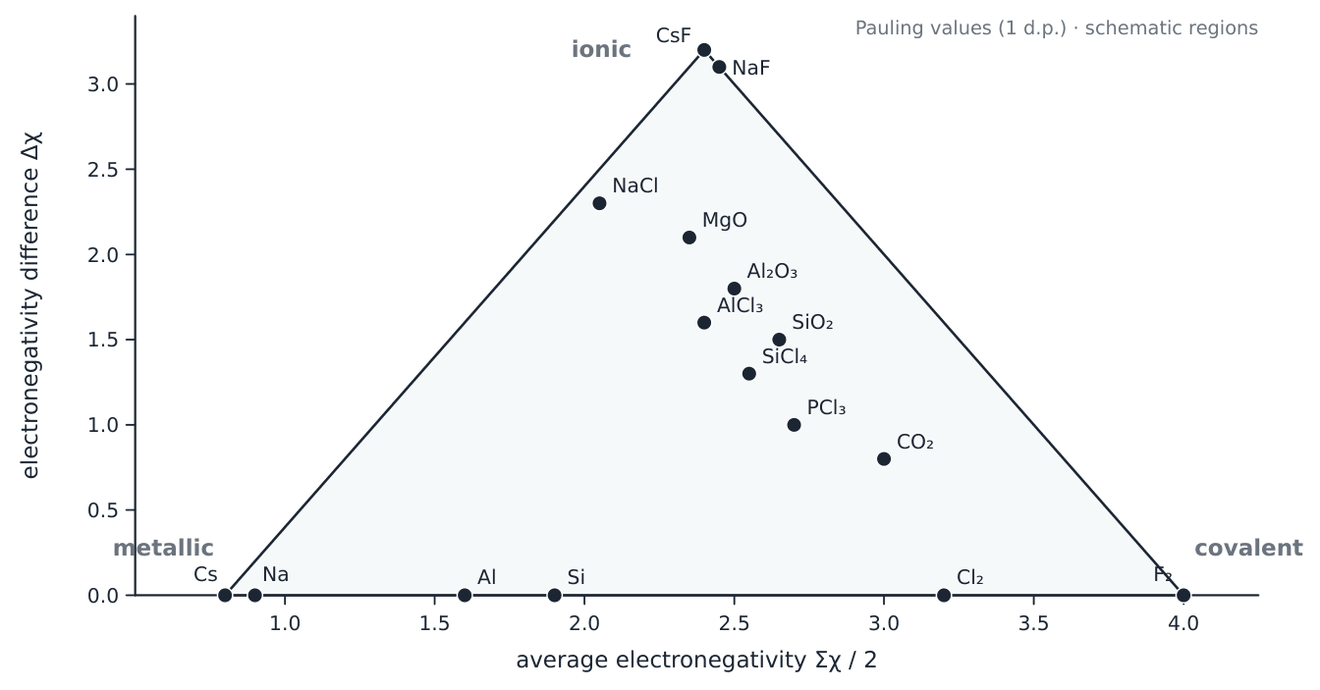
| Relationship | x = (χA + χB) ÷ 2 (average electronegativity); y = |χA − χB| (difference). χ(Cl) = 3.2. |
| NaCl | χ(Na) = 0.9: x = (0.9 + 3.2) ÷ 2 = 2.05; y = 2.3 → ionic region. |
| AlCl3 | χ(Al) = 1.6: x = 2.4; y = 1.6 → polar covalent region, bordering ionic. |
| SiCl4 | χ(Si) = 1.9: x = 2.55; y = 1.3 → polar covalent. |
| PCl3 | χ(P) = 2.2: x = 2.7; y = 1.0 → polar covalent, closer to covalent. |
| Prediction | Moving from NaCl to PCl3, bonding changes from ionic lattice to simple molecules. Expect NaCl to have a high melting point and conduct when molten; SiCl4 and PCl3 to be volatile molecular liquids that do not conduct; AlCl3 to show intermediate behaviour. |
| Check | Figure 2.23 places the points in the same order along a line from the ionic corner towards the covalent corner. |
From models to materials — the bonding triangle
Pick any two elements. The difference in electronegativity says how unequally the electrons are shared; the average says whether there are enough of them held loosely to make a metal.
Van Arkel–Ketelaar triangle. Horizontal axis: mean Pauling electronegativity. Vertical: the difference. The three corners are the three limiting models; almost everything real sits between them.
Boundaries between the regions are conventions, not laws. A point near a line is a substance with intermediate character — which is the useful part of the model, not a flaw in it.
| Region | Typical position | Structure | Predicted properties |
|---|---|---|---|
| Ionic | top of triangle (large Δχ) | ionic lattice | high melting point; conducts when molten or dissolved; brittle; often soluble in water |
| Polar covalent | middle | molecules with polar bonds, or networks (e.g. SiO2) | molecular: low melting points, non-conducting; network: high melting point, hard, non-conducting |
| Covalent | bottom right (small Δχ, high average χ) | non-polar molecules or networks | molecular: very volatile, insoluble in water; network: very high melting point |
| Metallic | bottom left (small Δχ, low average χ) | metals and alloys | conduct as solids; malleable; lustrous |
Classifying bonds as ionic, covalent or metallic is useful because it lets chemists generalize about substances and make predictions. But it is a simplification: the triangle shows that bonding varies continuously, and the same substance can show features of more than one model (the ions in some “ionic” compounds are distorted, giving partial covalent character). Composite materials such as reinforced concrete combine ionic and covalent components with steel bars to obtain properties that no single component has.
Assuming that a compound of a metal with a non-metal must be ionic. The position in the triangle depends on the actual electronegativity values: AlCl3 is largely covalent, and a compound of boron and carbon is not a giant ionic lattice. Calculations of percentage ionic character are not required.
Exam focus · what the published papers show
Three separate mark schemes in this collection ask for the same pair, and each states both:
| Compound | What the scheme states | Verdict |
|---|---|---|
| Iron(II) sulfide | «electronegativity difference» ∆Χ = 0.8 AND average «electronegativity» Χ = 2.2 | polar covalent |
| An oxide in a second item | Electronegativity difference is 1.2. AND Average electronegativity is 2.8 | polar covalent |
| Calcium bromide | «electronegativity difference =» 2.0 AND «average electronegativity =» 2.0 | ionic, and 35% covalent |
The word AND is in all three. One quantity is half a coordinate and locates nothing. Note also the chevrons: in the second row the arithmetic «3.4−2.2 =1.2, (3.4+2.2)/2 = 2.8» sits inside chevrons, which means the working is not required — but the two values are.
Outline why solid iron(II) sulfide is a polar covalent compound. Use sections 9 and 17 of the data booklet. [1]
The name has a metal in it and a roman numeral, so instinct says ionic. Instinct is not the method.
- Read both electronegativities from the data booklet.
- Difference = larger − smaller = 0.8.
- Average = (sum) ÷ 2 = 2.2.
- Plot the point. A difference that small, at that average, lands in the polar covalent region — not near the ionic corner.
One mark, and it is for the two numbers. The command word is outline, which here means “show me the coordinates”, not “describe polar covalency”.
Deduce, showing your working, the type of bonding and percentage covalent character in calcium bromide, CaBr2. Use sections 9 and 17 of the data booklet. [2]
Difference 2.0, average 2.0. That point sits high on the triangle and well to the left: the scheme's answer is ionic AND 35% covalent.
Two marks, and the second is read off the diagram — which is why the scheme adds Accept range 30 - 40% for percentage covalent character. A value anywhere in that band scores. A value outside it does not, however good the working above it.
Examiner feedback: Students found this question approachable. About 65% were able to deduce the type of bonding and percentage covalent character using the bonding triangle. Mistakes included percentage covalent character that was outside the range. Note where the failure sits — not in the arithmetic, but in reading the diagram afterwards. Draw the point on the triangle before you read a percentage off it.
One report makes the point better than any advice could. On the electronegativity part: Almost all candidates could correctly calculate the electronegativity difference as 1.2 and the average electronegativity as 2.8, leading to a polar covalent bond. (Average mark 1.70/2)
On the part immediately before it: Most of the candidates missed the first mark by not writing that this oxide is a simple/molecular covalent structure. (Average mark 0.86/2) Same candidates, same question, half the mean. The two numbers were found; the word structure was missing. Published lists of areas where students appeared well prepared include both Electronegativity difference and polar covalent bond and Deducing the type of bonding and percentage covalent character using the bonding triangle — this method is a reliable source of marks, provided the structure word goes in.
The supplied papers pre-date the bonding triangle and contain no question on plotting it. The items below assess the underlying skills: deciding the dominant bonding type from electronegativity and explaining properties from bonding.
In which of the following compounds does ionic bonding predominate?
Which describes the oxide of sodium, Na2O?
| Bonding | Conduction of electricity (pure substance) | pH of aqueous solution | |
|---|---|---|---|
| A. | covalent | as a solid and liquid | low |
| B. | covalent | as a solid only | high |
| C. | ionic | as a solid and liquid | low |
| D. | ionic | as a liquid only | high |
Some oxides of period 3, such as Na2O and P4O10, react with water. Explain the electrical conductivity of molten Na2O and P4O10. [2]
(i) State the type of bonding in potassium chloride which melts at 1043 K. [1]
(ii) A chloride of titanium, TiCl4, melts at 248 K. Suggest why the melting point is so much lower than that of KCl. [1]
Which statement best describes the intramolecular bonding in HCN(l)?
Which compound has the greatest volatility under the same conditions?
Solutions and mark-scheme guidance · Set K
K1 B
NaF combines the most electropositive metal and the most electronegative element of the choices: Δχ = 4.0 − 0.9 = 3.1, well into the ionic region of the bonding triangle, and it contains no covalent bonds. HCl is polar covalent; NH4Br and NaOH contain covalent bonds within their polyatomic ions.
K2 D
Na2O is ionic; ions can move only in the liquid, so it conducts only when molten; it reacts with water to form NaOH, giving a high pH.
K3 [2]
Molten Na2O contains mobile ions (charged particles) and so conducts ✓. Molten P4O10 is molecular and contains no mobile ions and so does not conduct ✓. No marks were given for answers based on electrons, and references to solutions (rather than the molten substances) limited the answer to one mark.
K4 [2]
(i) Ionic / electrostatic attraction between oppositely charged ions ✓.
(ii) TiCl4 has a simple molecular structure; only weak intermolecular forces (London, dispersion or van der Waals) between molecules must be overcome ✓. “Covalent” alone was not accepted.
K5 D
The bonds within HCN (intramolecular) are covalent: the attraction between shared electron pairs and the positively charged nuclei. Options B and C describe intermolecular forces; A wrongly treats HCN(l) as ionic.
K6 A
SO2 is a simple molecular substance (a gas at room temperature). SiO2 is giant covalent; SnO2 and SrO have giant ionic character. Weak intermolecular forces give the highest volatility.
Structure 2.4 · Materials
3Alloys 2.4.3 SL + HL
The syllabus statement: Alloys are mixtures of a metal and other metals or non-metals. They have enhanced properties. You are asked to explain the properties of alloys in terms of non-directional bonding. Two words in that statement carry the whole outcome: mixtures, and non-directional.
An alloy is a mixture of a metal with one or more other metals or non-metals, which has metallic properties.
Because metallic bonding is non-directional, atoms of another element can be introduced into a metal lattice without breaking a particular set of bonds: the delocalized electrons simply bind the new atoms into the lattice as well. Alloys are therefore mixtures of variable composition, not compounds with a fixed formula. There are two ways the added atoms fit in (Figure 2.24):
- Substitutional alloys: atoms of similar size replace some host atoms. In brass about one-third of the copper atoms are replaced by zinc; bronze is copper with tin.
- Interstitial alloys: much smaller atoms occupy the gaps between host atoms. Steel is iron containing a small percentage of carbon; stainless steel also contains chromium and nickel, which improve corrosion resistance.
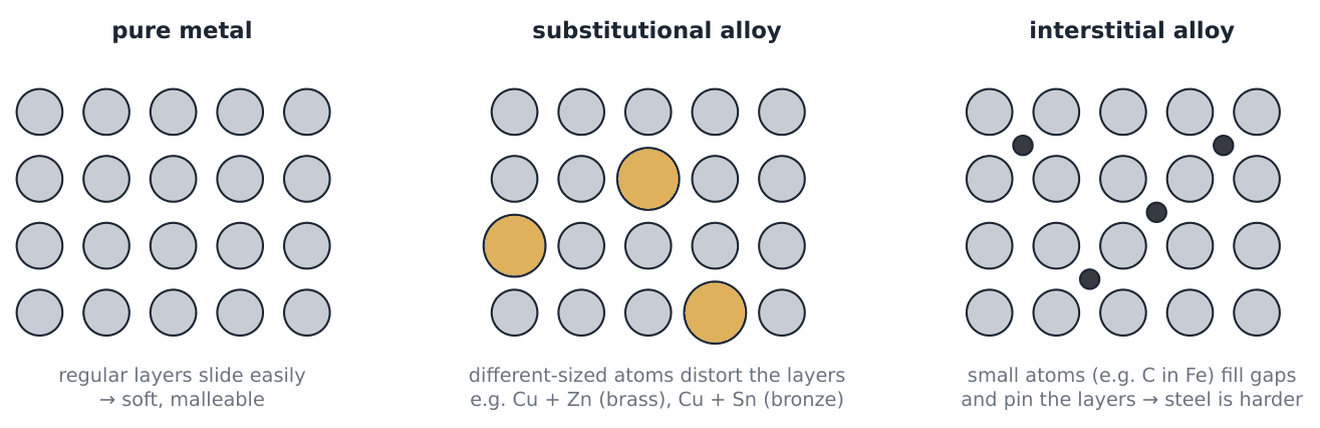
Explaining the enhanced properties. In a pure metal the layers of identical cations are regular and slide over one another easily, so pure metals are often soft. Atoms of a different size distort the regular arrangement of the lattice and act as obstacles that prevent the layers sliding. The alloy is therefore harder and stronger (higher tensile strength) but less malleable and ductile than the pure metal. Alloying can also change other physical properties such as density, melting point and electrical conductivity; the irregular lattice scatters moving electrons, so alloys usually conduct electricity less well than the pure host metal. Specific alloys need not be memorized; the explanation must be.
Explaining why an alloy is harder than the pure metal: (1) the added atoms/ions have a different size and distort the regular arrangement of the lattice ✓; (2) this prevents the layers sliding over each other ✓. A labelled diagram showing atoms of different sizes can earn the first mark.
Exam focus · what the published papers show
Structure 2.3 explained malleability by saying the layers slide and the non-directional bonding is not disrupted. An alloy keeps the second half and breaks the first.
The atoms mixed in are a different size from the host cations, so the layers are no longer regular planes. Sliding one layer past the next now means pushing past obstructions, which takes more force. The metal is harder and less malleable — because of the sizes, not because the bonding got stronger. Say both halves: the bonding is unchanged, the geometry is not.
Which statements are correct for alloys?
| I | They are homogeneous mixtures of metals with other metals or non-metals. |
| II | The different sizes of atoms in alloys prevent layers of metallic cations sliding over each other easily. |
| III | Adding carbon to iron produces an alloy that is stronger than pure iron. |
II and III are straightforwardly correct — II is the explanation above, and III is the standard example the syllabus offers. I is the interesting one, and it is why this question ended with two accepted answers.
Examiner feedback: Candidates found this multiple response question about alloys confusing. Responses II and III were clearly correct, while response I was more ambiguous. It was decided to accept both C (II and III correct) and D (I, II and III correct) as the correct answers. C was selected by 20% and D was selected by 39% of the candidates.
This question was set at both levels in one session, and the two reports do not agree about what made it hard. One describes it as By far the most challenging question on the paper with initially just slightly over 25% (the value expected from random guessing!) giving the correct answer to this question about hardness of alloys, and blames the size idea: candidates incorrectly thought that different sized cations enhancing the strength of the metallic bond was a factor in the greater hardness of alloys, alongside the greater resistance of planes slipping past each other. The other blames the word homogeneous.
The safe answer keeps the two ideas separate. Different sizes make the alloy harder by obstructing the planes, not by strengthening the metallic bond. That same feedback notes examiners judged the effect of cation size to be beyond what the scope of the syllabus demanded here — so lean on the geometry, which is what the syllabus asks for.
Alloying a metal with a metal of smaller atomic radius can disrupt the lattice and make it more difficult for atoms to slide over each other. Which property will increase as a result?
Explain why an aluminium–titanium alloy is harder than pure aluminium. [2]
Explain why the addition of small amounts of carbon to iron makes the metal harder. [2]
(iii) Describe the bonding in metals. [2]
(iv) Nickel alloys are used in aircraft gas turbines. Suggest a physical property altered by the addition of another metal to nickel. [1]
Solutions and mark-scheme guidance · Set L
L1 D
If layers cannot slide easily, the metal is harder and stronger, but less malleable and less ductile. Conductivity typically falls because the irregular lattice scatters the moving electrons.
L2 [2]
Titanium atoms (ions) are a different size and distort the regular arrangement of aluminium ions ✓; this prevents the layers from sliding over one another ✓ (a diagram is accepted).
L3 [2]
Carbon atoms are a different size and disrupt the regular arrangement of iron ions ✓; this prevents the layers (atoms) from sliding ✓.
L4 [3]
(iii) Electrostatic attraction ✓ between a lattice of cations and a sea of delocalized electrons ✓.
(iv) Any one physical property ✓: malleability, hardness, tensile strength, ductility, density, thermal or electrical conductivity, melting point, thermal expansion. Corrosion resistance and other chemical properties were not accepted.
4Polymers and the properties of plastics 2.4.4 SL + HL
The syllabus statement: Polymers are large molecules, or macromolecules, made from repeating subunits called monomers. The skill is to describe the common properties of plastics in terms of their structure — so again, a property with a structural reason attached.
A polymer is a very large molecule (macromolecule) made by joining many small repeating subunits called monomers. The repeating unit is the smallest section of the chain that, repeated, gives the whole polymer.
Polymers occur naturally and are made synthetically:
| Natural polymers | Monomer | Synthetic polymers | Monomer(s) |
|---|---|---|---|
| proteins (e.g. wool, enzymes) | 2-amino acids | poly(ethene), PE | ethene |
| starch, cellulose | glucose | poly(chloroethene), PVC | chloroethene |
| DNA | nucleotides | nylon (polyamide) | diamine + dicarboxylic acid |
| natural rubber | isoprene | PET (polyester) | diol + dicarboxylic acid |
Properties of plastics and their structural explanation
“Plastics” are synthetic polymers that can be moulded. Their common properties follow from their structure: very long molecules held together by covalent bonds along the chain, with intermolecular forces between the chains.
- Low density and light weight: made of light atoms (C, H, O, Cl) and the chains do not pack as closely as metal ions.
- Electrical insulators: no mobile ions or delocalized electrons.
- Durable and chemically unreactive: strong C–C and C–H covalent bonds; this is also why many plastics are not biodegradable and persist in the environment.
- Mouldable when heated (thermoplastics): heating gives the chains enough energy to overcome the intermolecular forces between chains so that they can slide past each other; the covalent bonds in the chains are not broken.
- Solids despite being molecular: each chain has a very large number of electrons, so the total London forces between long chains are large.
Properties can be tuned by changing the structure. Longer chains give stronger intermolecular forces and tougher materials (ultra-high molecular weight polyethene is used in body armour). Less branching lets chains pack closely into crystalline regions: high-density polyethene (HDPE) is harder and stronger than branched low-density polyethene (LDPE). Polar side groups add dipole–dipole forces: the C–Cl dipoles in PVC make it more rigid than polyethene. Cross-links (covalent bonds between chains) produce thermosetting polymers that do not soften on heating but decompose.
Exam focus · what the published papers show
Describe one chemical property that makes this type of polymer a useful material. [1]
The scheme's answer is short: «chemically» inert/unreactive, with Accept “non-biodegradable”.
And then the note that decides the mark: Do not accept physical properties such as strength. The question said chemical, and the scheme means it. Strength, flexibility, low density and being waterproof are all true of plastics and all worth nothing here. Read the adjective in front of “property” before you answer.
Discuss the following data in terms of the bonding and/or intermolecular forces in each substance. [3]
| Substance | Melting point / K |
|---|---|
| Silicon | 1683 |
| Poly(ethene) | 393 |
Three marks, and the scheme's three points are:
- covalent bonds between silicon atoms
- London/dispersion forces between poly(ethene) «chains/molecules»
- covalent bonds «much» stronger than London/dispersion/intermolecular forces «hence Si has higher melting point»
This is the whole of 2.4.4 in one answer. A plastic melts low because the chains are held to each other only by intermolecular forces — the strong covalent bonds are along the chain, and melting does not break them. The third mark is the one that fails: the scheme states Do not accept “bonding in silicon is stronger than poly(ethene)” without named bonding/forces. Name both, then compare them.
5Addition polymers 2.4.5 SL + HL
The syllabus statement: Addition polymers form by the breaking of a double bond in each monomer. The skill is to represent the repeating unit of an addition polymer from given monomer structures. You are told that Structures of monomers do not have to be learned but will be provided or will need to be deduced from the polymer — so this outcome is entirely about drawing, in either direction.
Alkenes (and other monomers with a C=C double bond) undergo addition polymerization: the π bond of each monomer breaks and the carbon atoms form new single σ bonds to neighbouring monomers, building a long saturated chain. No other product forms, so the atom economy is 100%.
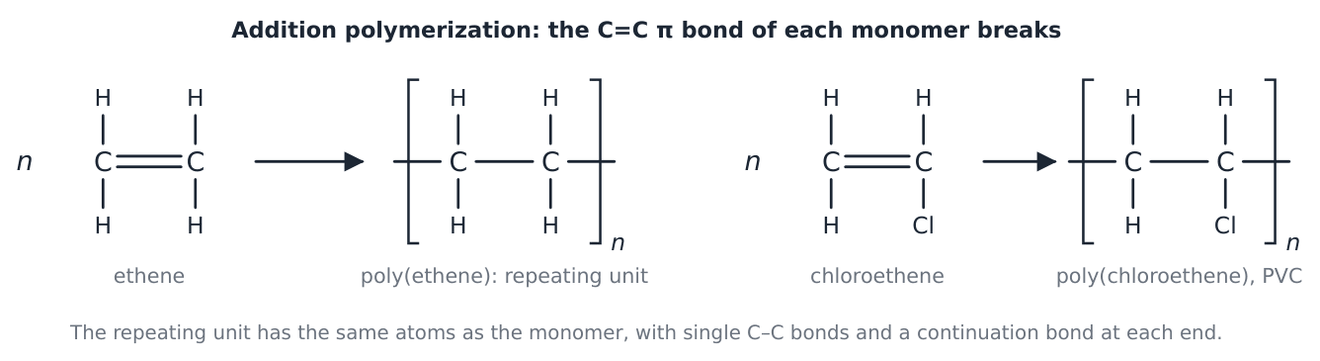
- Draw the monomer with the C=C in the middle and the four substituents above and below.
- Change C=C to C–C and add a continuation bond on each carbon, extending outside the brackets.
- To find a monomer from a polymer chain, identify a two-carbon repeating section in the main chain and put the double bond back between those carbons.
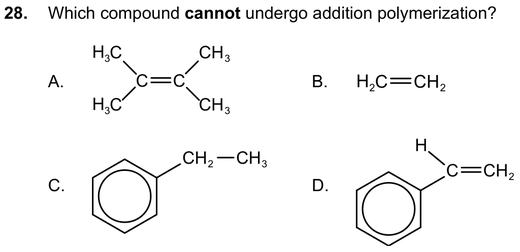
The main chain of an addition polymer contains only carbon atoms. A benzene ring or an alkane chain alone cannot polymerize by addition: a C=C in the monomer is essential.
| Propene | CH2=CH(CH3) → repeating unit –CH2–CH(CH3)–; the methyl group is a side group, not part of the main chain. |
| Tetrafluoroethene | CF2=CF2 → –CF2–CF2– (PTFE). |
| Phenylethene | CH2=CH(C6H5) → –CH2–CH(C6H5)– (polystyrene). |
| Three units | A section of three repeating units of poly(propene) has six carbons in the main chain: –CH2–CH(CH3)–CH2–CH(CH3)–CH2–CH(CH3)–. |
Exam focus · what the published papers show
Whatever the monomer, the backbone is built from the two carbons of the double bond and nothing else. Every other atom that was attached to them is still attached to them afterwards — hanging off the chain.
Draw it in three moves. Change the C=C to a C–C. Put a bond out of the left-hand carbon and out of the right-hand carbon: these are the continuation bonds. Keep every side group exactly where it was. That is one repeating unit, and it has the same molecular formula as the monomer.
| Required | Forgiven |
|---|---|
| Continuation bonds must be shown. correct structure AND continuation bonds shown |
Ignore brackets and ‘n’. — and elsewhere Accept without
square brackets or n. Accept head-to-tail or head-to-head orientation of monomer units. Ethyl groups do not all have to be on one side. Accept phenyl rings on either side of the polymer backbone Accept any correct structural representation including skeletal formulas |
Only one thing is compulsory. The brackets and the n are optional; which side the side groups point is optional; the drawing style is optional. The continuation bonds are not. Without them you have drawn a molecule, not a section of a polymer.
But-2-ene can be polymerized. Draw a section of the resulting polymer showing two repeating units. [1]
But-2-ene is CH3–CH=CH–CH3. The two carbons of the double bond join the chain; the two methyl groups stay attached to them, one on each backbone carbon. One repeating unit is therefore –CH(CH3)–CH(CH3)–, and the question asks for two of them, drawn end to end, with a continuation bond at each end of the section.
Check by formula. But-2-ene is C4H8; the repeating unit must also be C4H8. If what you have drawn is C2H4, you have drawn poly(ethene) and lost the methyl groups.
The side groups. Examiner feedback on the item above: 20% of the candidates were able to deduce the structure of poly(but-2-ene). Many candidates just drew the structure of poly(ethene). Errors also included missing hydrogen atoms. On another item: Polymers were rarely written correctly. Many used ethene monomers and then a long chain of 8 or 10 CH2 units; Very few had methyl groups shown. And on styrene: Most candidates were able to identify addition polymerization correctly, but few were able to draw the polymer correctly; the most common error included the phenyl ring in the polymer chain.
The ring is a side group. It hangs off a backbone carbon; it is never a link in the chain. The same is true of every substituent.
The count. The same feedback on the but-2-ene item: Question poorly performed, with an average score of 20%; some did not read the question carefully and showed only one repeating unit, not two. On a second item, asked for a section of three: Drawing the structure of an addition polymer proved to be challenging, not the least because some candidates just drew one monomer instead of a section of 3 as clearly stated, that was required to show how the monomers were connected. Published lists of areas that appeared difficult include Drawing two repeating units of an addition polymer given the monomer unit. and Drawing a section of a polymer showing two repeating units.
Questions run backwards as often as forwards: A section of an addition polymer is shown. … Deduce the structure of the monomer that forms this polymer. and, as a multiple-choice item, Which monomer produces this addition polymer?
To go backwards: find the repeating unit in the chain, take one unit, and put a double bond between its two backbone carbons. Everything else stays. Then check the formula — monomer and repeating unit must match atom for atom, because addition releases nothing. That single check catches almost every version of the lost-side-group error, in both directions.
No supplied IB paper asks directly about the general properties of plastics (2.4.4); the items below assess addition polymers (2.4.5).
Which structure represents a repeating unit of a polymer formed from propene?
Chloroethene, C2H3Cl, can undergo polymerization. Draw a section of the polymer with three repeating units. [1]
Outline the formation of polyethene from ethene by drawing three repeating units of the polymer. [1]
Solutions and mark-scheme guidance · Set M
M1 A
Propene, CH2=CH–CH3: the C=C opens and the CH3 group becomes a side branch, so the repeating unit is –CH2–CH(CH3)–. The main chain has two carbons per unit, not three.
M2 C
Addition polymerization requires a C=C double bond outside the benzene ring. Ethylbenzene has only a saturated ethyl side chain; the ring does not undergo addition.
M3 [1]
–CH2–CHCl–CH2–CHCl–CH2–CHCl– with continuation bonds at both ends ✓. All C–C bonds in the chain must be single; brackets and n are ignored; a head-to-head arrangement is also accepted.
M4 [1]
Six carbon atoms in a chain, each carrying two H atoms, with continuation lines at both ends: –CH2–CH2–CH2–CH2–CH2–CH2– ✓. The continuation lines must be shown.
6Condensation polymers 2.4.6 HL only
The syllabus statement: Condensation polymers form by the reaction between functional groups in each monomer with the release of a small molecule. The skill is to represent the repeating unit of polyamides and polyesters from given monomer structures, and the syllabus adds the idea that carries far beyond this topic: All biological macromolecules form by condensation reactions and break down by hydrolysis.
In condensation polymerization, each monomer has two reactive functional groups. A group on one monomer reacts with a group on the next, forming a new covalent linkage and releasing a small molecule, usually water. Because each monomer reacts at both ends, a long chain forms.
- Polyamides: a dicarboxylic acid (–COOH at both ends) and a diamine (–NH2 at both ends) form amide links, –CO–NH–. Nylon-6,6 is made from hexanedioic acid and hexane-1,6-diamine. Kevlar is an aromatic polyamide.
- Polyesters: a dicarboxylic acid and a diol (–OH at both ends) form ester links, –CO–O–. PET is made from benzene-1,4-dicarboxylic acid and ethane-1,2-diol.
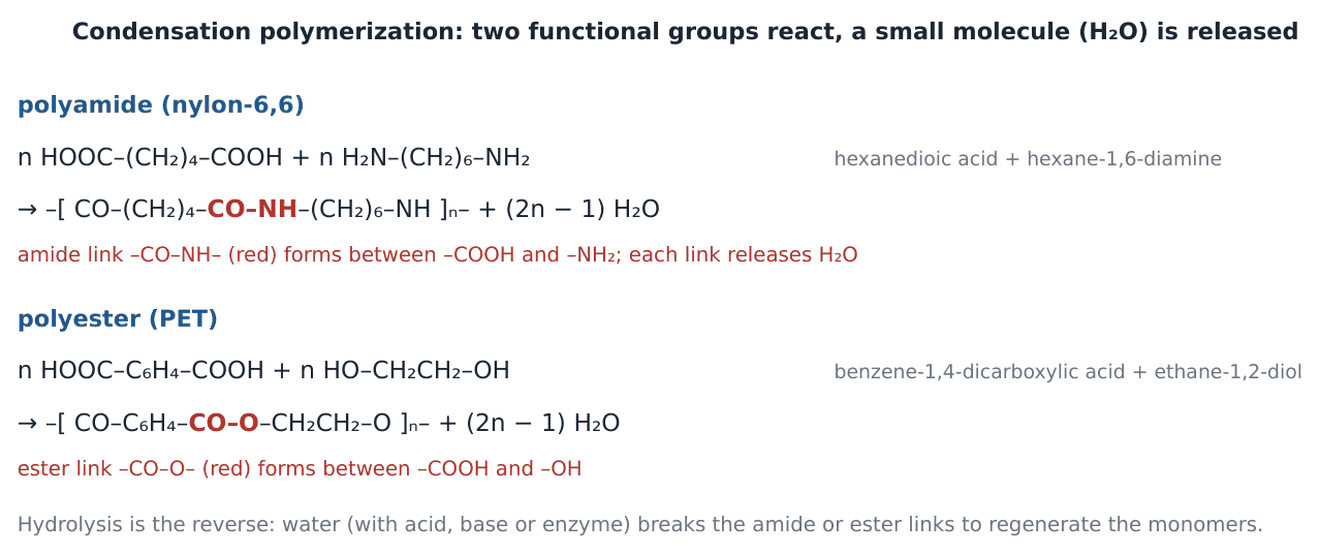
Polar amide and ester links give condensation polymers strong intermolecular forces between chains: hydrogen bonds between the N–H of one chain and the C=O oxygen of a neighbouring chain in polyamides, and dipole–dipole forces in polyesters. This explains the high tensile strength of nylon and PET fibres. Unlike most addition polymers, the chains contain links that can be hydrolysed (split by reaction with water, catalysed by acid, base or enzymes), which is the basis of some biodegradable polymers.
All biological macromolecules form by condensation and are broken down by hydrolysis: proteins from 2-amino acids joined by amide (peptide) links; polysaccharides such as starch and cellulose from monosaccharides; nucleic acids from nucleotides. Digestion is enzyme-catalysed hydrolysis of these links.
| Monomers | butanedioic acid, HOOC–(CH2)2–COOH, and ethane-1,2-diamine, H2N–(CH2)2–NH2. |
| Step 1 | –COOH of the acid reacts with –NH2 of the amine: the acid loses OH, the amine loses H, forming H2O and –CO–NH–. |
| Step 2 | Repeat at the other end of each monomer. |
| Repeating unit | –[CO–(CH2)2–CO–NH–(CH2)2–NH]– ; the other product is water. |
| Check | The repeating unit contains one residue of each monomer and two amide links; atoms of the monomers minus 2 H2O per repeating unit (except at the chain ends). |
Exam focus · what the published papers show
Each monomer carries a functional group at each end — that is what lets the chain grow in both directions. When two groups meet they join, and a small molecule (usually water) is released.
| Polymer | Monomers | The link formed |
|---|---|---|
| Polyamide e.g. nylon | a diamine and a dicarboxylic acid | amide link, –CO–NH– |
| Polyester | a diol and a dicarboxylic acid | ester link, –CO–O– |
The carboxyl group is common to both. What decides the polymer is the group it meets: an amine gives an amide, an alcohol gives an ester.
Nylon 6,6 is a polyamide. Deduce the structures of the two monomers that form it. [2]
Work backwards from the chain. Find an amide link, –CO–NH–, and cut it. Then give the nitrogen back its hydrogen and the carbonyl carbon back its –OH: that is the water each link released, put back. The scheme's answer:
Check by counting atoms. The two monomers together are C12H26N2O4; the repeating unit is C12H22N2O2, and the difference is exactly 2 H2O. If that subtraction does not come out, a group has been drawn wrong.
Two more notes from the scheme are worth having: Accept any type of structural or skeletal formula. and, on the hydrogen-bonding part that follows, O of C=O with H of H-N on opposite chain — the reason nylon is strong is hydrogen bonding between chains, and the bond must be drawn from a carbonyl oxygen to an N–H on the other chain.
State the type of polymer formed by reacting benzene-1,4-dicarboxylic acid with ethanediol, HOCH2CH2OH. [1] Draw the structure of the polymer, showing one repeating unit. [2]
An alcohol meeting a carboxyl gives an ester link, so the answer to the first part is condensation OR polyester. For the second, the scheme wants ester linkage and continuation bonds AND rest of structure, and it adds two notes: Accept without square brackets or n. and — the one that costs marks — Do not award M2 if more than one repeating unit is included.
Read the number. On the addition items above, drawing one unit where two were asked for lost the mark. Here, drawing two where one was asked for loses it. The requirement is not a habit to learn once; it is printed in each question.
Examiner feedback on the polyester item: (h)(i) About 30% of the students left this question blank, and 37% stated the correct type of polymer. (h)(ii) This was one of the more challenging questions on the paper. About 25% of the students drew the ester linkage, but less than 10% of the students drew the structure of the repeating unit correctly. The published list of areas that appeared difficult for that session includes Drawing the structure of a polyester.
Note the shape of those numbers: more students drew the linkage than named the polymer, and almost none assembled the whole unit. The two marks are separable — draw the ester link even if the rest defeats you, because a quarter of candidates earned something that way, and 30 % earned nothing by writing nothing.
Condensation polymers appear only in papers set under earlier guides; these items remain aligned with 2.4.6.
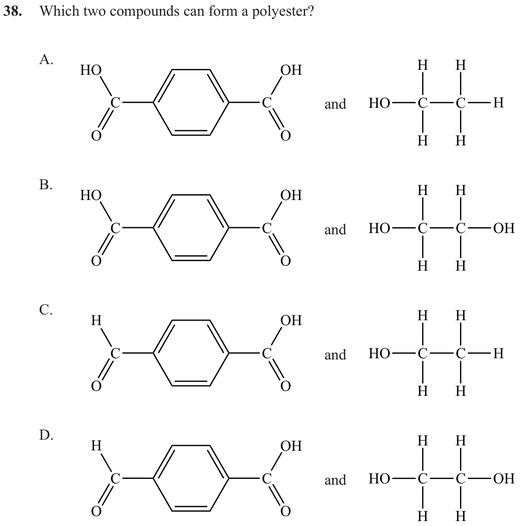
Which combination of monomers produces a condensation polymer with the repeating unit –[OC–C6H4–COOCH2CH2O]n–?
Which pairs of compounds can react together to undergo condensation polymerization reactions?
I. HOOC–C6H4–COOH and C2H5OH
II. H2N–(CH2)6–NH2 and HOOC–(CH2)4–COOH
III. H2N–CH2–COOH and H2N–CH(CH3)–COOH
A polyester can be formed when ethane-1,2-diol reacts with benzene-1,4-dicarboxylic acid. Deduce the structure of the repeating unit and state the other product formed. [2]
One form of nylon has the repeating unit:
![Repeating unit –[NH–(CH2)6–NH–CO–(CH2)8–CO]– with the amide group circled.](assets/fig/s2-qN5.png)
(i) Identify the circled functional group. [1]
(ii) Deduce the structures of the two monomers used to make this form of nylon. [2]
(iii) Nylon is a condensation polymer. Another condensation polymer can be formed by reacting ethane-1,2-diol with benzene-1,4-dicarboxylic acid. Deduce the equation for this reaction using n moles of each reactant. [2]
Solutions and mark-scheme guidance · Set N
N1 B
A polyester needs two monomers with two reactive groups each: a dicarboxylic acid (benzene-1,4-dicarboxylic acid) and a diol (ethane-1,2-diol). A monofunctional alcohol (A, C) would end the chain; D has an aldehyde group rather than a second –COOH.
N2 D
The repeat unit contains –OC–C6H4–CO– (from benzene-1,4-dicarboxylic acid, C6H4(COOH)2) and –OCH2CH2O– (from ethane-1,2-diol, HOCH2CH2OH).
N3 C
Pair I contains ethanol, which has only one –OH group, so the chain cannot grow. Pair II (diamine + dicarboxylic acid) forms a polyamide; pair III (two amino acids, each with –NH2 and –COOH) forms a polypeptide.
N4 [2]
Repeating unit –O–CH2–CH2–O–CO–C6H4–CO– with continuation lines (condensed formulae acceptable) ✓; other product: water ✓.
N5 [5]
(i) Amide (peptide) ✓.
(ii) H2N(CH2)6NH2 ✓ and HOOC(CH2)8COOH (or the acyl chloride ClOC(CH2)8COCl) ✓.
(iii) n HOOC–C6H4–COOH + n HOCH2CH2OH → HO–[OC–C6H4–COO–CH2CH2O]n–H + (2n − 1) H2O. One mark for the polymer ✓ and one for (2n − 1) H2O ✓. The water count is 2n − 1 because the two chain ends keep an H and an OH; –[OC–C6H4–COOCH2CH2O]n– is also accepted for the polymer.
Review · Structure 2.4
7The examiner’s view, and two habits
Evidence base: principal examiner reports for Cambridge International AS & A Level Chemistry (2016–2024) on the same chemistry.
When asked to deduce structure and bonding from data, strong answers linked each deduction to its evidence (for example “giant, because the melting point is high”, “no mobile charge carriers when molten, so not ionic”); weaker answers made contradictory statements such as “giant molecular with ionic bonding”, or assumed that any compound of a metal-like element with a non-metal must form a giant ionic lattice. For polymers, only stronger candidates identified the intermolecular forces between chains together with the groups responsible: hydrogen bonding between the N–H and C=O groups of amide links in adjacent chains, and London (van der Waals) forces between non-polar sections such as benzene rings. Answers such as “from COOH to NH2” or “ionic and dipole forces” were not credited. Many candidates could name two types of intermolecular force but did not refer to the atoms or groups present in the specific polymer.
The two halves of this topic are answered by two different habits.
| If the question asks… | …then |
|---|---|
| Why does this material behave like this? | Name the bonding (ionic, covalent, metallic) and the structure (giant or molecular), then the property. Never say “stronger bonding” without saying which. |
| What type of bonding is this compound? | Two numbers from the data booklet — the difference and the average — then plot the point. If a percentage is wanted, read it off the triangle and stay inside the accepted band. |
| Why is this alloy harder? | Different sized particles obstruct the layers, which can no longer slide easily. The metallic bonding itself is unchanged. |
| Draw the polymer / the monomer | Count the units the question asks for. Show continuation bonds. Keep every side group off the backbone. Then check the formula. |
| Which kind of polymerization? | A C=C in the monomer → addition, nothing released, 100 % atom economy. Two functional groups per monomer → condensation, a small molecule released. |
8Quick check
- A compound has an electronegativity difference of 2.0 and an average of 2.0. Another has 0.8 and 2.2. Which is nearer the ionic corner, and why?
- Why is iron(II) sulfide classed as polar covalent rather than ionic?
- Contrast one physical property of a metal and a non-metallic compound, in the form a scheme accepts.
- Explain in two clauses why an alloy is harder than the pure metal.
- Silicon melts at 1683 K and poly(ethene) at 393 K. Account for the difference.
- Draw one repeating unit of poly(propene) and say what its formula must be.
- What single feature must every polymer drawing show, whatever else it omits?
- HL Which two monomers give a polyamide, and what leaves?
- HL Why is the atom economy of an addition polymerization 100 %, and a condensation polymerization's less?
| 1 | The first. The difference is the vertical coordinate, and 2.0 is the larger of the two, so that compound sits higher — nearer the ionic corner. It is the one a scheme calls ionic. |
| 2 | Its electronegativity difference is only 0.8 and the average 2.2; that point falls in the polar covalent region of the triangle, not near the ionic corner. The name is no guide. |
| 3 | Both substances, joined by AND — for example: iron is malleable and iron(II) sulfide is brittle. A physical property only; rusting and reactivity score nothing. |
| 4 | The alloy contains particles of different sizes, so the layers of cations can no longer slide over each other easily; the metallic bonding itself is unchanged. |
| 5 | Silicon has covalent bonds between its atoms throughout a giant structure; poly(ethene) has only London (dispersion) forces between its chains. Covalent bonds are much stronger than intermolecular forces, so silicon melts far higher. |
| 6 | –CH2–CH(CH3)–, with a continuation bond at each end. Propene is C3H6, so the repeating unit is C3H6 too. |
| 7 | The continuation bonds. Brackets, the n, the drawing style and which side the side groups point are all optional; those two bonds are not. |
| 8 | A diamine and a dicarboxylic acid, releasing water — or the acid chloride in place of the acid, releasing HCl. |
| 9 | Addition builds the repeating unit from the whole monomer and releases nothing, so every atom of the reactant ends up in the product. Condensation releases a small molecule at every link, so some of the reactant mass leaves the polymer. |
9Summary and knowledge organiser
Essential knowledge
- Real compounds lie on a continuum: the bonding triangle uses average electronegativity and electronegativity difference to locate a substance between ionic, covalent and metallic.
- Alloys are harder and stronger than the pure metal because atoms of a different size disrupt the regular lattice and stop layers sliding.
- Addition polymers form from alkenes by opening the C=C bond, with no other product.
- HL Condensation polymers (polyesters, polyamides) form from monomers with two functional groups each, releasing a small molecule such as water.
Essential definitions and relationships
| Term or relationship | Meaning and use |
|---|---|
| Alloy | A mixture of a metal with one or more other metals or non-metals, which has metallic properties. |
| Polymer | A large molecule built from many repeating units derived from monomers. |
| Bonding triangle coordinates | Horizontal: average electronegativity, Σχ/2. Vertical: electronegativity difference, Δχ. Large Δχ → ionic; small Δχ with high Σχ/2 → covalent; small Δχ with low Σχ/2 → metallic. |
Examination checklist
- For alloys: different-sized atoms disrupt the regular arrangement and prevent layers sliding.
- Show continuation bonds on polymer sections; keep side groups off the main chain.
Knowledge organiser · from models to materials
| Model | Particles and attraction | Key facts and trends | Must-remember distinctions and common errors |
|---|---|---|---|
| Materials 2.4 | Bonding continuum. | Triangle: Σχ/2 (x-axis), Δχ (y-axis). Alloys harder. Addition polymers from alkenes; HL condensation polymers lose H2O. | Polymer sections need continuation bonds. Polyester: diacid + diol; polyamide: diacid + diamine. |