
Two teaching hours at both levels, outcomes 2.3.1 and 2.3.2, and one additional higher level hour, 2.3.3.
Guiding question: What determines the metallic nature and properties of an element?
Structure 2.3 · The metallic model
1The metallic bond and the properties it explains 2.3.1 SL + HL
More than three-quarters of the elements are metals. They share a recognisable set of properties: they conduct electricity and heat well in the solid and liquid states, they are malleable (can be hammered into sheets) and ductile (can be drawn into wires), they are lustrous, and most have high melting points and densities. A successful model of metallic bonding must explain all of these at once.
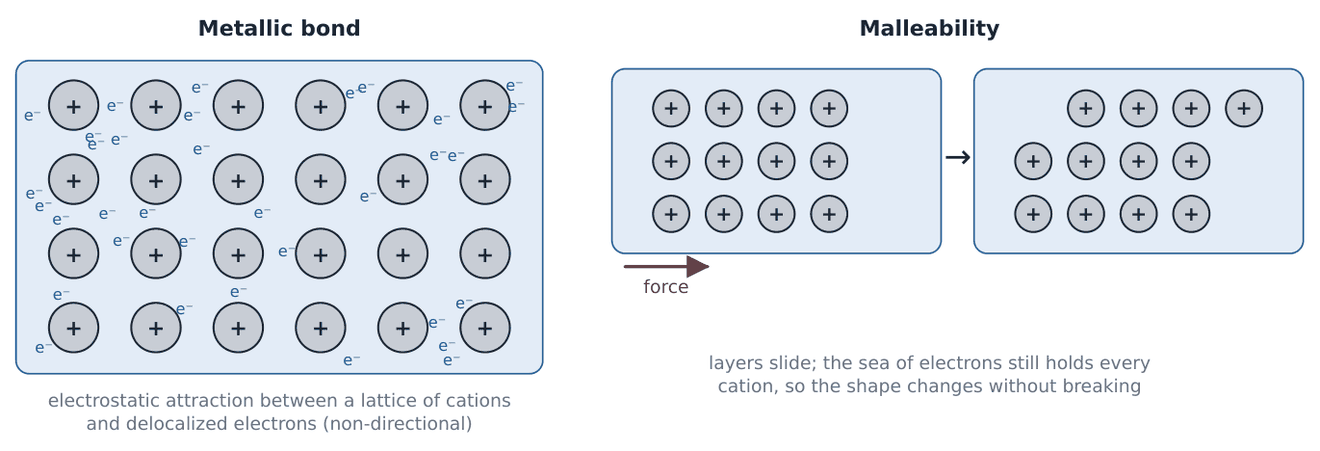
The syllabus statement is a single sentence: A metallic bond is the electrostatic attraction between a lattice of cations and delocalized electrons. Everything assessed in this outcome is that sentence used to explain something.
Metal atoms have few valence electrons, low ionization energies and low electronegativities. In a solid metal the valence electrons are not held by individual atoms; they are released into the structure as a whole and become delocalized. The metal atoms become cations arranged in a regular, closely packed lattice, surrounded by a “sea” of delocalized electrons that belongs to the whole lattice.
A metallic bond is the electrostatic attraction between a lattice of cations and delocalized electrons.
| Property | Explanation | Use that depends on it |
|---|---|---|
| Electrical conductivity (solid and liquid) | Delocalized electrons are mobile: when a potential difference is applied they move through the lattice towards the positive terminal, carrying charge. | Copper and aluminium in electrical wiring and cables; gold in electrical connections. |
| Thermal conductivity | Mobile delocalized electrons (and vibrating, closely packed cations) transfer kinetic energy rapidly through the lattice. | Saucepans (aluminium, copper), heating elements, heat sinks. |
| Malleability and ductility | Metallic bonding is non-directional. Layers of cations can slide past each other while the attraction between the cations and the electron sea is maintained; no like-charge repulsion arises, unlike in an ionic lattice. | Aluminium foil and cans; drawing copper into wire; shaping steel. |
| High melting point (most metals) | Strong attraction between cations and delocalized electrons throughout the lattice must be overcome. | Titanium alloys in high-temperature spacecraft and aircraft parts. |
| Lustre | Free delocalized electrons reflect light of all visible wavelengths. | Mirrors, decorative metals. |
Choosing a metal for a job means matching its properties to the need: aluminium is used for overhead power cables because it combines good conductivity with low density; titanium is used for hip replacements because it is strong, has a low density and is very unreactive.
“Describe metallic bonding” is worth two marks: electrostatic attraction ✓ between a lattice of cations / positive ions and delocalized (mobile) electrons ✓. Writing “metal atoms” or “nuclei” instead of cations or positive ions is not accepted. For conductivity add: the delocalized electrons move when a potential difference is applied. Saying only that there “are” delocalized electrons misses the idea that they must be free to move through the structure.
Exam focus · what the published papers show
A published scheme awards the mark for «between a lattice of» cations AND delocalized electrons, and carries two notes that decide many answers:
| Do not accept | metallic bonding on its own — naming the bond is not describing it. |
| Accept instead | sea of electrons in place of delocalized electrons. |
Examiner feedback on the same idea says candidates were expected to give metallic bonding as the attraction between metal cations and delocalized electrons. Write both components every time; the word attraction is what makes it a bond.
Three properties, two different reasons
| Property | The reason | What the reason rests on |
|---|---|---|
| Electrical conductivity | The delocalized electrons are free to move through the lattice, so they carry charge when a potential difference is applied. | The electrons move. |
| Thermal conductivity | Those same mobile electrons carry kinetic energy from the hot part of the metal to the cool part. | |
| Malleability | Layers of cations can slide over one another without disrupting the bonding, because that bonding is non-directional. | The bonding survives being moved. Nothing here is about electrons travelling. |
Two properties share one reason and the third has its own. Answering a malleability question with the mobile electrons matches none of the accepted routes, which are set out below.
Outline why aluminium is malleable. [1]
One mark, so one complete idea is needed — but it must be the right idea. The published scheme accepts any one of four routes, and they are worth reading side by side, because they are the same explanation in four wordings:
| 1 | «layers of» cations slide over each other without disrupting bonding |
| 2 | attraction between metal ions and delocalized electrons / metallic bonding is not disrupted by changing position of metal ions |
| 3 | metallic bonds are non-directional |
| 4 | changing the shape does not disrupt the bonding |
What all four have in common: each one says that something moves and the bonding still holds. An answer that describes the bond but never says it survives the movement matches none of them. A safe single sentence: the layers of cations slide over each other, and because the bonding is non-directional it is not disrupted.
This is the error the reports return to. On the aluminium question, examiner feedback records that most candidates wrote the definition of metallic bonding and some general concept applicable for malleability or ductility without connecting the two, and that candidates described the metallic bonding but failed to specifically answer why the bonding confers malleability.
The severity is on record. Feedback on one such item notes that credit needed reference to the non-directional nature of metallic bonding and only 10% of the candidates gave a complete answer, and adds that some candidates mentioned metallic bonding which did not receive any marks.
Naming the bond earns nothing. The command term outline or explain is asking for the link, not the label. Published lists of areas that appeared difficult include Outlining why aluminium is malleable and Associating metallic bonding and the properties it confers to metals (malleability in this case).
Malleability also appears in the multiple-choice papers, phrased as Which best explains the malleability of metals? and, in another session, Which statement best explains the malleability of magnesium metal?
Feedback on the first records that 64 % selected the best explanation. The word best is doing real work: more than one option will be a true statement about metals, and the distractors are usually true statements about conductivity. Choose the option that mentions layers moving or non-directional bonding, not the one that mentions electrons flowing.
One published scheme, comparing a metal with a non-metallic solid, credits Fe is malleable/ductile AND FeS is brittle/not malleable/ductile and carries the note Do not accept any chemical property.
Examiner feedback on a comparable item records that candidates offered malleability or conductivity, while others inappropriately referred to chemical properties like “rusting”. Reactivity, corrosion and rusting are chemical properties and score nothing when a physical property is asked for. Note also that this comparison is not a definition question — it needs a property of each substance, contrasted.
One report on this area is positive, and worth reading as a target: Bonding questions were very well answered, both for metallic bonding and sigma/pi bonds. The definition is reliably known. It is the step from definition to consequence that the marks hang on.
The ionic and metallic models — who carries the charge?
Electrical conductivity is a single question asked of every structure: are there charged particles, and are they free to move? Apply a voltage and see.
Turn the voltage up. Only the mobile charged particles drift; everything else keeps vibrating about a fixed position, which is exactly why the solid ionic sample does not conduct.
2The strength of the metallic bond 2.3.2 SL + HL
The syllabus statement: The strength of a metallic bond depends on the charge of the ions and the radius of the metal ion. You are asked to explain trends in melting points of s and p block metals, and told that a simple treatment in terms of charge of cations and electron density is required — so this is a comparison in words, never a calculation.
The strength of metallic bonding depends on:
- the charge on the cation (equivalently, the number of delocalized electrons per atom): more delocalized electrons and a higher cation charge give a stronger attraction;
- the radius of the cation: a smaller cation lets the delocalized electrons approach the nucleus more closely, giving a stronger attraction.
These combine as the charge density of the cation (charge relative to size). Stronger metallic bonding gives a higher melting point, greater hardness and often a higher density.
| Group 1 | Li | Na | K | Rb | Cs |
|---|---|---|---|---|---|
| Melting point / °C | 180 | 97.8 | 63.4 | 39 | 28.5 |
| Period 3 | Na | Mg | Al | Period 4, group 2 vs group 1 |
|---|---|---|---|---|
| Melting point / °C | 97.8 | 650 | 660.3 | K 63.4 · Ca 842 |
Trend down group 1
Each alkali metal contributes one delocalized electron per atom, so the cation charge is constant (1+). Down the group the cations have more occupied shells and become larger, the delocalized electrons are further from the nuclei, the attraction weakens, and less energy is needed to disrupt the lattice. Melting point decreases from Li to Cs.
Trend across period 3 (Na → Mg → Al)
From Na to Mg to Al, the number of delocalized electrons per atom increases (1, 2, 3), the cation charge increases (Na+, Mg2+, Al3+) and the cation radius decreases. Both factors strengthen the metallic bond, so melting point increases. The simple model predicts the direction of this trend but not its size: Al melts only about 10 °C above Mg. Melting points also depend on the crystal structure, which the simple model ignores.
| Question | Explain why calcium (842 °C) has a much higher melting point than potassium (63.4 °C). |
| Point 1 | Calcium releases two valence electrons per atom into the delocalized sea and forms Ca2+; potassium releases one and forms K+. |
| Point 2 | Ca2+ is smaller than K+ (same shells, more protons), so its charge density is higher. |
| Conclusion | The electrostatic attraction between the cations and the delocalized electrons is stronger in calcium, so more energy is needed to overcome it: higher melting point. |
Exam focus · what the published papers show
Charge on the cation. A metal that releases more electrons per atom leaves behind a more highly charged cation and puts more electrons into the sea. Both changes strengthen the attraction, which is why charge is the more powerful of the two levers.
Radius of the cation. At the same charge, a smaller ion concentrates that charge in a smaller volume, so the delocalized electrons are held more tightly. Smaller means stronger. Stronger metallic bonding then shows up as a higher melting point, because more energy is needed to separate the particles.
Explain why aluminium has a much higher melting point than sodium.
| Element | Cation formed | Electrons released into the sea | Ionic radius |
|---|---|---|---|
| Sodium | Na+ | one per atom | largest of the three |
| Magnesium | Mg2+ | two per atom | smaller |
| Aluminium | Al3+ | three per atom | smallest of the three |
Answer. Across period 3 the charge on the cation rises from 1+ to 3+ and the ionic radius falls. More delocalized electrons and a smaller, more highly charged cation both increase the electrostatic attraction, so the metallic bonding is stronger in aluminium and more energy is needed to melt it. Both levers push the same way here — say so, and you have covered the whole trend in one sentence.
Which of magnesium, calcium, strontium and barium has the strongest metallic bonding?
Every group 2 cation carries the same 2+ charge, so the charge lever is switched off and the answer is decided by radius alone. Ionic radius increases down the group, so bond strength falls down the group: magnesium is the strongest of these four.
Examiner feedback on this item reports that 65 % of students identified option A, Mg, as having the strongest metallic bonding of the group 2 elements given. This is because metallic bond strength increases with decreasing radius of the metal ion. Note how short the accepted reason is — one clause naming radius, in the correct direction.
The clearest statement of this error comes from a different multiple-choice question — one about the hardness of alloys, which belongs to Structure 2.4. Examiner feedback on it records that a number of candidates incorrectly thought that different sized cations enhancing the strength of the metallic bond was a factor in the greater hardness of alloys, and the published list of areas that appeared difficult for that session includes The effect of having different sized cations on the strength of metallic bonding.
That feedback adds something useful about depth. Examiners judged that perhaps the effect of cation size was beyond what the scope of the syllabus demanded in the alloy context, and two of the options were accepted. Inside outcome 2.3.2 the syllabus is explicit that radius counts — but do not carry a size argument into an alloys question and expect it to carry the answer on its own.
Size matters in one direction only. Being different in size explains nothing; being smaller, at the same charge, is the explanation. Write the direction into the sentence every time: smaller ion, stronger bonding, higher melting point.
Feedback on a related item notes that credit went to candidates who had the appropriate description of an increase in metallic bonding strength or an increase in the number of delocalized electrons, and on another that the answer needed metallic bonding strength or an increase in delocalized/bonding/or valence electrons. Simply stating an increase was not enough.
Name the quantity that increases. “It increases” is not an answer; “the number of delocalized electrons increases” is.
A multiple-choice item asks Which answer shows the correct order of metallic bond strength from strongest to weakest?, and a structured task asks candidates to identify the strongest metallic bond among a set. Both are answered the same way: check the charges first. If the charges differ, the highest charge almost always wins. Only when the charges are equal does the question come down to radius, and then the smallest ion wins.
3Transition elements: delocalized d electrons 2.3.3 HL only
The syllabus statement is one line: Transition elements have delocalized d-electrons. You are asked to explain the high melting point and electrical conductivity of transition elements. That is the whole outcome — the same model as before, with more electrons in the sea.
In the transition elements, the 3d and 4s orbitals are close in energy, and electrons from both the 4s and the 3d sub-levels can become delocalized. Compared with the s-block metals of the same period, transition elements therefore have:
- more delocalized electrons per atom, giving higher cation charge density and stronger metallic bonding;
- smaller atomic and ionic radii (a greater nuclear charge pulls the electrons closer), allowing closer packing.
Consequently transition elements have high melting points (titanium 1670 °C, vanadium 1910 °C, iron 1538 °C, compared with calcium 842 °C and potassium 63.4 °C), are hard and dense, and are good electrical conductors because of the large number of mobile delocalized electrons. The increase in melting point across the d-block is much less regular than across the s and p blocks (Structure 3.1), which again shows that the simple charge-density model is only a first approximation. The chemical properties of transition elements are treated in Reactivity 3.4.
Exam focus · what the published papers show
In an s-block or p-block metal, the electrons released into the sea are the valence s and p electrons. In a transition element, the 3d electrons lie close in energy to the 4s electrons, so d-electrons are delocalized as well.
The consequence in one line: more electrons per atom enter the delocalized sea, so the electrostatic attraction between the cations and that sea is greater than in a comparable main-group metal.
| Property | Explanation the syllabus asks for |
|---|---|
| High melting point | Delocalized d-electrons add to the s-electrons already in the sea, so there are more delocalized electrons per atom. The metallic bonding is therefore stronger, and more energy is needed to overcome it. |
| Electrical conductivity | Those same d-electrons are delocalized and mobile, so there are more charge carriers free to move through the lattice. |
Notice that both explanations run through the same clause — d-electrons are delocalized too — and then branch. Melting point is about the strength of the attraction; conductivity is about the mobility of the electrons. Keep the two branches distinct, exactly as at standard level.
Across period 3, the number of electrons each atom contributes to the sea rises sharply — one, then two, then three — and the melting points rise with it. Across the d-block, successive electrons are being added to an inner 3d subshell while the outer 4s population stays much the same, so the number of delocalized electrons per atom changes far less from one element to the next.
So the melting points across the d-block vary much less sharply than across period 3. The model has not changed; the quantity it depends on simply changes more slowly. This is the linking question the syllabus itself raises against this outcome.
The syllabus notes that the chemical properties of transition elements — variable oxidation states, coloured complexes, catalysis — are covered elsewhere, in Reactivity 3.4. Under this outcome the two properties in scope are the physical ones above.
There is little to say here, so the risk is the opposite of the usual one: an answer that is too thin. A complete high-level answer names the d-electrons, says they are delocalized, says this gives more delocalized electrons per atom, and only then states the consequence — stronger bonding, or more charge carriers. Three steps, then the property.
This outcome is close to unrepresented in the published material behind these notes — repeated searches found no question assessing it directly. It remains one hour of examinable higher level content, and the treatment above is taken from the syllabus statement itself.
Review · Structure 2.3
4Misconceptions, the examiner’s view, and the four questions
- “Metals contain metal atoms held by delocalized electrons”, or “nuclei” in the sea of electrons. The particles in the lattice are cations (positive ions).
- Mixing models: describing the metallic bond correctly and then adding “intermolecular forces” or “ionic bonds between the atoms”. Keep to one model.
- Explaining the group 1 trend with ionization energy or attraction for the outer electron of an isolated atom. The relevant attraction is between the cations and the delocalized electrons in the lattice.
Evidence base: principal examiner reports for Cambridge International AS & A Level Chemistry (2016–2024) on the same chemistry.
High melting points of metals are generally attributed correctly to strong metallic bonding, and most candidates recognise that metals such as copper have metallic bonding. Conductivity is less well explained: many answers state that delocalized electrons are present but do not say that these electrons move throughout the structure, which is what allows conduction. Many answers omit that the metallic lattice is giant. When comparing group 2 and group 1 metals, correct statements about stronger metallic bonding were sometimes negated by also referring to intermolecular forces or another type of bonding; successful answers used either the greater charge of the group 2 cation or the greater number of delocalized electrons.
Almost every question in this topic is one of four, and each has a fixed opening move.
| If the question asks… | …then the answer must contain |
|---|---|
| What is a metallic bond? | Electrostatic attraction between a lattice of cations AND delocalized electrons (a “sea of electrons” is accepted). Both halves, or no mark. |
| Why does a metal conduct? electrically or thermally | The delocalized electrons are free to move — carrying charge, or carrying kinetic energy. |
| Why is a metal malleable? | Layers of cations slide, and the bonding is non-directional so it is not disrupted. Do not mention moving electrons here. |
| Which has the stronger metallic bonding? | Compare charge first; if the charges are equal, compare radius, and say smaller is stronger. Higher bond strength then means a higher melting point. |
5Past-paper practice
Attempt these before opening the solutions below. References give the session, level, paper and question number of the original examination.
Which combination causes the strength of metallic bonding to increase?
| Charge on cations | Ionic radius | |
|---|---|---|
| A. | smaller | smaller |
| B. | larger | larger |
| C. | smaller | larger |
| D. | larger | smaller |
Why does the melting point of the elements decrease down group 1?
Which series shows the correct order of metallic bond strength from strongest to weakest?
Describe metallic bonding and how it contributes to electrical conductivity. [3]
Explain why the melting points of the group 1 metals (Li → Cs) decrease down the group. [2]
Outline why aluminium is malleable. [1]
(i) Suggest two reasons why solid calcium has a greater density than solid potassium. [2]
(ii) Outline why solid calcium is a good conductor of electricity. [1]
Titanium and vanadium are consecutive elements in the first transition metal series.
(a) Describe the bonding in metals. [2]
(d)(ii) Suggest why the melting point of vanadium is higher than that of titanium. [1]
Solutions and mark-scheme guidance · Set J
J1 D
A larger cation charge and a smaller ionic radius both increase the attraction between the cations and the delocalized electrons.
J2 C
Down group 1 the charge stays 1+ but the cation radius increases, so the attraction to the delocalized electrons weakens. Ionization energy describes an isolated gaseous atom and does not explain the strength of the metallic lattice.
J3 D
Mg2+ has the greatest charge and a small radius (two delocalized electrons per atom), so it is strongest; the group 1 metals then weaken as radius increases: Mg > Na > K > Rb.
J4 [3]
Electrostatic attraction ✓ between a lattice of cations (positive ions) and a sea of delocalized electrons ✓ (“nuclei” not accepted; “mobile” or “free” electrons accepted). The mobile electrons move through the structure when a potential difference is applied, carrying charge ✓.
J5 [2]
Atomic/ionic radius increases down the group ✓; so the charge density of the cation falls and the attraction between the metal ions and the delocalized electrons decreases (weaker metallic bonding) ✓. An answer about attraction between the nucleus and its valence electron was not accepted.
J6 [1]
Any one ✓: layers of cations can slide without disrupting the bonding; the attraction between metal ions and delocalized electrons is not disrupted by a change of position; metallic bonding is non-directional.
J7 [3]
(i) Any two ✓✓: stronger metallic bonding; smaller atomic/ionic radius (closer packing); two electrons per atom delocalized / greater ionic charge; greater atomic mass (“heavier” alone not accepted).
(ii) Calcium has delocalized electrons that are free to move ✓.
J8 [3]
(a) Electrostatic attraction ✓ between a lattice of cations and delocalized electrons ✓ (not “metal atoms” or “nuclei”).
(d)(ii) Vanadium has a smaller ionic radius (and one more valence electron to delocalize), giving stronger metallic bonding ✓.
6Quick check
- State the two components a scheme requires in a definition of the metallic bond.
- Of sodium, magnesium and aluminium, which has the strongest metallic bonding, and why?
- Magnesium or calcium — which has the stronger metallic bonding? Give the reason in one clause.
- Explain in one sentence why a metal is malleable.
- Explain in one sentence why a metal conducts electricity.
- A metal bends when it is struck; an ionic solid shatters. Why the difference?
- HL Explain why transition elements have high melting points.
| 1 | A lattice of cations and delocalized electrons, held together by electrostatic attraction. Naming the bond alone is explicitly refused. |
| 2 | Aluminium. It forms a 3+ cation and releases three electrons per atom into the sea, and its ion is the smallest of the three, so the attraction is strongest. |
| 3 | Magnesium — at the same 2+ charge its ion is smaller, so the delocalized electrons are held more tightly. |
| 4 | Layers of cations slide over each other and the bonding, being non-directional, is not disrupted. |
| 5 | The delocalized electrons are free to move through the lattice and so carry charge. |
| 6 | In a metal the sliding layers stay surrounded by the same sea of electrons, so the bonding survives. In an ionic lattice the same displacement brings like charges alongside each other; they repel and the crystal splits. |
| 7 | Their d-electrons are delocalized in addition to the s-electrons, so there are more delocalized electrons per atom, the metallic bonding is stronger, and more energy is needed to melt them. |
7Summary and knowledge organiser
Essential knowledge
- Metallic bond strength increases with cation charge (number of delocalized electrons) and decreases with cation radius.
- HL Transition elements have delocalized 3d as well as 4s electrons, which strengthens metallic bonding.
Essential definitions
| Term | Definition |
|---|---|
| Metallic bond | Electrostatic attraction between a lattice of cations and delocalized electrons. |
Essential observations and properties
| Structure type | Melting point | Conductivity | Solubility in water | Mechanical |
|---|---|---|---|---|
| Metallic | Usually high | Good as solid and liquid (mobile electrons) | Insoluble | Malleable, ductile |
Common misconception
- Metals contain “atoms” or “nuclei” in a sea of electrons. The lattice consists of cations.
Knowledge organiser · the metallic model
| Model | Particles and attraction | Key facts and trends | Must-remember distinctions and common errors |
|---|---|---|---|
| Metallic 2.3 | Lattice of cations and delocalized electrons. | mp ↓ down group 1 (radius ↑); ↑ across Na → Mg → Al (charge ↑, radius ↓). HL d electrons delocalized in transition elements. | “Cations”, not “atoms” or “nuclei”. Conducts because electrons move. Malleable: bonding non-directional. |